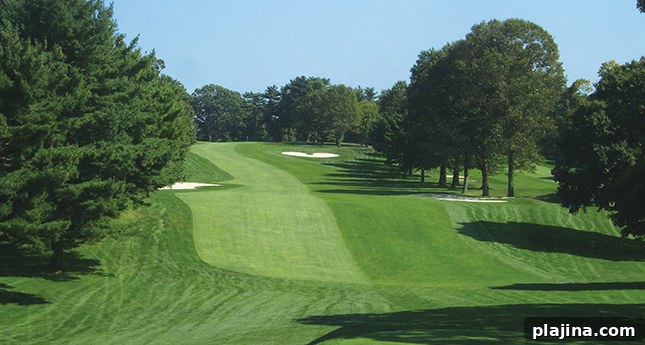
The Muttontown Club, founded in 1962, ranks among Long Island’s most distinguished and well-maintained golf courses. Set around an elegant Georgian mansion that serves as the clubhouse, the property combines classic architecture and a thoughtfully routed course for a memorable day of golf.
Construction of the mansion began in the early 20th century and was completed in 1919 for Howard C. Brokaw, owner of Brokaw Brothers Clothiers in New York City. Built with 44 rooms, 26 fireplaces and 13 chimneys, the residence earned the nickname “The Mad Chimneys.” Its historic character remains a defining feature of the club.
The estate later became linked to the Fonda family. Frances Ford Seymour married George T. Brokaw in 1931 and, after his death, later married actor Henry Fonda. While details about how much time the family spent at the estate vary, it’s easy to imagine children exploring the grounds in earlier decades.
The golf course was designed by Alfred H. Tull, a prolific architect of courses across the eastern United States. Tull favored designs that flow naturally across the land: holes that penalize errant shots while rewarding thoughtful, well-struck shots. From the back tees the course plays 6,533 yards with a USGA rating and slope of 70.3/128. Beyond the golf itself, the club is known for excellent cuisine, making a round combined with a clubhouse lunch a perfect outing. Rick Irwin, our host for the day, is a longtime friend of Global Traveler.
Hole 1
(341 yards, par 4)
The opening hole sets the tone with the clubhouse visible left of the tee and the rest of the course stretching right. It’s not overly demanding, but accurate tee shots are rewarded. Aim to the right-center of the fairway to leave a good angle into a slightly elevated green. Bunkers guard both sides of the putting surface, so an approach struck with precision is important. Many players, including Rick, routinely walk away with par.
Hole 3
(443 yards, par 4/5)
This downhill tee shot favors accuracy though long hitters can shorten the hole. The fairway is relatively narrow and flanked by trees; errant drives can find the woods or travel out of bounds. The second shot often leaves a delicate chip to a small, sunken green at the bottom of the hill. Bunkers protect the landing areas and the green, so careful club selection and control are key to a good score here.
Hole 7
(149 yards, par 3)
A memorable short par 3 fronted by a pond, this hole has entertained many friendly wagers and challenges. A well-placed tee shot will avoid the water and leave a short birdie opportunity. On this visit a low-slicing tee shot missed the pond and finished right of the green, leaving a close chip and a routine par.
Hole 8
(531 yards, par 5)
The longest hole on the course and the No. 1 handicap, this par 5 features three visible bunkers near the landing area, two of them side by side. The strategy is to find the plateau near the traps with your drive, then take an aggressive second shot to get within range of the green. Trees line both sides of the hole, making trajectory control essential. A well-struck third shot to the green completes the uphill challenge while avoiding the bunkers.
Hole 10
(415 yards, par 4)
After lunch at the clubhouse, players return refreshed to tackle this dogleg right. The fairway opens up, encouraging a strong drive; favor the left-center to set up an approach into a green that sits in a small depression. The green is tricky to hit in regulation, and many golfers find themselves taking three shots to reach it, which sets the tone for the back nine.
Hole 12
(566 yards, par 5)
One of the course’s toughest tests, this long par 5 requires careful strategy and consistent ball-striking. The hole bends sharply to the right but demands two excellent shots before that turn comes into play. Favor the left side off the tee, then play your second shot toward the left as you work uphill toward a green that remains out of view until late. Thick trees and hazards litter the route, so staying on the intended line is crucial for a chance at par.
Hole 13
(465 yards, par 4)
This par 4 often plays longer than its yardage suggests. Trees frame the hole for much of the route from tee to green, and the fairway narrows approaching the tree line. A modest dogleg left sets up a long approach — nearly 200 yards — and a bunker guarding the left side of the green can catch an aggressive line. Accurate long irons or fairway woods will be rewarded here.
Hole 16
(166 yards, par 3)
A pleasant mid-length par 3 with an elevated, well-bunkered green. On this round two playing partners hit the putting surface while a tee shot slightly left finished over the green, leading to a chip-and-two-putt for bogey. The green’s elevation and surrounding sand demand a confident, well-judged iron shot.
The Muttontown Club remains a classic example of thoughtful routing, strategic bunkering and mature, tree-lined fairways. Its combination of historic architecture, challenging golf and quality clubhouse amenities make it a standout destination on Long Island for players seeking both character and a solid test of golf.
The Muttontown Club
5933 Northern Blvd.
East Norwich, NY 11732-0009