
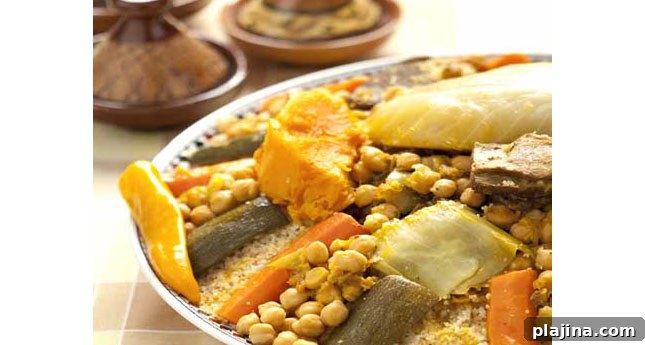
The rich, aromatic spices of Moroccan cuisine linger long after a visit ends. Recreating those flavors at home can seem challenging, but couscous — Morocco’s signature dish — has become popular worldwide, making it easy to enjoy a taste of Morocco in restaurants or straight from the grocery aisle.
In Morocco, couscous is often served as traditional seksu or kesksu, topped with a hearty meat or vegetable stew. In Sicily, it commonly accompanies seafood. The grain is enjoyed across West Africa, the Sahel, France, Spain, the Canary Islands, Portugal, Madeira, Turkey, Bulgaria, Greece, Malta, Cyprus, parts of the Middle East and India, offering endless possibilities for creative preparations.
The true origins of couscous are debated. Some historians compare its beginnings to pasta in China, while others point to East Africa. The most widely accepted theory places its origin in North Africa, where cooking tools associated with couscous production dating back to the ninth century have been discovered. From there the dish spread across the region in the 11th century and later reached Andalusia and the broader Mediterranean.
The earliest written reference appears in a 13th-century Hispano-Muslim cookbook, Kitāb al-ţabīkh fī al-Maghrib wa’l-Andalus, which includes a Marrakesh recipe for alcuzcuz fitīyānī, described as “made for the young” and “known all over the world.” Once a simple, filling meal for nomads — often prepared with sour milk and melted butter — couscous has evolved into a versatile dish served with richly spiced meats, fish and vegetables.
By the 16th century, references to couscous appear in French literature, and Portuguese immigrants carried the dish to South America. Today couscous is celebrated internationally for its adaptability and flavor.
Couscous is, in fact, a form of pasta made from semolina, the coarsely milled flour from the hardest part of durum wheat. The semolina is sprinkled with water and rolled into tiny granules that resemble farina, polenta or grits. The production process involves repeatedly dusting the granules with flour and sieving them until they form the light, uniform pellets known as couscous.
To approach the authentic taste of Moroccan couscous at home, avoid relying solely on prepackaged versions. Traditional preparation uses a couscoussière or a heatproof colander set over a stockpot, steaming the couscous until it absorbs moisture without being covered, since condensation can make the grains mushy.
Although no dish can fully reproduce the memory of a first bite on the spot, the global popularity of couscous brings the flavors of Morocco within easy reach, whether enjoyed at a local restaurant or prepared carefully in your kitchen.