
Travelers often call Buenos Aires the “Paris of South America” for its wide boulevards, Belle Époque architecture and lively European-style atmosphere. As a meetings destination, the city consistently ranks at the top: in 2012 about 400,000 conference attendees were among its 5 million visitors, and Buenos Aires hosted roughly 815 events that year (665 meetings and 150 fairs).
In 2013 the International Congress and Convention Association named Buenos Aires the No. 1 city in the Americas for the fifth consecutive year. The city organized 20.8 percent of Latin America’s meetings with more than 3,000 attendees and, between 2003 and 2012, hosted 32.5 percent more events of that size than Washington, D.C.; Toronto; Montréal; or Vancouver. Bilingual MICE specialists at the Buenos Aires Tourist Office and Convention & Visitors Bureau provide professional support to planners and organizers.
Meeting planners value Buenos Aires for its accessibility: two airports and 31 airlines connect the city internationally and regionally. Aeroparque Jorge Newbery is about 15 minutes from the city center; Ministro Pistarini (Ezeiza) International Airport is roughly 45 minutes away. Airlines serving the city include Aerolíneas Argentinas, LAN, American Airlines, Delta and United. Once in the city, trains, subways, 144 bus lines and a fleet of approximately 40,000 affordable taxis make local travel straightforward—though having taxi phone numbers is handy late at night or in bad weather.
Major exhibition venues offer extensive space and facilities for conferences and trade shows. La Rural, the flagship convention center in Palermo, operates seven modern pavilions and hosts more than 200 events annually across roughly 860,000 square feet, accommodating up to 8,900 attendees. La Rural began as an agricultural fairground in 1886 and still includes a large outdoor area used for Argentina’s Exposition on Livestock and Agriculture.
Centro Costa Salguero, a riverside exhibition complex opened in 1993 near the regional airport, provides about 335,000 square feet and can host up to 6,000 people in its large halls.
The soon-to-open Buenos Aires Convention Center (BACC) underscores the city’s investment in the MICE sector and its Green Agenda. Built largely underground, this high-tech, three-level facility encompasses about 234,000 square feet and includes a divisible main hall for 4,500 attendees, another space for 800 and indoor parking for 900 vehicles. Solar panels, rooftop greenery and sustainable design elements reflect efforts to meet environmental standards, improve urban quality of life and boost business tourism. The BACC sits next to Parque Carlos Thays in Recoleta—within walking distance of five-star hotels, the University of Buenos Aires School of Law, the Museo de Arte Latinoamericano de Buenos Aires (MALBA) and the historic Recoleta Cemetery.
As “the Culture Capital of Latin America,” Buenos Aires also offers distinctive event venues. Teatro Colón, an elegant horseshoe-shaped opera house, seats 2,600; La Usina del Arte, a restored power plant turned cultural center, accommodates about 1,250; and the Centro Metropolitano de Diseño (IncuBA) serves smaller creative gatherings of 200 to 800 people.
Outdoor stadiums and sports facilities range widely in capacity, from 20,000 up to 74,624 at River Plate Stadium. The city’s sports infrastructure continues to expand ahead of hosting the 2018 Youth Olympic Games.
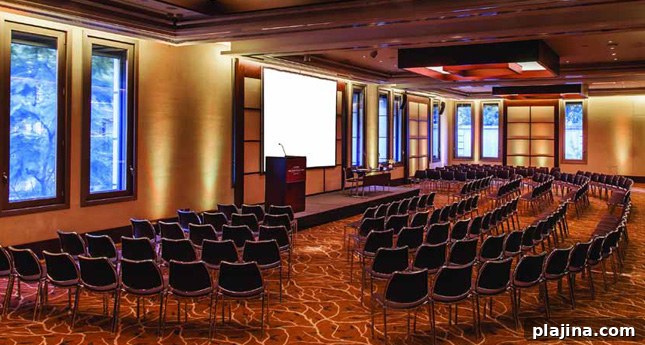
For corporate conventions, the Hilton Buenos Aires in Puerto Madero is a leading option: the hotel offers about 71,000 square feet of meeting space for up to 2,700 attendees and sits close to the financial district.
Hilton Buenos Aires meeting space © Hilton Hotels & Resorts
Exclusive five-star hotels in Recoleta provide refined settings, modern meeting facilities, gourmet dining and extensive wine lists. The Alvear Palace Hotel features mirrored, bronze and marble interiors and a ballroom that can host banquets for up to 700 guests; kosher catering is available for groups up to 400. The Four Seasons Hotel Buenos Aires offers seven salons, including a 4,478-square-foot ballroom for 450 and intimate rooms with views of the 1930s-era La Mansión. Palacio Duhau – Park Hyatt Buenos Aires blends historic elegance with contemporary amenities: meetings take place in the palace, the terraced gardens, an underground art gallery and modern function rooms, including a 3,200-square-foot ballroom for 450 guests.
Smaller boutique properties in Recoleta are ideal for private groups. Algodon Mansion features Argentine-style suites, a restaurant, a covered patio and a rooftop pool. HUB Porteño offers individually decorated rooms, two cozy living rooms and a rooftop terrace with restaurant access that preserves guest privacy.
Across the river, the Faena Hotel Buenos Aires transformed a former grain warehouse into a Philippe Starck–designed hotel with meeting rooms and a 250-seat ballroom. The adjacent Faena Art Center provides expansive event space, with large halls capable of hosting hundreds of guests on each floor.
Outside of meetings, Buenos Aires invites visitors to its leafy plazas, outdoor cafés and late-night restaurants that typically fill around 9:30 p.m. Tango salons welcome guests to listen, watch, learn and participate in the iconic dance. Cultural attractions include opera at Teatro Colón, theater at Teatro Cervantes and the Museo Nacional de Bellas Artes. History seekers visit Plaza de Mayo and the Casa Rosada, while photographers are drawn to La Boca’s colorful houses along Caminito and the Fundación PROA art museum. Sports fans enjoy soccer, pato and polo; food lovers savor grass-fed Argentine beef at parrillas and explore vinotecas for wine tastings in Palermo SoHo. Shoppers find favorable exchange rates and tax-free benefits in Recoleta boutiques and Palermo Viejo design shops. On Sundays, San Telmo’s open-air market and the nearby streets toward El Mercado offer antiques, crafts and street life—visitors are advised to secure valuables when browsing busy markets.
Buenos Aires is also notable for its inclusive culture: Argentina was the first country in Latin America to legalize same-sex marriage in 2010, and the LGBT community is part of the city’s diverse neighborhoods. With a culinary scene filled with Italian-influenced pasta and pizza, a thriving design culture and a strong tradition of handcrafted leather goods, many locals jokingly say, “We are Italians who speak Spanish.”