Ethiopia’s capital, Addis Ababa, is full of surprises — not least its sense of ancient continuity. Although the city was officially founded in 1886, it sits at the heart of a landscape and a history that feel timeless. Mornings and evenings can seem hushed and elemental, with wisps of wood smoke threading through narrow streets and moments that feel almost biblical, even as the city hums with modern life.
One unexpected legacy visible across Addis Ababa is the influence of Italian occupation between 1936 and 1941. More than seven decades later, traces remain in everyday details: the blue-and-white Fiat taxis that still navigate busy boulevards, the colonial-era buildings that line some neighborhoods, the local fondness for pasta dishes, and place names such as Mercato that recall that period.
Mercato: The city’s vibrant pulse
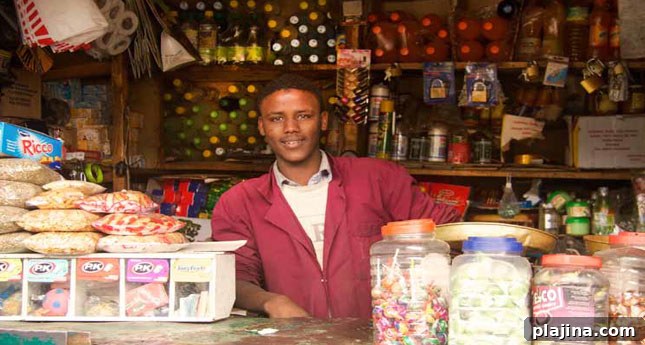
Mercato is much more than a conventional market; it is the living, breathing center of Addis Ababa. While other parts of the city display planned boulevards and ceremonial spaces, Mercato spills into a maze of dusty lanes and crowded alleyways where apparent disorder conceals a working order. The market is organized into districts and streets that specialize in particular goods, and once you learn to read its rhythms, the logic becomes clear.
One moment you may be surrounded by fresh produce vendors heaping ripe fruit and vegetables into woven baskets. A few steps later, the air floods with the scents of roasted coffee beans and an array of spices, and further on you’ll enter narrow streets lined with stalls selling electronics, computer parts, textiles, household goods, and traditional crafts. Haggling is part of the experience: transactions are social rituals composed of offers and counteroffers, and shoppers are expected to bargain for a fair price.
Scale, atmosphere and practicalities
Mercato lays claim to being the largest open-air market on the African continent, and wandering its passages it is easy to see why. The market’s tangle of lanes resists conventional mapping — a paper map rarely helps, and GPS signals can be unreliable among the dense stalls. Navigating Mercato successfully depends on paying attention to landmarks, trusting your sense of direction, and blending into the flow to avoid standing out as a bewildered visitor.
With that scale comes both incredible variety and the need for vigilance. The market offers an astonishing range of merchandise; locals will tell you you can buy almost anything here, and they are not exaggerating. At the same time, the crowds can attract opportunists, so travelers should keep personal belongings secure and remain aware of their surroundings. A guarded but respectful approach will help you enjoy the market safely.
Why Mercato matters
Visiting Mercato is essential to understanding Addis Ababa’s energy and culture. The market is where commerce, daily life and social exchange converge. It is where many residents shop, meet, and conduct business; where informal networks keep small enterprises functioning; and where the city’s diversity and resourcefulness are on full display. After an intense visit to Mercato, the rest of Addis Ababa — a bustling metropolis of more than three million people — can feel comparatively calm.
For travelers who want to experience Addis Ababa beyond its official sites and planned squares, Mercato offers an immersive, sensory-rich glimpse into urban life: vibrant, chaotic, organized in its own way, and always alive with the sound and smell of the city.