
It doesn’t take a mathematician to see that Medellín of the early 1990s — with roughly 500 homicides per month and nearly 20 percent unemployment — is a far cry from the city today. By the first half of 2008, homicides had dropped to fewer than 330 in six months and unemployment had fallen to about 12 percent. Achieving that turnaround, however, did require a mathematician: Sergio Fajardo, whose background in mathematics informed a pragmatic, data-driven approach to urban renewal.
Fajardo, who earned his Ph.D. in mathematics at the University of Wisconsin, served as mayor of Colombia’s second-largest city until December 2007. His policies and public works left a durable legacy: enhanced security, ambitious infrastructure projects and renewed economic momentum across a metropolitan area of some 2.4 million people known affectionately as Paisas. Under his administration, striking library parks were commissioned for neighborhoods once plagued by violence, and the MetroCable — a system of gondola cars that link hillside communities to the city’s efficient metro network — was launched, improving mobility for thousands of residents.
The transformation goes beyond aesthetics. Medellín contributes more than 8 percent of Colombia’s gross domestic product, and its export sector has strengthened over two decades, helped in part by duty-free access to U.S. markets. Traditional strengths such as textile manufacturing, flower farming and coffee production continue to underpin the economy, but the improved security climate attracted regional offices and new investment from companies such as Philip Morris, Renault and Toyota. New sectors have also grown rapidly, notably healthcare and business tourism, supported by venues like the Medellín Convention and Exhibition Center at Plaza Mayor, which offers 130,000 square feet of flexible event space.
Once infamous as the nerve center of Colombia’s cocaine trade, Medellín has repositioned itself. By April 2008, there were 127 high-rises under construction across the city — more than in Manhattan and Los Angeles combined — and trade fairs have multiplied: the city hosted three fairs in 2004 and 14 in 2007, matching Bogotá’s recent pace. Though the national capital remains larger and richer in cultural institutions, Medellín can proudly claim one of Colombia’s foremost cultural icons, painter and sculptor Fernando Botero.
A pivotal factor in this renaissance was a 65 percent increase in Medellín’s education budget under Fajardo. That investment funded schools and inspired Cultura E, a program that connects academic institutions with industry to foster a “culture of entrepreneurialism.” Medellín is now positioning itself as a Latin American innovation hub — a place for incubating ideas and growing high-value industries, not just manufacturing. It’s an ambitious vision, but recent history suggests Medellín can redefine itself again and again.
LODGING
HOTEL DANN CARLTON MEDELLÍN
Located within walking distance of Parque Lleras — the lively social hub where locals and visitors mingle — the Hotel Dann offers ample meeting and convention space, modern design and a highly regarded buffet breakfast. Business travelers will find practical amenities such as high-speed Internet and fax services, and on-site conveniences like a barbershop and beauty parlor. The hotel is known for friendly service and an English-speaking staff.$$$
HOTEL DANN CARLTON MEDELLÍN
7–50 Carrera 43A, Avenida El Poblado
tel 57 4 444 5151
INTERCONTINENTAL MEDELLÍN
The InterContinental, renovated in 2007, was a stop on a visit by U.S. congressmen who came to see the “Medellín miracle.” With 294 rooms, it is about 15 minutes from the airport and a short drive from downtown. Tennis courts, a jogging trail, a heated outdoor pool and a sauna give it a resort-like feel, while a 24-hour business center and tranquil atmosphere make it well suited for business travelers.$$$$
INTERCONTINENTAL MEDELLÍN
28–51 Calle 16, Variante Las Palmas
tel 57 4 319 4450
PARK 10 HOTEL
For a more intimate stay, the 55-room, all-suite Park 10 blends five-star comfort with boutique charm. Rooms are spacious and equipped with wireless Internet and flat-screen TVs. Like the Dann, it’s a short, safe walk to Parque Lleras. The hotel’s La Fragrata restaurant is known for excellent seafood.$$$
PARK 10 HOTEL
11–12 Carrera 36B
tel 57 4 310 6060
DINING
EL HERBARIO
El Herbario showcases how herbs and vegetables can define a meal. Chef Rodrigo Isaza crafts inspired dishes like goat cheese wrapped in grilled vegetables and fresh octopus served on panela. Even meat lovers are likely to be impressed by the depth of flavor and creativity here.$$
EL HERBARIO
10–30 Carrera 43D
tel 57 4 311 2537
HATOVIEJO PALMAS
Just across the street from the InterContinental, Hatoviejo — “The Old Farm Ranch” — serves hearty, traditional comida Paisa in a rustic, thatched-roof setting. It’s a longtime favorite for carnivores; try the plato montañero, a generous plate of spiced ground beef, baked beans, fried eggs, chicharrón and plantains.$$
HATOVIEJO PALMAS
28–60 Calle 16
tel 57 4 266 7550
LA SALON VERSALLES
La Salon Versalles is a Medellín institution inspired by the literary cafés of Buenos Aires. For nearly 50 years it has been known for Argentinian- and Chilean-style empanadas and a convivial atmosphere. Around lunchtime, it remains a preferred meeting spot for local professionals and creatives.$$
LA SALON VERSALLES
53–59 Pasaje Junín
tel 57 4 251 7416
DIVERSIONS
Santo Domingo Savio, once at the center of the city’s armed conflicts, now hosts Parque Biblioteca España: a modern, three-building complex with a library, auditorium and computer lab that symbolizes Medellín’s transformation. From there visitors can ride the MetroCable for panoramic views of the Aburrá Valley.
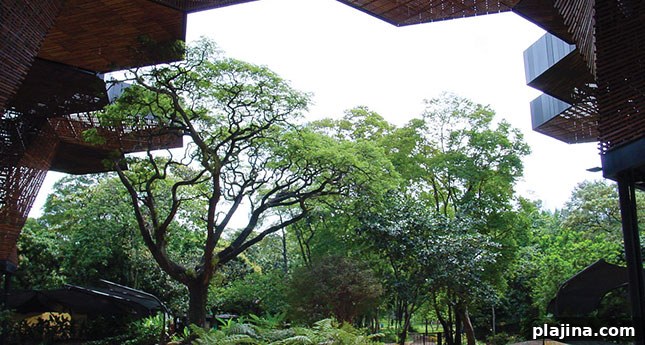
Explora Park, on the city’s northeastern edge, is a 398,000-square-foot interactive science and technology center that delights school groups and tourists alike. Inside, South America’s largest aquarium features species from the Amazon and Orinoco rivers. Nearby, the Orquídeorama in the Jardín Botánico offers a shaded retreat beneath an elegant wooden lattice of “flower-tree” structures.
At Plaza de las Esculturas, Medellín honors Fernando Botero with 23 of his signature plump sculptures displayed outdoors for visitors to see and touch. The Museum of Antioquia houses 92 paintings donated by Botero along with contemporary works and notable colonial and pre-Columbian collections.
For nightlife, Parque Lleras in the Zona Rosa is the place to be, with open-air bars and restaurants that attract a fashionable crowd. Plastic surgery is widely available and remains part of the city’s medical-tourism draw. Shopping is another local strength: Medellín’s long textile tradition has produced a thriving retail scene with more than 25 malls and numerous boutiques. Oviedo Mall in El Poblado is a go-to destination for higher-end shopping.
Those seeking a countryside escape can take a short drive to Fizebad Club Campestre in El Retiro. This historic, mid-19th-century estate sits amid the scenic hills of northern Antioquia and features a nine-hole golf course, a pool and extensive grounds for horseback riding and exploration.
INFO TO GO
José María Córdova International Airport (MDE), located about 22 miles southeast of the city, is Medellín’s main international gateway and busiest domestic airport. Flights to Bogotá depart frequently. A taxi from downtown costs about $20, and there is a departure tax of around $28 for stays up to two months.