
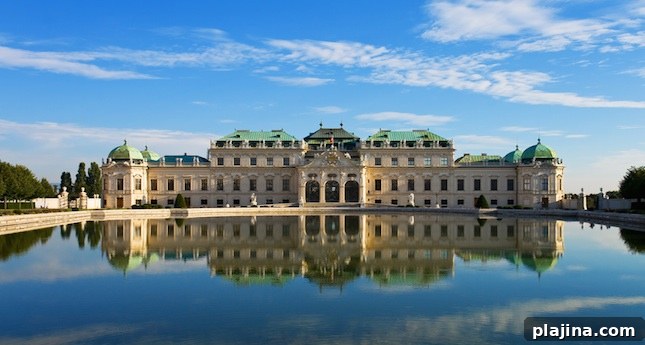
Noted fin-de-siècle Austrian artist Max Kurzweil is the subject of the 14th Masterpiece in Focus series at the Belvedere Museum and Palace complex’s Upper Belvedere in Vienna. Max Kurzweil: Light and Shadow examines a multifaceted artistic legacy that spans French Naturalism, Impressionism, Symbolism and early Expressionism.
The exhibition brings together well-known works alongside rarely seen paintings and graphic pieces. Highlights include Kurzweil’s portrait of Therese Bloch-Bauer, sister and subject of Gustav Klimt’s famous Portrait of Adele Bloch-Bauer; this portrait will be shown publicly for the first time since 1908. The selection offers a clear view of Kurzweil’s strengths as a portraitist of Viennese society, as well as his studies of the human figure and his luminous Impressionist landscapes created in Brittany, Italy and Dalmatia.
Kurzweil trained at the Vienna Academy of Fine Arts and at the Académie Julian in Paris, absorbing contemporary currents from both centers. His life reflected the turbulence of his era: born into a well-to-do bourgeois family, he married a French woman who suffered from depression, increasingly became estranged from her, and later formed a relationship with a student. In 1916, while on leave from his role as a war painter in World War I, Kurzweil and his young companion died by suicide from gunshot wounds in his Vienna studio. Despite the tragic end to his life, Kurzweil’s work remains valued for its refined technique, sensitivity to light and color, and nuanced portrayals of turn-of-the-century Viennese life.
Curated by Markus Fellinger, the exhibition places Kurzweil in the broader context of European art at the turn of the 20th century, emphasizing his exchanges with French painting and the development of a distinctive personal style. Visitors can trace how naturalistic detail, atmospheric Impressionist handling and symbolic undertones coexist in his oeuvre, from intimate portraits to landscape studies and graphic work.
The exhibition at the Upper Belvedere runs through Sept. 4. It presents an opportunity to rediscover an artist whose work bridges several major movements of the fin-de-siècle period and whose contribution to Austrian art history deserves renewed attention.