
The journey is half the adventure. Two natural barriers stand between us and Manali. From the air, as we descend toward Chandigarh, we can see them both to the north: the foothills of the Himalayas — a sudden rise after the flat expanse of India’s central plains — and a dense curtain of cloud hiding the higher peaks.
It is monsoon season. Flying into the narrow Himalayan valleys is challenging even in good weather; during the rains it becomes hazardous. For that reason, Air India suspends flights into Himachal Pradesh for much of the monsoon, and so we find ourselves in Chandigarh boarding a bus for the long, winding ride to Shimla and beyond.
Traveling in northern India during the monsoon means accepting uncertainty. Plans must remain flexible and travel times unpredictable. As the road climbs from the plains into conifer forests and the temperature drops, we become more exposed to a series of hazards — some expected, some surprising.
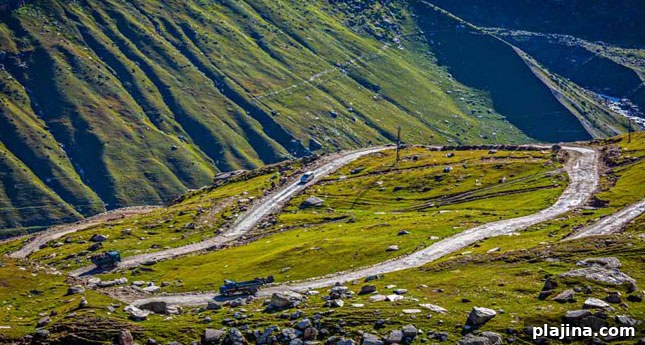
Torrential rain can reduce progress to a crawl. Landslides and slips can halt traffic for hours. Floods sometimes wash away bridges, forcing detours or retreats. Rough, improvised routes increase the risk of punctures, while the thinner air at higher altitude strains vehicle engines.
Despite the wild impression, this region once hosted India’s summer government during the colonial era; each year officials moved from the lowland heat to the cooler hill station of Shimla for several months.
Hillside town of Shimla © Outline205 | Dreamstime.com
The first view of Shimla (known to the British as Simla) is arresting. Red-roofed houses tumble down steep slopes, compacted into narrow terraces and linked by switchback streets and flights of stairs. For residents, daily life is a constant climb; monkeys, by contrast, dart across roofs with ease.
The Lower Bazaar is a lively maze of shops and food stalls, the kind of place Rudyard Kipling described. As we climb through the town, traces of British architecture reveal themselves until we arrive at The Ridge, Shimla’s broad public space and traditional center.
Christ Church’s dignified tower watches over The Ridge. Nearby, a mock-Tudor municipal library and the imposing Town Hall sit alongside the Gaiety Theatre, which has hosted the town’s cultural life for nearly 150 years. The cluster of colonial buildings can temporarily make visitors feel as if they have stepped into an English market town rather than an Indian mountain city.
Monsoon downpours are frequent. Runoff fills gutters that feed into streams, which swell into rivers. Streams flowing west from Shimla eventually reach the Arabian Sea; those flowing east join the Ganges and head for the Bay of Bengal. In this way, the city links both sides of the subcontinent and serves as a natural gateway to the higher Himalayas.
We resume our journey the next morning, following routes that echo ancient trade paths. Modern road-building has widened and anchored these tracks into the mountainsides. Towering rock overhangs and steep drops beside the road remind us how exposed these routes are.
As we press into the Kullu Valley, there is a sense of relief. The wild Beas River has carved out a broad corridor, its icy waters tumbling over boulders and gradually carrying the mountains away to form flat banks suitable for roads, stalls, towns and even the riverside runway at Bhuntar Airport — though flights there pause during the monsoon.
A hiker in Hampta Pass, Kullu © Falk66 | Dreamstime.com
The peaks around us rise higher and some wear snow caps. We reach Kullu — once called Kulanthpitha, “the end of the habitable world.” The road continues, but beyond this point the mountains grow wilder. Venture off the main tracks and you enter habitat for bears and snow leopards.
After roughly nine hours from Shimla, we arrive in Manali at about 6,700 feet above sea level. Long established as a hub for Himalayan tourism, Manali draws two main types of visitors: local honeymooners seeking tranquility and international adventurers chasing outdoor thrills.
We are in the latter group, though it is easy to be seduced by the calm that attracts honeymooners. In the soft evening light we wander through apple orchards and pine woods, accompanied by birdsong and the sound of streams. It is a brief pause: in the morning others will go rafting, rock-climbing, paragliding or mountain-biking, while we set out on a three-day trek.
At the trailhead porters wrap our bags in plastic against the mist and rain before shouldering them. The morning is cold and damp; later the mist will turn to drizzle and then rain. We head upward confident that the weather will be drier where we are going, into a more arid, lunar-like landscape.
From the plains the Himalayas can seem like an impenetrable wall, but once inside you discover extraordinary diversity — in climate, wildlife and culture. Historically the region comprised many small kingdoms separated by natural barriers. In 1971 these areas were united as Himachal Pradesh, yet local customs and dress still vary noticeably from valley to valley. In the Kullu Valley, women wear shawls with geometric patterns and men don colorful caps.
Vegetation changes just as dramatically as culture. The Kullu Valley is lush and green; our first day on the trail takes us across alpine meadows and into forests that shield us from much of the rain. We camp at altitude and sleep fitfully, then press on the next morning despite tired legs and sore feet.
The trees thin and the terrain grows harsher. Bare rock faces rise above us and cold winds blow down from nearby glaciers. Another night under canvas and we descend into the Spiti Valley, which lies in a rain shadow. Here the world turns to a cold high desert: no forests, only stark, astonishing beauty.
Though this landscape feels ancient, it still offers surprises. Boys along the roadside sell fossils chipped from the slopes — petrified shells of sea creatures — evidence that this elevated land was once under the ocean. Geologically the Himalayas are young, thrust skyward when the Indian subcontinent collided with Asia, pushing old seafloor up into the clouds — a fact made more awe-inspiring when your head is light from thin air.
We return by bus to bustling Manali, grateful for warm showers and cold beers. After the trek we sleep well before the journey back to the lowlands, knowing half the adventure remains ahead.
Manali Info to Go
Bhuntar Airport (KUU), also called Kullu Manali Airport, has seasonal flights from Delhi operated by Air India. During the monsoon (July–September), Chandigarh Airport (IXC) serves as the primary aviation gateway to Himachal Pradesh. If time allows, consider arriving by train: from Kalka, near Chandigarh, a narrow-gauge railway climbs into the hills to Shimla in up to six hours. Local operators in Himachal Pradesh and Manali offer jeep and trekking tours throughout the region.