
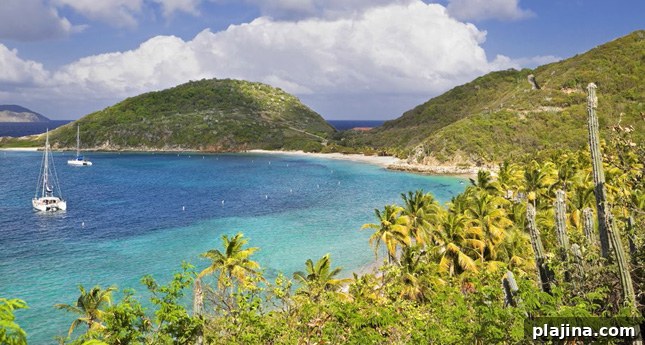
We imagined a sailing paradise: a tropical setting with year-round sunshine, warm nights, and no winter. Add steady trade winds to fill the sails and gentle ocean currents to ease navigation. For variety and interest, picture an archipelago of roughly 50 islands draped in lush vegetation and edged with quiet white-sand coves and swaying palms.
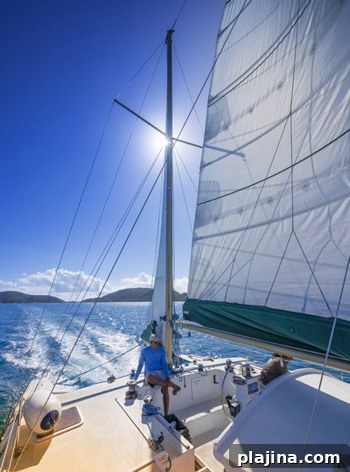
Sailing the clear blue waters of the British Virgin Islands © CHRISTIAN DELBERT | DREAMSTIME.COM
Some islands remain uninhabited to preserve a Robinson Crusoe atmosphere, while others are home to welcoming, laid-back communities that provide essentials: beach bars, marinas, provisioning, and boat repair. English is widely spoken, often with a charming local accent, and for historical continuity the British monarch serves as head of state. As it happens, this ideal already exists: welcome to the British Virgin Islands.
The islands’ human story begins with the Arawak people, who settled the region for more than a millennium before being displaced by the Caribs. When Christopher Columbus arrived, he named the islands after Saint Ursula and her 11,000 virgins — later shortened simply to “The Virgins.” Over centuries the islands changed hands among European powers, with the British ultimately controlling most of the territory. The U.S. purchased other Caribbean holdings in 1917, while the B.V.I. evolved more slowly. Today the British Virgin Islands have a population of roughly 23,000, concentrated mainly around Road Town on Tortola, the largest island.
Tortola spans about 12 miles by three miles, featuring a volcanic, hilly interior and many near-deserted beaches. By local standards it can feel substantial; Road Town, sleepy by some measures, functions as the islands’ commercial and administrative hub. Anegada, the second-largest island, is a flat, coral island with a population of about 285 residents — most gathered in a village called The Settlement. Anegada’s pristine beaches, shallow turquoise lagoons, flamingo populations, and the rare Anegada ground iguana make it unique among the islands. The surrounding waters are famous for Anegada lobster, served fresh in island restaurants.
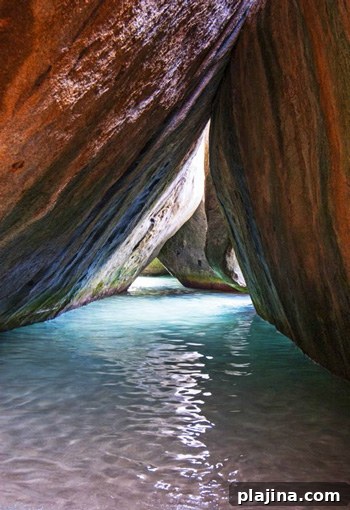
The Baths on Virgin Gorda © MIRCEA DOBRE | DREAMSTIME.COM
Virgin Gorda, the third-largest island, mixes lush interior hills with powdery beaches and high-end resorts. Its best-known natural attraction, The Baths, is a labyrinth of rounded granite boulders, tidal pools, and hidden grottoes at the island’s southern tip — ideal for bathing and snorkeling. To avoid crowds, plan visits for later in the day when cruise-ship passengers have left.
Several small islands and cays surround Virgin Gorda. Necker Island, owned by Sir Richard Branson, is among the most famous and is marketed as an ultra-exclusive retreat with Balinese-style architecture and luxury amenities. Although private-island stays can be costly, limited excursions and nature tours sometimes offer more accessible ways to experience Necker’s wildlife, including lemurs, flamingos, and giant tortoises.
Colorful personalities have shaped life across the B.V.I. Foxy Callwood, MBE, for example, helped make Jost Van Dyke a favorite stop for sailors and celebrities, and his legendary New Year’s Eve parties and lively calypso performances draw visitors year after year. The islands balance celebrity allure with low-key island culture and a strong maritime tradition.
Above all, the British Virgin Islands are a sailor’s paradise. Whether you are an experienced mariner or a novice, prefer monohulls or multihulls, or enjoy paddling smaller craft, you’ll find vessels to match your needs. Charter companies across the main islands offer bareboat and crewed options, allowing travelers to experience the islands at sea — with wind in the sails, the bow slicing through blue water, and a coastline of coves and anchorages to explore.
British Virgin Islands Info to Go
International flights arrive at Terrance B. Lettsome International Airport (EIS) on Beef Island, which is connected to Tortola by the Queen Elizabeth II Bridge. The airport links to regional hubs such as San Juan, Puerto Rico; Saint Thomas in the U.S. Virgin Islands; Antigua; and Sint Maarten. Charter flights and ferry services connect to outlying islands, and taxis are available for transfers on Tortola. Travelers should carry a valid passport for entry.
Where to Stay in the British Virgin Islands
Anegada Beach Club — Choose a luxury tent with a private beach deck and hammock for a relaxed, seaside stay. Anegada Island
Peter Island Resort and Spa — A private-island resort with a limited number of rooms and a well-regarded spa, offering a quieter alternative to the most exclusive retreats. Peter Island
The Sugar Mill Hotel — A boutique property on western Tortola featuring guest rooms set among gardens beside a small beach, ideal for a peaceful island base. Apple Bay, Tortola
Restaurants in the British Virgin Islands
Big Bamboo Restaurant — A casual, beachfront spot where you can sample the famous Anegada lobster, often selected directly from local traps. Loblolly Bay, Anegada
De Loose Mongoose — A classic beach bar near the airport that highlights local ingredients, sometimes with Asian-inspired twists. Beef Island Guest House, East End Tortola (Beef Island)
Dove Restaurant & Wine Bar — A refined venue in Road Town offering a French-influenced menu, popular for special occasions. 67 Main St., Road Town, Tortola