
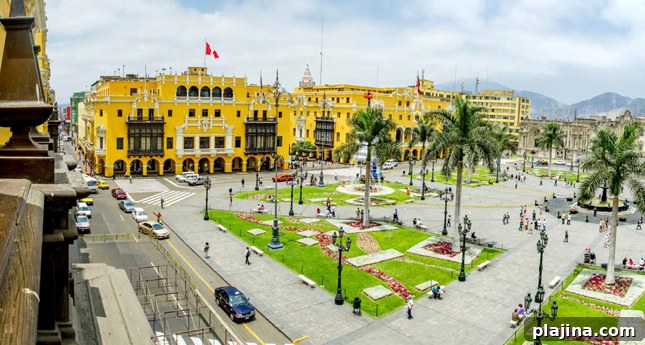
Once the centerpiece of Spain’s South American empire — where, by royal decree, all commerce of the viceroyalty had to pass — Lima was the keystone of a trade network linking the Americas, Europe and the Far East. Evidence of that prosperity remains visible in the city’s busy streets, colorful Baroque mansions standing beside modern high-rises, and leafy boulevards that evoke a Parisian air. Today Lima’s economy is resurging. Having endured political turmoil, epidemics, juntas, inflation and earthquakes, Peru’s capital is now a dynamic metropolis re-emerging as a Pacific economic powerhouse.
Long before the Spanish arrived, the region prospered under the Incas, who deployed advanced agriculture, mining, infrastructure and labor organization to build a strong native state. Francisco Pizarro founded Lima in 1535, and Spanish rule redirected the region’s resources to benefit aristocrats in Europe. Independence in 1821 ushered in decades of political and military instability. Major earthquakes in 1746 and 1940 inflicted severe damage, and the mid-20th century brought cholera outbreaks, Shining Path terrorism and military rule.
Democracy returned in 1980, but the country struggled with hyperinflation until the 1990 election of Alberto Fujimori, whose authoritarian but market-oriented policies triggered an economic turnaround. Over the following decade, infrastructure improvements and trade-friendly reforms attracted investors from Spain, the United States, Chile, Switzerland and Mexico, setting the stage for a sustained boom.
Public debt fell, foreign reserves rose and macroeconomic stability improved. Over the past decade the country’s GDP grew at an average of about 6.3 percent. Exports increased dramatically, private investment expanded, and foreign companies concentrated their operations in Lima. With roughly 9 million residents — about one-third of Peru’s population — the capital serves as the country’s industrial and financial center.
Situated on the Pacific coast with the Rimac River at its back, metropolitan Lima comprises 43 municipalities that coordinate through a metropolitan authority. Among the most important are Callao, El Centro, San Isidro, Miraflores and Barranco.
Callao, the port municipality, is the regional hub for Lima’s cargo industry and handles most of Peru’s imports and exports as well as its fishing fleet. Major export categories include minerals such as gold, silver, zinc and copper; textiles including cotton and alpaca and llama wool; agricultural products like sugar, coffee, cacao, fruits and vegetables; plus chemicals, oil, steel and fish meal.
El Centro, a UNESCO World Heritage site and the city’s historic core, draws visitors to sites such as the Governor’s Palace, the Cathedral and Archbishop’s Palace on Plaza Mayor, cloisters and museums, and the riverside park being developed along the Rimac.
San Isidro, south of El Centro, is Lima’s primary business district and hosts major corporate and banking headquarters. As one of Latin America’s key financial centers, the city is home to institutions such as Banco de Crédito del Perú, Interbank and Bank of the Nation, alongside numerous insurance firms.
Next to San Isidro, upscale Miraflores offers attractive residences and apartment buildings, tree-lined avenues and shops that stretch to the sea. Larcomar, an unusual three-story open-air mall, occupies prime oceanfront real estate and is a popular destination for shopping, dining and views.
Visitors take in the sea view at Larcomar, the unusual three-story open-air center in Miraflores. © Svenschermer | Dreamstime.com
Barranco, adjacent to Miraflores, is the city’s bohemian neighborhood, known for galleries, restaurants and nightlife housed in charming Spanish-style buildings. It remains the center for artists, writers and cultural life.
Lima’s workforce, infrastructure and transport links support a robust manufacturing sector, which contributes about 23 percent of national output. By the mid-20th century, the capital produced the bulk of Peru’s consumer goods; today most heavy industry remains concentrated around Lima, with thousands of factories manufacturing food products, chemicals, leather goods and oil derivatives. The textile sector continues to draw on traditional skills, producing garments from cotton and native alpaca and llama fibers.
Mining continues to be a cornerstone of the national economy, accounting for a large share of exports. Peru ranks among the world’s leading producers of silver, gold and copper and holds significant reserves of coal, iron ore, tin, sulfur and zinc, along with growing finds of petroleum and natural gas.
Fishing is also a major industry: Peru’s waters yield nearly 10 percent of the world’s fish catch, supplying species such as bonito, mackerel, sea bass and tuna. A large portion of the catch is processed into fish meal and anchovy-based products used as fertilizer and animal feed.
Geographically the third-largest country in South America, Peru spans coastal plains to the high Andes and supports a wide diversity of climates and crops. Exported agricultural products include artichokes, avocados, grapes, mangos, peppers, sugarcane, coffee and cotton. Demand for organic produce is rising, and the domestic wine industry is expanding.
Peruvian cuisine has undergone a regional gastronomic revolution rooted in its long history of cultural fusion. Criollo cooking blends Andean, African, Spanish, Asian and European influences, while nuevoandina cuisine integrates native herbs and ingredients into contemporary dishes. The city hosts Mistura, a major international food festival each September. Leading chefs such as Gastón Acurio and Virgilio Martínez have elevated Lima’s global culinary reputation, with restaurants like Astrid y Gastón and Central frequently cited among the world’s top dining experiences.
One agricultural challenge is coca cultivation, which fuels cocaine production and creates environmental and social problems. Coca has traditional uses and legal products made from it are widely sold, but illicit drug production remains a source of corruption and ecological harm despite government efforts to combat trafficking.
Santo Domingo Convent © Andrew Howson | Dreamstime.com
Tourism continues to grow despite logistical hurdles like heavy traffic and inconsistent street naming. Taxis are inexpensive but can be caught in severe congestion, and while metropolitan bus corridors and express routes have improved transit along key arteries, overcrowding still occurs. Street signs are sometimes uneven and Spanish predominates outside the main business districts, so visitors may find English less common.
Peru remains one of the world’s faster-growing economies, though its export dependence makes it vulnerable to external shocks. Addressing inequality and the effects of the drug trade are ongoing priorities as the country seeks domestic and foreign investment across sectors. With ambitious infrastructure projects and growing global attention — including Lima’s selection as host for the 2019 Pan American Games — the capital is positioned to renew its historical role as an economic center on the Pacific.
Things to Do in Lima
Travel through the city’s traffic can be time-consuming, but El Centro is essential for first-time visitors. Around Plaza Mayor you can watch the changing of the guard at the Governor’s Palace, visit the Cathedral, explore the Archbishop’s Palace and enter historic cloisters and museums. Climb the tower of the Church and Convent of Santo Domingo for panoramic views toward the ocean. The Museo Banco Central de Reserva del Perú, housed in a converted bank, displays an impressive collection of Incan and pre-Columbian artifacts alongside modern Peruvian painting.
Peruvian Pisco sour cocktail © Ildipapp | Dreamstime.com
No visit to Lima is complete without trying a Pisco sour, the national cocktail. Made from grape brandy, lime juice, sugar water and egg white and finished with a dash of bitters, it’s a local classic. Enjoy one at a seaside lounge to watch the sunset and surfers, or sample craft beers and fusion plates at lively bars and small restaurants in Barranco and Miraflores.
For nightlife and events, catch a soccer match at Estadio Nacional, attend concerts and festivals at Gran Teatro Nacional, or enjoy film festivals and cultural programming at venues like the Centro Cultural PUCP in San Isidro.
CHECKING IN WITH MARCO TABET
General Manager, Hilton Lima Miraflores
You came to Lima after working in eight countries, four in Latin America. How did Lima strike you?
I was surprised by how clean and green the city is: parks, museums, art, restaurants, safety and the oceanfront are all strong positives. Living close to the hotel I can bike to work year-round. The quality of life is high. Winters can be long, gray and cool, but rainfall is rare; Lima’s climate is essentially desert with frequent coastal mist.
What is the business situation in Lima?
Business is booming, driven largely by mining and infrastructure projects. Many large companies are opening operations here. Practical tips: electricity runs at 220 volts, and because traffic can be heavy it helps to stay near your work location. Tourists should avoid unregistered street taxis and use hotel-arranged transport when possible.
How concerned should we be about safety in the city?
Neighborhoods such as Miraflores, San Isidro and Barranco are generally safe and well-managed. As in any major city, exercise common-sense precautions: avoid flashing valuables in crowded areas and stay aware of your surroundings. Local apps and municipal services make reporting problems, like a broken streetlight or pothole, straightforward.
What is it like to run a hotel here?
The hospitality culture stands out: staff take pride in service, which simplifies training and elevates guest experiences. That genuine warmth makes managing hotel operations rewarding.
Ceviche © Tito Alarcon | Dreamstime.com
What activities do you recommend for diversion after work?
Sample the local cuisine. Ceviche is essential, and many restaurants highlight fresh regional ingredients. Dining ranges from world-class, innovative establishments to small, authentic cevicherias where a cold beer and a simple seafood plate make for a memorable meal. Peruvian pride in food means waitstaff are often eager to describe dishes and their origins.
Lima Info to Go
Jorge Chávez International Airport in Callao is about 10 miles from downtown Lima, but travel time can be long in heavy traffic. Hotel-arranged taxis are the most reliable option; drivers usually follow standardized fare charts, so confirm the rate before departing. The trip to Miraflores typically costs around $20. International departure taxes are generally included in your ticket.
Lima: Just the Facts
Time Zone: GMT -5
Phone Code: Country code: 51 City code: 1
Currency: Nuevo sol
Entry/Exit Requirements: Tourists may stay up to 183 days with a passport valid for at least six months and two blank pages. Business travelers should consult the Peruvian embassy for multi-entry visas.
Official Language: Peruvian coastal Spanish; Quechua and Aymara are also spoken in parts of the country.
Key Industries: Shipping, shipbuilding, banking, oil refining, food processing, manufacturing, cement, chemicals, pharmaceuticals, plastics, textiles, clothing and furniture.
Where to Stay in Lima
Hilton Lima Miraflores The Hilton blends brand-name amenities with boutique service in a quiet, convenient location featuring an executive floor, rooftop infinity pool and a creative breakfast offering. Ave. La Paz 1099. $$$
Sheraton Lima Hotel & Convention Center A solid choice near El Centro, this modern tower includes dining options, a lively bar and access to a neighboring shopping mall. Paseo de la República 170. $$$
The Westin Lima Hotel & Convention Center A mirrored conference hotel in the financial district with more than 300 rooms, restaurants, a spa and indoor pool. Calle Las Begonias 450, San Isidro. $$$
Restaurants in Lima
ámaZ Restaurante Named for the Amazon region, this restaurant offers inventive dishes using unique river ingredients and bold flavors. Ave. La Paz 1079, Miraflores. $$
Domus Restaurant & Café Located in a restored 19th-century mansion, this intimate El Centro spot offers a reasonably priced daily fixed menu popular with locals. Ave. Miro Quesada 410. $$
Tanta Part of Gastón Acurio’s group, Tanta serves classic Peruvian comfort foods like aji de gallina in a pleasant downtown setting. Pasaje Nicolás de Rivera 142. $$