
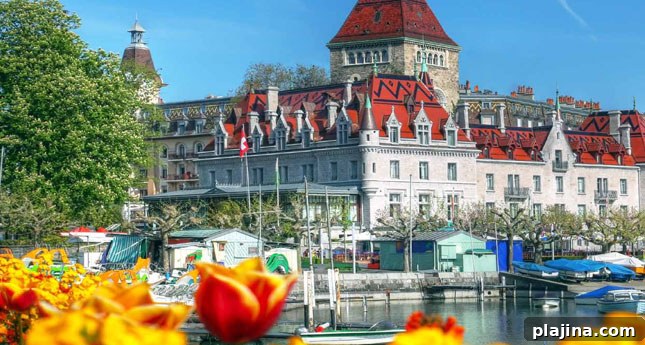
If location matters, Lausanne delivers. This lakeside city has served as a strategic crossing and trading post since Roman times, and during the Middle Ages its cathedral was an important stop on the Way of St. James.
Today’s business travelers appreciate Lausanne for both its accessibility and its striking setting. High-speed trains link Paris in about four hours, and regional connections run directly from Geneva and Zürich airports. Built on three hills, the city stretches from elegant lakeside promenades and grand Belle Époque hotels up to Switzerland’s finest early-Gothic cathedral. Each level of the city offers sweeping views across Lake Geneva (Lac Léman) to the Savoy Alps, making a hotel room without a view hard to find.
Reflecting its history as a commercial crossroads, Lausanne hosts the headquarters or major offices of several international companies, including Nespresso, Philip Morris International, Medtronic, Ferring Pharmaceuticals and Bobst Group. Nearby Vevey is home to Nestlé’s global headquarters.
Lausanne is also an important financial hub: the city houses central offices for Compagnie Financière Tradition, one of the world’s largest brokerage firms, and is the headquarters location for several leading Swiss commercial banks. Robust transport and communications infrastructure supports business activity: trains, buses and boats run seamlessly under the Swiss Travel System, and reliable internet and mobile coverage are widely available.
The city has invested in facilities to attract business events, including the World Trade Center, the MCH Beaulieu Congress and Exhibition Centre, and significant hotel meeting capacities, notably at the centrally located Lausanne Palace. The Swiss Tech Convention Center at the École Polytechnique Fédérale de Lausanne (EPFL) further expands the city’s event capabilities with highly flexible, automated spaces designed for conferences and exhibitions.
Lausanne benefits from top-tier educational institutions that fuel innovation and talent. EPFL is internationally recognized for engineering and technology, Université de Lausanne hosts a leading business school, and its Master of Laws program in International and European Economic and Commercial Law prepares lawyers for cross-border corporate work. Business School Lausanne and other institutions contribute to a thriving startup ecosystem.
From these academic roots have emerged prominent technology companies and research-driven firms clustered around the Science Park Ecublens on the EPFL campus. Notable examples include Kudelski, a leader in television decoder technology, and Logitech, a major global manufacturer of computer peripherals.
Switzerland’s non-membership in the European Union and its strong franc have historically affected trade dynamics. During the eurozone instability, the Swiss National Bank intervened to prevent an excessive appreciation of the franc, buying large amounts of euros to stabilize the exchange rate. Despite currency pressures, the Swiss government forecasted growth supported by strong domestic demand, and international forecasts anticipated continued GDP gains.
The advantages of a stable currency and high living standards come with higher prices, which can make Swiss exports less competitive when neighboring currencies decline. Unemployment remains low, and Swiss manufacturers are increasingly dependent on innovation to offset export challenges. Lausanne’s concentration of technical expertise and research helps support that innovative drive.
As one local observed, Swiss producers must focus on exceptional quality—whether making watches or water bottles—to remain competitive in global markets given higher production costs and a strong currency.
Vibrant public space in Flon © Mihai-bogdan Lazar | Dreamstime.com
CHECKING IN WITH FRANÇOIS MICHEL
Vice President, Lake Geneva Region Tourist Office
WHAT ARE THE STRONGEST BUSINESS SEGMENTS IN LAUSANNE RIGHT NOW?
Lausanne’s economy rests on several pillars. The city is home to the International Olympic Committee and more than 50 international sports organizations, making sport a key sector. Education and research are another strength, with institutions such as Université de Lausanne, EPFL and design schools drawing international students and talent. The Hotel School Lausanne also contributes to the city’s international profile in hospitality.
ARE OTHER NEW PROJECTS PLANNED BESIDES THE FLON RENOVATION?
Yes. A major transit project will add a new metro line that connects the central streets and main train station with the Beaulieu Congress and Exhibition Centre, continuing north to a redevelopment zone that includes a new residential area. This line will be especially useful for business travelers connecting the station and the Beaulieu Centre.
Another highlight is the Swiss Tech Convention Center at EPFL. Its modular design allows the main hall to transform from a 2,200-seat auditorium to a flat exhibition floor in about 15 minutes, expanding Lausanne’s capacity to host varied events. It opened for events following its inauguration in 2014.
WHAT IS THE QUINTESSENTIAL LAUSANNE EXPERIENCE FOR VISITORS?
Spend time in the Lavaux vineyards, a UNESCO World Heritage site just outside the city. Take a short boat ride and explore villages such as Saint-Saphorin or Lutry, hike through terraced vines, and stop at cafés and bistros. The region’s scenic beauty, wine tastings and lakeside villages provide an ideal escape from meetings and conferences.
WHAT ELSE SHOULD A BUSINESS TRAVELER KNOW ABOUT LAUSANNE?
Cultural life is rich for a city of its size. Museums, the Olympic Museum, the Béjart Ballet and a municipal orchestra create a lively arts scene. Lausanne’s compact scale makes it easy to combine business with cultural exploration and leisure.
Diversions
Lausanne is easy to navigate: downhill leads to the lake with parks, promenades and regular boat services to Vevey, Geneva and Montreux; uphill brings you to the cathedral and Place de la Riponne, home to a Saturday market; the rail station sits roughly midway. The metro, notable for its steep incline, links the lake to points above the city and connects the train station to convention venues, EPFL’s Science Park and commercial districts.
Begin at the cathedral to admire the medieval painted doorway, then follow the covered Escaliers du Marché down to a steep, historic street punctuated by cafés such as Café le Barbare. The old town’s pedestrian lanes converge at Place de la Palud, where an animated clock performs each hour.
Flon is Lausanne’s modern district, transformed from warehouses into a dynamic hub for art, design and nightlife. The city emphasizes green spaces and sustainability—an example being the green roof atop the Flon metro station, visible from the footbridge to the Lausanne Palace.
Swiss chocolatiers are world-renowned; Durig, near the Grancy metro stop, is a highly regarded chocolatier that offers custom corporate gifts and premium boxes to take home.
Museums in Lausanne include Musée Cantonal des Beaux-Arts for fine art, MUDAC for design and contemporary art, and Collection de l’Art Brut, a leading institution for outsider art. Lausanne-Vidy Roman Museum presents an excavated Roman villa and local history.
Stroll the lakeside gardens and board vintage steamers or modern boats to view the UNESCO-listed Lavaux vineyards, which cascade east of Lausanne in sun-drenched terraces. A paved path winds through the vines, linking lakeside towns where vintners offer tastings. The Train des Vignes runs from Vevey to Chexbres and includes wine stops along the route.
Nearby Vevey is a charming alternative base for visitors, reachable by boat or train. Attractions include the Alimentarium, a modern food museum, and several notable restaurants serving local lake perch. Vevey blends historic character with easy access to Lausanne’s business and cultural offerings.
Escaliers du Marché © Mihai-bogdan Lazar | Dreamstime.com
INFO TO GO
Geneva International Airport (GVA) is about 45 minutes from Lausanne by direct train; the rail station is on the arrivals level. Tickets can be purchased at machines or service desks. In Lausanne, the metro stops at the train station and taxis are available at street level. Hotel guests receive a Lausanne Transport Card, valid for the duration of their stay and covering local public transport. A single-day ticket costs roughly the equivalent of $9, and the metro is often faster than taxis. SwissPasses are accepted on local transport, regional trains and lake boats.
JUST THE FACTS
Time Zone: GMT +1
Phone Code: Country: +41; City: 21
Currency: Swiss franc
Entry/Exit Requirements: U.S. citizens need a passport valid for at least three months beyond their travel dates; no visa is required for stays up to 90 days within a six-month period for business or leisure.
Official Language: French
Key Industries: Financial services, education and research, tourism and conventions
LODGING
Lausanne Palace & Spa
A Belle Époque grand hotel with elegant salons and modern amenities, exceptional concierge service and a central location. Rue du Grand Chêne 7
Château d’Ouchy
A historic lakeside château offering contemporary rooms and easy access to steamer landings and the metro; noted for its restaurant. Place du Port
Grand Hôtel du Lac
A century-old property reinvented as a boutique hotel with spacious rooms and balconies overlooking the lake, located in Vevey. Rue d’Italie 1, Vevey
DINING
Nomade
A stylish restaurant and vinothèque at the edge of Lausanne’s trendiest neighborhood, offering international influences on classic dishes. Place de l’Europe 9
La Table d’Edgard
Located in the Lausanne Palace & Spa, this restaurant is known for its refined tasting menus and elegant setting—ideal for special dinners. Rue du Grand Chêne 7
La Veranda
The slightly more relaxed, glass-walled sibling of the hotel’s fine-dining venue, notable for creative regional dishes and a welcoming atmosphere for business lunches. Grand Hôtel du Lac, Rue d’Italie 1, Vevey