
Marriage is never easy. Even couples who seem perfectly matched often choose to live together before making a lifelong commitment, wanting to learn one another’s strengths, quirks and habits. Today’s couples also face practical questions: who will take whose name, how to merge households and whether friends and family will accept the union.
The comparison between marriage and the merger of two airlines may seem unusual, but it fits well in the story of LATAM Airlines Group, formed when LAN and TAM united to become the largest airline group in Latin America.
With service to 136 destinations across the region, LATAM operates one of the most modern and fuel-efficient fleets in Latin America, including Airbus A350 XWB, A321, A320neo and Boeing 787 aircraft. Carrying roughly 60 million passengers annually, LATAM ranks as the second-largest carrier between the United States and South America and the third-largest between Europe and South America.
The airline continually refines its route network. In May 2016 LATAM launched the only non-stop flight between Washington-Dulles International Airport and Lima (LIM). Seasonal services were added, including three weekly non-stop flights between Los Angeles (LAX) and Santiago (SCL) and two weekly non-stop flights between Orlando (MCO) and Santiago. LATAM also became the only Latin American airline group serving Africa with the inauguration of the São Paulo (GRU)–Johannesburg (JNB) route.
If two airlines seemed destined to merge, LAN and TAM were prime candidates. “When you consider South America as a destination or place of origin and 50 percent of that is Brazil, you need a big footprint,” says Pablo M. Chiozza, senior vice president USA, Canada & Caribbean for LATAM Airlines Group, explaining the strategic rationale behind the merger.
LAN dominated Spanish-speaking markets while TAM was Brazil’s leading carrier. For years the two companies alternated at the top of Skytrax’s Best Airlines in South America rankings. Their 2012 partnership evolved into a full consolidation that culminated in the announcement of a single brand — LATAM — in August 2015, marking the first time an airline group in the region unified under one brand identity.
The merger blends LAN and TAM’s strengths and regional knowledge, creating an airline greater than the sum of its parts. Enrique Cueto, CEO of LATAM Airlines Group, notes that both companies grew from modest beginnings into major regional players “thanks to their shared passion for flying, vision, dedication and innovation.” Together they now connect Latin America more effectively with the rest of the world.
Although full rebranding of the entire fleet is gradual, business travelers are already seeing service and product upgrades designed to align LATAM with world-class international carriers. The South American touch begins the moment passengers step aboard, from warm cabin service to thoughtfully designed interiors and regionally inspired meal offerings.
“There’s something in the DNA of the people of South America — a warmth, a welcoming nature, a focus on service,” says Chiozza. “LATAM capitalizes on that.”

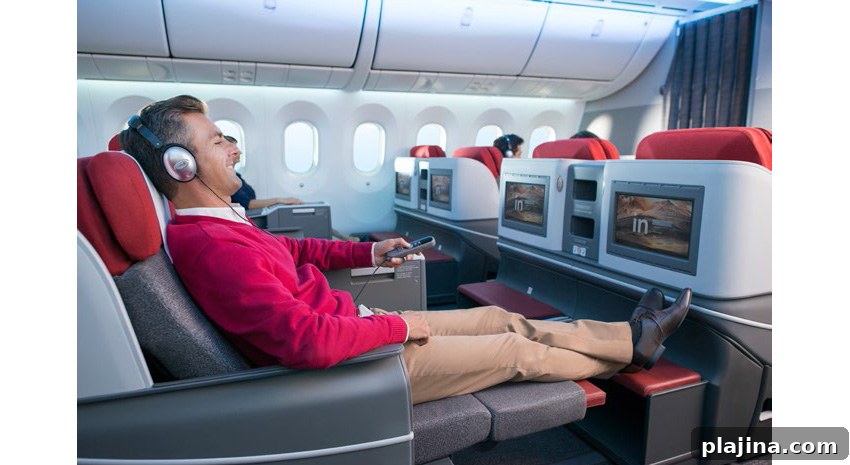
LATAM lie-flat bed © LATAM AIRLINES GROUP
Cabin designs include distinctive touches — for example, floors on the Airbus A320 that echo the Copacabana walkway. Long-haul Premium Business Class features full-flat seats with dividing panels, plush pillows and blankets. On the Boeing 787, full-flat seats add an ottoman, lumbar massage and a memory system that recalls seat position. All premium seats include high-resolution displays with touch-screen in-flight entertainment. Amenity kits by Salvatore Ferragamo contain travel essentials such as creams, an eye mask, lip balm and a mirror.
In-flight menus emphasize local ingredients native to each country LATAM serves, rotating selections every four to six months. Regional dishes might feature Patagonian king crab, Argentine flat-iron steak, Brazil nuts, quinoa, pirarucu fish, hearts of palm or sea bass, offering passengers a true taste of South America on board.
To develop a premium wine list, LATAM enlisted Héctor Vergara, the only Master Sommelier in Latin America. Vergara curated a selection highlighting wines from Chile and Argentina, choosing labels from regions such as Uco and Salta in Argentina and Colchagua and Limarí in Chile. “Our goal was to create a wine list of international quality that represents the original wines and latest trends being developed in this part of the world,” he says.
LATAM service © LATAM AIRLINES GROUP
Frequent flyers can access VIP lounges in São Paulo, Santiago, Buenos Aires, Bogotá and Miami, plus more than 600 lounges across oneworld alliance member airlines. The LATAM mobile app lets passengers check in, select seats, download boarding passes, monitor flight status and manage itineraries.
Short-haul flights within South America use the LATAM Entertainment platform, which offers free wireless streaming of films, TV series, children’s programming and flight information directly to passengers’ mobile devices.
Even after years of integration and around $150 million invested in aligning operations and branding, LATAM faces ongoing challenges — including ensuring customers recognize the unified LATAM brand rather than the legacy LAN or TAM names.
Chiozza points out that only a small percentage of Latin America’s population currently flies. LATAM aims to expand the local market by making air travel more affordable and educating potential travelers about the benefits of flying versus long overland journeys. A joint business agreement with American Airlines is also underway, expected to strengthen transborder connectivity.
“LATAM’s goal is to be the leading carrier in South America to the United States,” says Chiozza. “It’s not about being big for the sake of being big but getting close to our passengers with a high quality of service. We connect the world to Latin America better than anyone else.”
This new union appears poised to celebrate many successful anniversaries as it continues to evolve and improve the travel experience across the region.
LATAM
Route system: 136 destinations in 24 countries
Alliance: oneworld Loyalty program: LATAM PASS and LATAM Fidelidade
Fleet: Approximately 329 aircraft with an average age under seven years, including Airbus A319, A320, A321, A320neo, A350; and Boeing 767, 777, 787-8 and 787-9.
Markets: Core markets include Brazil, Chile, Colombia, Argentina, Ecuador and Peru, which account for the majority of the region’s air traffic, plus service to Europe, the United States, the Caribbean, Oceania and Africa.
Hubs: São Paulo (GRU), Brasília (BSB), Santiago (SCL), Lima (LIM). North America non-stop gateways: New York (JFK), Washington-Dulles (IAD), Los Angeles (LAX), Miami (MIA), Orlando (MCO), Toronto (YYZ)