
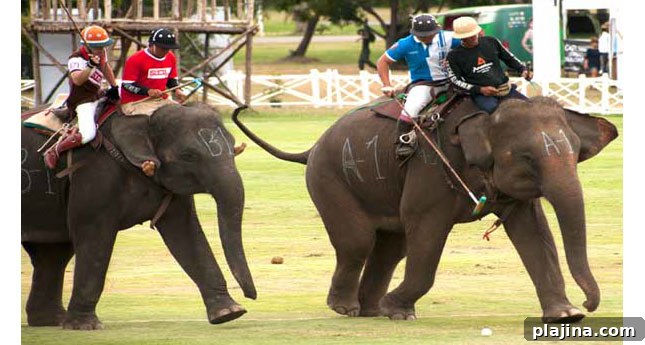
Like many of the world’s most beloved sports, elephant polo is said to have begun as a lighthearted idea among fans that eventually turned into an organized game. The World Elephant Polo Association established formal rules in 1982, and the sport has evolved from that point into a distinctive, much-photographed event.
Although the World Elephant Polo Tournament is held annually at the association’s headquarters in Royal Chitwan Park, Nepal, one of the most prominent and widely attended events is Thailand’s King’s Cup Elephant Polo Tournament. Introduced in Thailand in 2001 by Anantara Hotels, Resorts & Spas, the King’s Cup has become both a popular social event and a meaningful fundraiser. Over the years the tournament has raised more than $750,000 to support the care and conservation of Thailand’s wild and domesticated elephants.
The King’s Cup is also known for its colorful, celebrity-filled atmosphere. Recent tournaments have featured 16 teams and roughly 50 players, drawing a diverse mix of participants: Thai supermodels, professional polo players, international rugby players, and performers from Thailand’s well-known cabaret shows. The event’s festive schedule typically includes an opening parade, themed days such as Children’s Day and Ladies’ Day, and a variety of family-friendly activities.
Because of growing attendance and logistics, the 2014 tournament was moved about 125 miles north from Hua Hin on the Malay Peninsula to Bangkok. The four-day festival, traditionally held in late August, combines competitive matches with social events designed to attract visitors, raise funds, and increase awareness for elephant welfare.
Official Rules
- No elephants may lie down in front of the mouth of the goal; doing so is a foul.
- A free hit is awarded to the opposing team from the semi-circle in front of the goal following that foul.
- Teams are formed from a pool of elephants and balanced as fairly as possible, taking into account each elephant’s size and speed.
- After selection, each elephant is categorized and marked as A, B, C, D, E or F.
- Having three elephants in one half of the pitch constitutes a foul.
- An elephant may not pick up the ball with its trunk during play; this is a foul and results in a free hit for the opposing team from the spot where the ball was picked up.
- Defending players must stand 15 meters from the spot of a free hit.
- No more than two elephants may be inside the penalty D at the same time—one from the attacking team and one from the defending team.
- There are no restrictions on an elephant’s height, weight or sex for competition.
- After each match, elephants are rewarded with sugarcane or vitamin-packed rice balls, and the elephant handlers receive a cold beer or soft drink—never the other way around.