
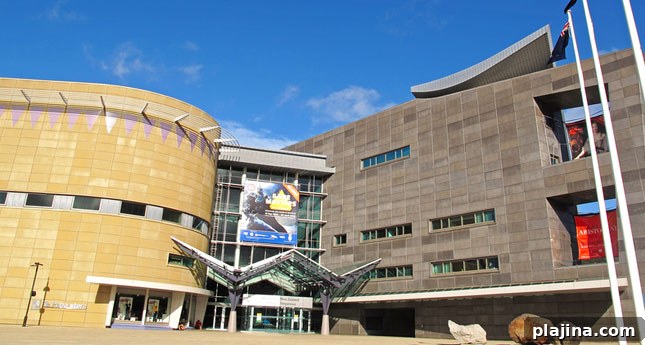
Located in Wellington, the National Museum of New Zealand—Te Papa Tongarewa, which in Māori means “container of treasures”—is one of the most impressive and accessible museums I have visited. The museum combines thoughtful design with engaging, hands-on exhibits that welcome visitors of all ages.
One standout installation is a 46-foot-long floor map of New Zealand in the OurSpace gallery. The map is interactive: stepping on different parts of the map activates large wall displays that show images and short videos connected to that region. There are 27 trigger points embedded across the map, and each point cycles through several visuals that highlight the local landscape, wildlife, history, or cultural features.
For example, when I stepped on the Central Plateau the wall displays showed volcanic activity; at points along the fault line the visuals emphasized seismic forces and the dramatic geology of the country. The Wellington trigger brought up an image resembling a bustling hive, a playful nod to the city’s energetic character. Stepping on the ocean areas revealed deep, dramatic seascapes that conveyed how profound the surrounding waters are—enough to create a brief sensation of vertigo.
The design encourages exploration and discovery. Repeatedly activating the same trigger produces different images and video clips, so the experience changes with each step. It feels interactive and almost playful—I found myself moving from spot to spot, watching new sequences unfold, and enjoying the way the exhibit turns geography into a visual story.
That blend of technology, storytelling, and cultural context makes the map memorable. It’s an engaging way to learn about New Zealand’s diverse landscapes and communities without feeling like a traditional, passive museum display. The installation invites interaction, turns learning into an active moment, and leaves visitors curious to explore the rest of the museum.
Overall, Te Papa’s floor map is a creative example of how museums can use immersive exhibits to connect people to place. It offers an approachable, sensory-rich introduction to New Zealand’s geography and culture, and it manages to be informative while also being a lot of fun. I had to be gently persuaded to move on so I could see the rest of the museum, which says a lot about how captivating the experience was.