
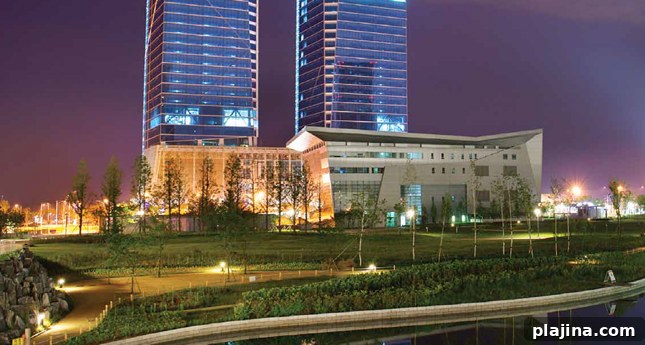
For rent: LEED-certified office space with sweeping views of Central Park, fully wired with the latest network technology, and attractive tax incentives. The listing sounds almost too good to be true, but it captures the vision behind Incheon’s bold wager on the international business hub of the future: a $40 billion city built from scratch, featuring 1,500 acres of cutting-edge offices, energy-efficient residences and global design influences.
Songdo City is the largest private real estate development in history and the most ambitious component of Incheon’s trio of Free Economic Zones created on reclaimed land in the bay. Together with the Cheongna Entertainment District and Yeongjong Island, home to Incheon International Airport, these projects aim to transform Incheon into a global gateway for Northeast Asia’s leading economies.
Positioned on the Yellow Sea about 22 miles west of Seoul, Incheon has long been Korea’s link to the wider world. After centuries of isolation, the port opened to trade in 1883 and soon attracted Chinese merchants who established Korea’s first official Chinatown. Today Incheon International Airport, less than two decades old, serves a massive catchment—roughly one-third of the world’s population within a three-hour flight—and consistently ranks among the world’s busiest airports.
Nevertheless, Incheon is still building its reputation as a business hub. In 2003 the national government designated more than 50,000 acres of Incheon as a Free Economic Zone, offering incentives such as a flat 17 percent income tax for foreign executives, grants for high-tech foreign investment and exemptions on import duties for capital equipment. In 2007 the city launched a Free English Zone initiative to raise English proficiency; the goal is that by 2020 Incheon will be a bilingual environment where foreigners feel comfortable living, working, shopping and enjoying leisure activities.
Unlike many rapidly grown Asian cities that developed without a plan, Songdo was conceived to avoid congestion, poor air quality and other modern urban problems. With more than $83 billion allocated for green investment in Korea’s economic stimulus package, President Lee Myung-bak emphasized eco-city development as a means to reduce national carbon emissions and promote Korea as a leading green economy.
Songdo carries particularly high expectations. Built on a former marshland once frequented by migratory birds and insects, the decade-long development is a collaboration between New York–based Gale International and Korea’s Posco. More than half complete, it already houses roughly 35,000 of the projected 65,000 residents. The plan centers on a 100-acre park inspired by New York’s Central Park and is surrounded by residences, schools, an International Business District, a convention center and a Jack Nicklaus championship golf course.
The city’s infrastructure emphasizes sustainability and mobility: a 16-mile network of bicycle lanes, electric vehicle charging stations and a master plan by the U.S. firm Kohn Pedersen Fox that includes saltwater canals modeled after Venice and electric water taxis. Of the 1,500 acres in Songdo, about 600 acres are reserved as open space. As Korea’s first fully LEED-certified district, buildings incorporate solar panels, green roofs and pneumatic waste collection to meet rigorous environmental standards.
Urban amenities remain a priority alongside green goals. The Incheon Arts Center is planned to house a concert hall, opera house, contemporary art museum, design school, music conservatory and library. Songdo already boasts the Northeast Asia Trade Tower, Korea’s tallest skyscraper; the planned Incheon Tower, when completed, is expected to become one of the world’s tallest landmarks.
While many Koreans embraced the vision—some early residential phases sold out within days—skeptics question whether Songdo can attract enough multinational corporations. Early signs are promising: Cisco Systems signed a major deal to provide network infrastructure and locate its Smart+Connected Communities global headquarters in Songdo. High-profile events such as the 2014 Asian Games helped raise the city’s international profile and showcased new facilities.
Regardless of comparisons to Hong Kong or Singapore, Incheon’s leaders have committed to the long-term bet that building a superior living and working environment will draw residents and companies. The city’s planners believe that by creating world-class infrastructure and sustainable urban design, Songdo will become a destination where people and businesses want to be.
Diversions
To experience Incheon’s layered history, walk through Chinatown near Incheon Station in Jung-gu. Established when Korea opened its ports in 1883, it remains the nation’s first official Chinatown. Sample hearty noodles or pork dumplings at a traditional restaurant, then continue uphill to Jayu Park, Korea’s first modern park, created in 1888.
The Korean War’s turning point at the Battle of Incheon in 1950 is commemorated at the Incheon Landing Memorial Monument Hall in what is now part of Songdo City. The museum details General MacArthur’s amphibious landing and its impact on the war.
For a glimpse of Songdo’s present and future, stroll through Songdo Central Park, visit the Northeast Asia Trade Tower—South Korea’s tallest skyscraper—and observe construction on the 151 Incheon Tower, projected to be one of the world’s tallest upon completion.
With more than 150 islands in the administrative district, Incheon provides easy access to beaches and island scenery. Yeonan Pier offers fresh seafood and ferry connections to nearby islands like Jagyak Island, known for its peony blooms. Eurwangni Beach on Yeongjong Island is a short drive from Incheon International Airport and is popular for seafood and surf. A brief ferry ride brings visitors to Muui Island, noted for its beaches and pine forests; at low tide, it’s even possible to walk from Silmi Beach to the small uninhabited Silmi Island.
Ganghwa Island, the region’s most visited tourist island, is an accessible day trip from Seoul. Noted for mysterious dolmen burial sites, it features a UNESCO World Heritage listing, sacred mountains and remnants of 13th-century palaces and temples.
CHECKING IN WITH TOM MURCOTT
Executive Vice President and Chief Marketing Officer, Gale International
WHAT WILL DRAW INTERNATIONAL CORPORATIONS TO DO BUSINESS AT SONGDO CITY?
The fundamentals of the Republic of Korea are a strong foundation: stable democracy, rule of law and a skilled, highly educated workforce. But to attract top multinationals, Songdo must offer an exceptional quality of life. The aerotropolis concept, together with inspired master planning, creates a superior living and working environment that sets Songdo apart from other Asian cities.
WHAT IS THE KOREAN RESPONSE TO THE PROJECT?
Songdo IBD reflects the vision and commitment of Incheon’s leaders with robust support from the national government. The development is intended to create jobs, spur economic growth in the region and gain global recognition as a green city. These objectives have won broad Korean support.
WHAT WILL THE DEVELOPMENT OF SONGDO MEAN FOR THE CITY OF INCHEON?
Songdo already employs thousands daily and hosts hundreds of domestic and international companies. More broadly, it showcases Incheon’s ambition to play a leading role in the global economy. The project’s long-term success will be measured by how future generations of Korean and international residents live, work and prosper in the region.
Info To GoKorea’s primary international gateway, Incheon International Airport (ICN), is located on Yeongjong Island. The airport’s A’REX express subway connects with Incheon’s Line 1 (about 20 minutes, fare varies), Gimpo International Airport (28–33 minutes) and Seoul Station (43–53 minutes). Both limousine and regular buses run frequently to downtown Incheon. The recently completed 7.4-mile Incheon Bridge links Yeongjong Island with Songdo City. |
Just The FactsTime Zone: GMT +9 Phone Code: 82 (South Korea), 32 (Incheon) Currency: South Korean won Entry/Exit Requirements: U.S. citizens need a valid passport. Visitors staying more than 90 days or for purposes other than tourism or short business trips may require a visa in advance. Official Language: Korean. Efforts are underway to raise English proficiency among residents. Key Industries: Automobiles, biotechnology, finance, information technology, real estate, renewable energy, tourism |
LodgingGolden Sky International Resort: Set on scenic Eurwangni Beach, this family-friendly resort offers in-room kitchens and a water park for children. Ideal for beachside stays. Hyatt Regency Incheon: Located minutes from Incheon International Airport, the Hyatt provides extensive amenities and easy access to the West Sea Islands. Sheraton Incheon Hotel: Songdo’s first hotel features non-smoking, LEED-rated rooms, business services and meeting facilities. |
|
DiningHoebaragi: A popular Eurwangni Beach restaurant known for its wide selection of raw fish (hoe) and grilled shellfish. Suta Jjajangmyun: A local favorite where Korean and Chinese flavors meet in handmade black-bean noodles (jjajangmyeon). Wonbo: Street-style steamed buns filled with savory pork and vegetables, a Chinatown staple. |
|