
Steeped in history yet vibrantly modern, Washington, D.C., is a city where iconic institutions celebrate human achievement across intellect, culture, politics and science. A prime example is the Smithsonian Institution’s National Air and Space Museum.
Although Orville and Wilbur Wright were from Dayton, Ohio, and first flew at Kitty Hawk, North Carolina, their 1903 Wright Flyer is on display in The Wright Brothers & The Invention of the Aerial Age exhibit. The Apollo 11 command module Columbia, designated a Milestone in Flight, is showcased in The Destination Moon gallery. To see these and thousands more artifacts from the museum’s collection of roughly 60,000 objects, visitors should reserve a complimentary timed-entry pass online.
The federal District of Columbia was established as the nation’s capital in 1790. A year later Pierre Charles L’Enfant designed the city’s layout at the junction of the Potomac and Anacostia rivers, combining a conventional north-south, east-west grid with diagonal avenues, broad public promenades, parks and circles to create a striking wheel-and-spoke plan.
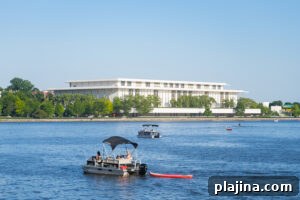
PHOTO:
© WASHINGTON.ORG
The Northwest quadrant, the largest and the central business district, contains many of the city’s most famous sites: the White House, the National Mall, Dupont and Logan circles, the Kennedy Center and historic Georgetown. Georgetown predates the establishment of the capital by decades; once a tobacco inspection port, today it is a scenic neighborhood with riverside dining and upscale hotels. Waterfront restaurants such as Fiola Mare specialize in Italian-influenced coastal cuisine, while luxury accommodations include the Four Seasons Hotel Washington, D.C. and The Ritz-Carlton Georgetown.
Several prestigious five-star hotels are concentrated in Northwest, offering elegant rooms, business facilities, fitness centers and spas, as well as distinctive meeting places. The Waldorf Astoria Washington, D.C., opened in 2022 in the restored Old Post Office building and features the light-filled atrium Peacock Alley. Dining options in the area range from the inventive plates at The Bazaar by José Andrés to the Michelin-starred Sushi Nakazawa. The Tasting Salon hosts private tastings of rare spirits and wines beneath the Clock Tower, where visitors can also access the National Park Service’s observation area.
The Watergate Hotel retained Luigi Moretti’s iconic 1967 curved “ship on the Potomac” silhouette after a major renovation. Its dramatic interiors—spiral staircases, polished columns and rounded furnishings—are complemented by lively venues such as The Next Whisky Bar and the double-height Kingbird restaurant, where sculptural chandeliers enhance the atmosphere. Top of the Gate, the hotel’s rooftop bar, offers sweeping views that include the Kennedy Center and the Washington Monument.
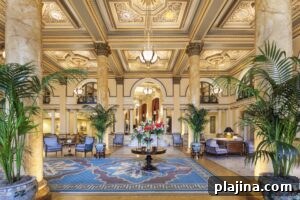
PHOTO:
© WASHINGTON.ORG
The 335-room InterContinental The Willard Washington D.C. has hosted presidents and notable figures since 1853. Its Peacock Alley and Willard Tea Room feature live harp music and refined afternoon tea service, while Café du Parc serves classic French brasserie dishes. The Round Robin Bar, established in the mid-19th century, retains a long-standing reputation as a storied spot for conversation and cocktails.
The Wharf, along the Southwest waterfront, has been transformed into a mile-long pedestrian promenade within a 24-acre mixed-use development. The area includes The Anthem, a 3,000-seat concert venue, and a range of dining options such as Del Mar, which specializes in Spanish coastal cuisine. InterContinental Washington D.C. – The Wharf is a contemporary glass-clad hotel with a rooftop pool overlooking the Potomac and East Potomac Park. A free Southwest Shuttle connects The Wharf to the National Mall.
Aviation has long played a role in the life of the capital, from ceremonial arrivals at Joint Base Andrews to daily travel needs served by nearby airports. Business travelers typically use Washington Dulles International (about 26 miles away), Baltimore/Washington International Thurgood Marshall Airport (about 32 miles away) or Ronald Reagan Washington National Airport, just across the Potomac with a direct metro connection. Amtrak delivers convenient rail access to the beautifully renovated Union Station, and local services such as the D.C. Circulator provide budget-friendly transit (including a $1 route around the National Mall and to Georgetown).
Visitors find Washington easy to navigate once they understand the quadrant system—N.W., N.E., S.W. and S.E.—which helps locate addresses and major destinations across the city.