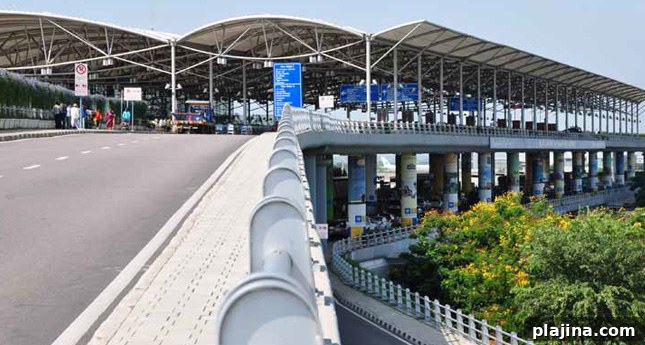
Less than a decade after opening in 2008, Hyderabad’s Rajiv Gandhi International Airport is already planning for the future. Located about 19 miles south of central Hyderabad — one of India’s fastest-growing urban centers and a hub for information technology, pharmaceuticals, biotechnology and finance — the airport is a critical part of a broader regional development strategy.
Unveiled in January 2013, the Hyderabad Master Plan 2031 for the Hyderabad Metropolitan Region covers roughly 2,300 square miles and serves a population of about 18.4 million. The master plan positions Rajiv Gandhi International Airport as a key transportation node, driving growth and connectivity across central and southern India. Today the airport handles roughly 12 million passengers annually; under the master plan it is being prepared to manage up to 40 million passengers a year.
The airport’s existing infrastructure reflects a forward-looking approach. Phase 1 of the master plan covers current facilities, including the airport’s primary runway — the second-longest in India — which is capable of handling the latest generation of superjumbo aircraft such as the Airbus A380. A secondary parallel runway supports widebody aircraft up to the size of a Boeing 747. On-site facilities also include a cargo terminal, dedicated rescue and firefighting services, and advanced air traffic control systems integrated with operational databases.
Terminal design emphasizes modularity and ease of expansion. The main passenger terminal includes multiple contact boarding bridges, remote stands, common-user terminal equipment, check-in counters and self-service kiosks, along with customs and immigration facilities and a transit hotel. An on-site “Airport Village” offers retail, dining, lounges, meeting points, a children’s play area, parking and transfer assistance, creating a convenient centralized passenger experience.
Future phases outlined in the master plan call for expanded airside capacity and passenger handling: a dual-runway system connected by two cross taxiways, two integrated passenger terminals and dedicated cargo terminals to support both scheduled and freight operations as traffic grows.
Meanwhile, the airport is implementing technological improvements to improve passenger flow and operational efficiency. In August, Rajiv Gandhi International became the first airport in India to receive regulatory approval for eBoarding. As part of the national Digital India initiative, paperless boarding will simplify the boarding process for travelers and reinforce the airport’s position as a technology leader in the country’s aviation sector.
The ongoing developments at Rajiv Gandhi International Airport reflect a coordinated effort to align infrastructure with long-term regional growth, strengthening Hyderabad’s role as a major gateway to central and southern India while prioritizing scalable design and digital innovation.