
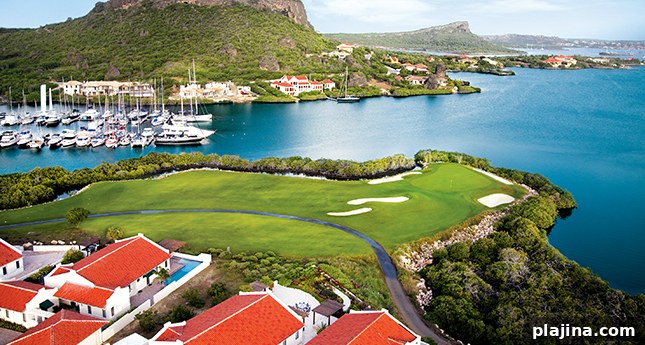
The Smeets family, a banking dynasty in Curaçao, envisioned transforming a beachfront parcel into a premier recreational destination unlike anything previously seen in the Netherlands Antilles. Their site was once part of a 19th-century limestone quarry, and remnants of that history remain—hole markers crafted from massive limestone slabs and vintage quarry equipment displayed around the course.
To bring their vision to life, the Smeets family enlisted Jack Marshall, a developer with two decades of experience creating golf courses and residential communities. Marshall recruited renowned course designer Pete Dye. The resort’s overall aesthetic, particularly the Hyatt Regency Curaçao Resort, was inspired in part by Marshall’s travels through Tuscany.
Dye’s routing embraces the natural terrain, guiding golfers from the turquoise seas alongside the first two holes, through the rugged Tafelberg Mountains, and finally down toward Seru Boca Marina. While the oceanfront holes provide stunning scenery, many players find the interior routing to be more varied and technically demanding.
Fairways and tees are planted with paspalum grass, chosen for its tolerance of brackish or recycled irrigation water, while the rough is seeded with native grasses to blend with the island environment. Although the course is relatively new, it has matured quickly and provides excellent playing conditions.
Jim Bolinger, a Curaçao native serving as golf manager, and golf professional Oliver Riding are both dedicated to guest service. They can provide detailed information about the course, the dining options at the Hyatt, and local attractions to explore while visiting Curaçao.
Hole 2 (552 yards, par 5)
Holes 1 and 2 run along the coast and offer spectacular views of ships and pleasure craft. From the tees you can also see the dramatic color change where the coastal shelf drops away. The prevailing wind generally blows into your face, tempting players to overadjust from the tee. When the wind shifts sideways, drives can drift left into a fairway bunker. The second shot should favor the left side to avoid a rocky outcropping on the right. Approach shots typically require a wedge to a green guarded by two front bunkers and the sea to the right.
Hole 5 (484 yards, par 4)
This hole climbs to a crest and then descends back to the green. From the tee aim slightly left of center to steer clear of the traps near the hilltop; a well-placed drive will carry past the crest. The short dogleg left features two trees on the right before your landing area. The green shows significant undulation and is defended by three bunkers—one centered and two left—plus a short fairway that can act as a false front, luring some shots to come up short.
Hole 7 (140 yards, par 3)
The course’s shortest hole requires a delicate flop shot to the green. It’s picturesque, with harbor views and sailboats at anchor; small mangroves fringe the waters nearby. When played during development, homes were under construction along the right. The green is protected by three bunkers on the right and one on the left, with an additional back bunker positioned to catch overly ambitious shots that run past the putting surface.
Hole 8 (550 yards, par 5)
Depending on wind conditions, this reachable dogleg left can tempt players to try for the green in two. The fairway skirts a tidal marsh and a scenic bay, offering sweeping views of the harbor and a distinctive cliff-faced mountain. A conservative second shot often sets up a scoring opportunity: a well-struck sand wedge into the green can leave a realistic birdie chance. Attempts to reach the green in two can end in lost balls when the shot goes awry.
Hole 10 (402 yards, par 4)
This dogleg left begins from a slightly elevated tee and finishes at an elevated green. A shallow pond parallels the left side of the fairway, and a large bunker provides a margin of safety for pulled drives that might otherwise find the water. Waste bunkers line the right. A strong drive should leave a mid-to-short iron or wedge into the green. This hole rewards accuracy and course management.
Hole 15 (466 yards, par 4)
From the tee you can assess the hole and pick a landing zone. A stiff crosswind can push drives toward the brush. The fairway nestles in a valley between the tee and the green, and the putting surface features pronounced triple-tiered undulation. Any putt from the lower tier to the top of this narrow, elongated green requires careful touch. Right of the green a 20-foot drop awaits many misjudged approach shots.
Hole 17 (484 yards, par 5)
Players face an unusual choice off the tee on this hole’s split fairway, divided by a line of century-old cactus and quiebra hacha bushes. The left route presents a risk from a gumbo-limbo tree that leans with the prevailing wind, while the right side typically yields a more straightforward line toward the green. Short or errant approach shots are vulnerable to bunkers: two left, one right, and a front trap protecting the elevated green.
Hole 18 (425 yards, par 4)
The finishing hole offers a memorable downhill tee shot with Spanish Water Bay as a dramatic backdrop and red-tiled roofs in the distance. Despite the postcard setting, focus is essential: bunkers guard both sides of the landing area with two traps short left and right and two more encroaching on the left. The wind can carry balls past the green, so club selection is critical—playing one less club than expected often helps to keep your approach on the surface.
Old Quarry Golf Course
Hyatt Regency Curaçao Golf Resort, Spa & Marina
Santa Barbara Plantation, Curaçao, Netherlands Antilles
tel 599 9 840 6886