
PITTSBURGH WILL ALWAYS BE STEEL CITY, but today it is also known as a growing center for robotics, artificial intelligence and related technologies. That transformation began when the steel industry collapsed decades ago and the region had to diversify. Over time, Pittsburgh shifted from a primarily blue-collar economy to one anchored by finance, health care, education and technology.
“The transformation is something people have to see,” said Mark Thomas, president of the Pittsburgh Regional Alliance. “Pittsburgh has retained its character and culture and is building on its phenomenal legacy. It may have missed the skyscraper era, but it’s fast-forwarded to what will impact the next century.”
According to the Pittsburgh Technology Council, the technologies shaping the region span several categories: information technology (hardware and software); life sciences (medical devices and health services); advanced manufacturing; advanced materials (chemicals and plastics); energy technology (including petroleum and hydroelectric production); and environmental technology (such as waste management). Robotics, AI and autonomous vehicles fit within these categories, alongside many everyday products and services that often go unnoticed. As a result, technology is Pittsburgh’s fastest-growing industry and now represents roughly 23 percent of the local workforce.
“A lot of people think of tech being just hardware and software, but it is so much more,” said Jonathan Kersting, vice president of communication and media at the Pittsburgh Technology Council.
Nontechnology sectors in the region—finance, education and healthcare, for example—also reinforce the tech ecosystem. PNC Financial Services, a Fortune 500 company headquartered in the city, offers financing solutions for technology equipment. Local universities, including Carnegie Mellon University and the University of Pittsburgh, provide strong programs in engineering, computer science and robotics that feed talent into the local economy.
Carnegie Mellon in particular has been pivotal. It was among the first universities in the country to offer computer science, the first to grant a Ph.D. in robotics (1979) and an early leader in undergraduate AI education. CMU attracted leading researchers and innovators—people like robotics pioneer William “Red” Whittaker—and helped draw investment and startups to the city.
That environment helped spawn many startups. Some attracted major corporate partners or funding—Argo AI, for example, received a large investment from Ford Motor Co. in support of autonomous vehicle development—while others were acquired by established firms seeking innovation. Many of these companies cluster near the Strip District in an area popularly called Robotics Row.
Large technology firms have also expanded their presence. Amazon increased its staff at the Pittsburgh Tech Hub, Facebook established an AI research lab with a multi-million-dollar investment, and companies such as Uber, Google, Bossa Nova Robotics and Microsoft maintain local engineering teams. These moves underscore Pittsburgh’s global significance in robotics and AI.
“At the end of the day, Pittsburgh is in the top three, if not at the top, for robotics in the world,” Kersting said.
Despite strong university programs, companies still face challenges finding enough local talent with highly specialized skills. Some firms actively recruit from other regions: Duolingo, for instance, ran a billboard campaign aimed at San Francisco tech workers encouraging relocation with the pitch, “Own a home. Work in tech. Move to Pittsburgh.”
The Pittsburgh Technology Council and the Pittsburgh Regional Alliance promote the region’s advantages to attract talent, especially younger professionals. Beyond job opportunities, Pittsburgh offers quality-of-life benefits: nine county parks totaling about 12,000 acres, extensive riverfront trails, four Carnegie museums and a vibrant food scene. The city is also a leader in sustainability, with hundreds of LEED-certified buildings.
To grow further, Pittsburgh needs better global connectivity. Pittsburgh International Airport is investing in a new $1.1 billion terminal to improve capacity and efficiency. The nearby Pittsburgh Airport Innovation Campus, envisioned as a foreign-trade zone, will provide incentives for international companies and is planned to include office, R&D and manufacturing space when fully built out. That campus is expected to strengthen the region’s ability to attract foreign investment and support advanced manufacturing.
Talent remains central to continued progress. Tech employers need qualified people to scale and compete globally, and local leaders hope the combination of educational institutions, quality of life, and growing industry presence will draw and retain that workforce.
“I’d like to see the tech companies here grow and open offices around the world,” Kersting said.
SCENIC DRIVES
If you want to step away from Pittsburgh’s tech and robotics scene for a day, several scenic drives showcase the region’s history and natural beauty. Head south on I-79 to U.S. Route 40, the nation’s first federally funded interstate highway. From there you can drive east past Fort Necessity and historic toll houses, or travel west, cross the Ohio River and continue toward Columbus.
The Ohio River Scenic Byway is another option. Starting in East Liverpool, Ohio, it follows Highway 7 along the river through forests and small towns. With more time you can continue for several days to Fort Defiance State Park in Illinois, or simply turn back after a half-day outing.
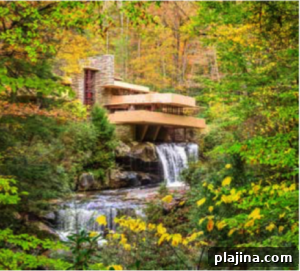
Frank Lloyd Wright’s Fallingwater
PHOTO: © SEAN PAVONE – DREAMSTIME.COM
Fans of Frank Lloyd Wright should consider the Laurel Highlands Scenic Byway. Take State Route 711 south from Seward, stop at Fort Ligonier, then continue to Normalville and follow State Route 381 to Fallingwater, Wright’s acclaimed home that is now a UNESCO World Heritage site. Tours operate daily except Wednesdays from March through December. You can end your drive there or continue seven miles south to Kentuck Knob, another Wright residence. Polymath Park, featuring additional Wright-designed homes, is also nearby. Book tours in advance to ensure availability.