
I set out to explore some of Hong Kong’s oldest streets, starting beneath the lower end of the Central–Mid-Levels Escalator. My first stop is Good Spring Company, on the corner of Stanley and Cochrane Streets, a traditional herbal teahouse that has offered Chinese remedies since 1916. Three herbal brews are ready to go; while I consider the honey-colored American ginseng and floral teas, the brewer recommends a dark 24-variety infusion — a bitter, restorative drink I decide to trust. Around me, staff scoop herbs, roots and dried ingredients from wooden drawers lining the shop. An herbalist offers quiet advice, and fortified by the mystery tea, I head out toward the market.
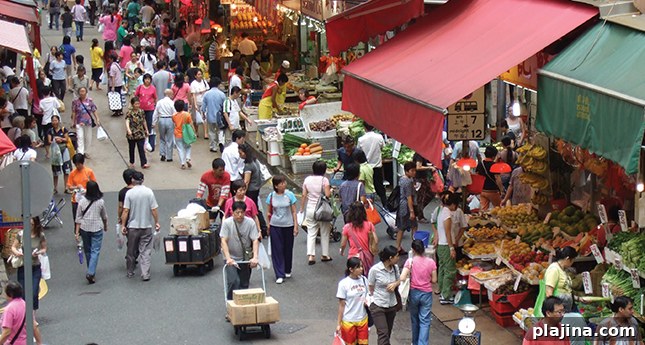
Hong Kong’s outdoor “wet market” along Graham and Gage Streets has been in continuous use since the 1840s. On Graham Street, stalls overflow with vegetables, fruit, flowers and local produce. Some items puzzle visitors — thousand-year-old eggs and various preserved vegetables among them — while others stun with color: papayas, pineapples and mangoes piled beside Barbie-pink dragon fruit, and the odd spiky durian ready for its close-up.
Business hums at the fish stalls. “You want garoupa, you want prawns? It’s all fresh!” calls a stallholder, switching among at least three languages. Many fish remain alive in polystyrene pools or flap on the chopping block — it doesn’t get much fresher than that.
For those used to buying meat from chilled displays, Gage Street’s open-air meat stalls can be confronting: bloody wooden blocks and flesh hanging from hooks are a reminder of how food was traditionally sold. More appealing to many are the roast meat shops, their windows filled with lacquered chunks of char siu, roast goose, duck and chicken. Locals buy takeaway portions or sit down for quick, satisfying meals. The plates are simple but packed with flavor. At Lung Kee Restaurant (5 Gage St.) you can try char siu fan (barbecued pork with rice) and choi (vegetables) for just $4–5.
Around the corner, Tsim Chai Kee Noodle (98 Wellington St.) serves bowls of king prawn wonton noodles for less than $3, a bargain that has earned praise from travel and food critics. I enjoy a late breakfast while watching staff make fresh mountains of wontons, humming and chatting as they deftly fold prawn into delicate wrappers.
Up on Hollywood Road, shops generally open between 10 and 11 a.m. Walking west toward Sheung Wan, the contrast between old and new Hong Kong deepens. The street is lined with art galleries and antique shops; contemporary Asian art sits alongside everything from reproduction terracotta warriors and Tibetan artifacts to classic Chinese ceramics, textiles and traditional furniture.
I step into the 153-year-old Man Mo Temple, where the air hangs hazy with smoke from spiraling coils of incense suspended from the ceiling. Worship at Hong Kong temples tends to be informal and transient: a few devotees pause on their way to work or after the school run to offer quiet prayers to the Taoist gods of literature (Man) and war (Mo).
Nearby, Upper Lascar Row — better known as the Cat Street Market — overflows with antiques, furniture shops and stalls selling a mix of curios and mass-produced China-themed souvenirs. The antiques stores and chaotic junk shops brim with the promise of vintage finds. Approaching Possession Street, where the British first claimed Hong Kong Island in 1841, furniture shops sit alongside coffin makers proudly displaying giant wooden caskets — not a place for impulse purchases.
A newer addition to the neighborhood is 208 Duecento Otto (208 Hollywood Road), the latest venture from Yenn Wong, founder of JIA Boutique Hotels. This two-floor, New York–style Italian restaurant and bar is led by Executive Chef Vinny Lauria, formerly of Babbo in New York. The menu leans toward rustic Italian cooking; the décor reflects that simplicity, though white and blue Chinese wall tiles lend the place a sense of local continuity.
Hollywood Road runs for about a block before meeting Queen’s Road West. I turn down Sutherland Street and enter the heart of Hong Kong’s wholesale market for traditional medicine and dried foods. The distinctive aroma — hints of star anise, ginseng and dried fish — marks this district as clearly as the tubs of dried abalone and shrimp displayed outside the shops.
On Ko Shing Street, men push hand trolleys, moving containers of dried ingredients for Chinese medicine and cuisine at a brisk pace. Nearby, Wing Lok Street and Bonham Strand West are home to wholesalers selling birds’ nests, ginseng, dried seafood and mushrooms, alongside sea slugs, starfish, antlers and other, often hard-to-identify items. A troubling sight is the vast number of dried shark fins on display; as a global center of this trade, the area serves an unsustainable demand for a prestigious banquet dish among China’s expanding wealthy population.
All this wandering through food markets makes it time to eat, and with more than 10,000 restaurants in the city, choices abound. Tonight I meet friends at Busy Suzie (1881 Heritage, Canton Road, Tsim Sha Tsui), a lively Japanese robatayaki restaurant where meat, seafood and vegetables are grilled to order. After a satisfying meal, I take the short walk to one of the most charming journeys home: the Star Ferry, crossing the harbor as the city’s lights shimmer on the water.