
For travelers visiting Melbourne, Australia, the Younghusband Woolstore Redevelopment is a must-see. One of the country’s most ambitious adaptive reuse projects, it establishes new standards in sustainable development and decarbonization. Led by Woods Bagot, the project transformed more than 182,986 square feet of underused industrial land into a lively mixed-use precinct through a careful, “light touch” approach.
With a history spanning more than 120 years, the Younghusband Woolstore is a rare surviving example of Victoria’s once-thriving wool trade. Located roughly 2 miles from Melbourne’s Central Business District and adjacent to Kensington Village, the historic site benefits from excellent transport links and proximity to one of the city’s most vibrant neighborhoods.
© Trevor Mein
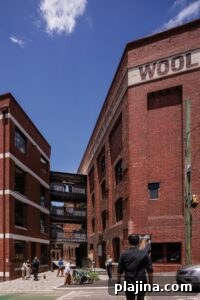
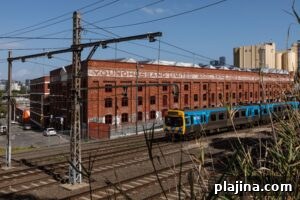
The restoration reveals striking character details—historic bail elevators, wool pulleys and original ghost signage—while retaining much of the building’s original fabric. The Woolstore is a compelling example of turn-of-the-century Victorian industrial architecture, with large redbrick volumes, a distinctive saw-tooth roof and deep floor plates. Natural patina and remnants of pastoral equipment contribute to a distinctive urban setting for living, working and socializing.
Over the decades the Woolstore served diverse community uses, from housing costume storage for the Australian Ballet to providing studio space for grassroots arts organizations. Since 2016, Woods Bagot has conducted regular community consultation to guide the renewal and ensure the project respected local values and memories.
Rather than treating heritage as merely a façade, the project extends adaptive reuse to structures previously overlooked, using restoration to communicate the site’s history to new visitors and residents.
© Trevor Mein
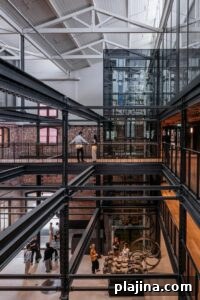
New architectural insertions are contemporary yet sympathetic to the heritage context. Glass lifts and external link bridges, suspended above the bluestone laneway, improve access and introduce kinetic visual interest. The original bluestone cobbles were individually lifted, planed and re-laid to provide a smoother, more accessible surface for wheelchairs, prams, walking aids and bicycles.
Multiple curated entry points create strong connections between public and private spaces and encourage active use. A centrally located town square serves as the precinct’s civic heart, offering light-filled seating and gathering space that links directly to the newly activated rail corridor—a shared landscape for pedestrians and cyclists.
© Trevor Mein
Material reuse across the project delivered an 84 percent reduction in embodied carbon compared with similar new construction. The development also includes rooftop solar with battery storage to offset electrical demand, helping reduce operational emissions.
Sustainability measures extend to water efficiency: a rainwater collection tank supports landscape irrigation and toilet flushing, while efficient fixtures and fittings reduce potable water use by about 25 percent compared with a typical reference building.
The civic legacy of the Younghusband Woolstore Redevelopment is its successful conversion of a historic industrial complex into a vibrant, inclusive neighborhood that celebrates community, heritage and sustainability. By preserving and adaptively reusing the Woolstore buildings, the project reinforces Melbourne’s cultural identity while ensuring these places remain accessible and relevant for future generations.