
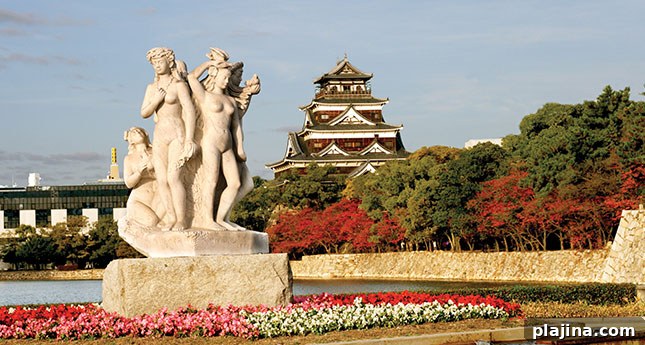
Hiroshima. The name evokes a tragic chapter in history—the first city to suffer an atomic bombing—yet today Hiroshima is a vibrant, modern city of about 2 million people known for its commitment to peace, its culinary specialties and a range of attractive sights.
Hiroshima was founded in 1589 when the daimyõ Mōri Terumoto selected a site on the delta of the Ōta River—formerly Gokamura, or “Five Villages”—to build a castle. The castle was finished shortly afterward, but Terumoto’s tenure was brief: after choosing the losing side at the Battle of Sekigahara in 1600 he lost his holdings. By 1619, samurai Asano Nagaakira became lord of the domain, and under the Asano family the city prospered with relatively little conflict until the feudal system was abolished in the late 19th century.
With the Meiji Restoration, the imperial government replaced shogunal rule and rapid modernization followed. Hiroshima developed industry, including cotton mills, and became home to one of the government-authorized English-language schools. As the city’s economic importance grew so did its military role. Hiroshima’s position on the Seto Inland Sea and the arrival of rail service in 1894 made it an important logistics and supply center during the First Sino-Japanese War, and the emperor even resided at Hiroshima Castle for a time. The city’s industrial base expanded again during the Russo-Japanese War of 1904–05, and by the 1930s the region contributed troops and materiel during Japan’s campaigns in mainland Asia. During World War II many military units were based in Hiroshima and its port served strategic purposes.
On Aug. 6, 1945, an atomic bomb was detonated over Hiroshima. The blast and its immediate effects killed tens of thousands, and many more later succumbed to injuries and radiation-related illnesses. Recovery was further hindered when a typhoon struck the region a month after the bombing, causing additional deaths and damage.
Despite the devastation, Hiroshima rebuilt. The 1949 Hiroshima Peace Memorial City Construction Law provided resources and land for reconstruction, and planners laid out Peace Memorial Park as a central element of the city’s rebirth. Over time Hiroshima transformed into an international center for peace advocacy and nuclear disarmament. Institutions such as the Hiroshima Interpreters’ and Guides’ Association (established 1992) and the Hiroshima Peace Institute (founded 1998 as part of Hiroshima University) support conferences and research. The mayor of Hiroshima serves as president of Mayors for Peace and routinely expresses concern when nuclear tests occur worldwide. Today the city is both a living urban center and a global voice for a nuclear-free future.
Diversions
No visit to Hiroshima is complete without the Hiroshima Peace Memorial Museum (1–2 Nakajimama-cho, tel 81 82 242 7798). The museum’s exhibits document the events that led to war, the development and use of the atomic bomb, and the human consequences of the blast. Displays include photographs, artifacts and survivor testimonies; among the most poignant objects is a pocket watch stopped at 8:15 a.m., the moment of detonation. The museum carefully addresses Japan’s wartime actions while focusing on the importance of peace and nuclear abolition. From the museum, Peace Memorial Park stretches along a reflecting pool and past the ever-burning Peace Flame to the A-Bomb Dome, a UNESCO World Heritage site and one of the few structures left partially standing in the blast zone. The park also houses the Children’s Peace Monument, honoring Sadako Sasaki and the thousands of paper cranes sent from around the world in her memory, a moving symbol of hope.
Hiroshima Castle (21–1 Motomachi, Naka-ku, tel 81 82 221 7512), nicknamed “Carp Castle,” was destroyed in 1945 and rebuilt in 1958. Its museum explores the castle’s history and the region’s samurai past. Nearby, the Hiroshima Botanical Garden (495 Kurashige 3-chome, Saeki-ku, tel 81 82 922 3600) features six greenhouses with tropical plants and prized orchids; its cherry trees are popular in spring. Shukkeien Garden (2–11 Kaminobori-cho, tel 81 82 221 3620), commissioned by Asano Nagaakira in 1620, is the city’s largest traditional Japanese garden and offers a tranquil landscape of ponds, bridges and carefully arranged plantings.
The 14th-century Fudō-in Temple (3–4–9 Ushita-shin-machi, Higashi-ku, tel 81 82 221 6923) is Hiroshima’s oldest surviving building and its golden pavilion is designated a national treasure. The Hiroshima Museum of Art (3–2 Motomachi, Naka-ku, tel 81 82 223 2530) contains fine works by Impressionist masters including Cézanne, Manet, Renoir and Van Gogh.
One of Japan’s most celebrated scenic destinations lies a short ferry ride away: Miyajima Island, formally Itsukushima (tel 81 82 930 9141). The island’s UNESCO World Heritage shrine is famous for its large vermilion torii gate that seems to float at high tide and stand on exposed seabed at low tide. Miyajima offers hiking trails, botanical gardens, temples and a 13th-century five-story pagoda—enough to fill a full day of exploration.
Seafood is a highlight of Hiroshima’s cuisine. The city’s bay produces the majority of Japan’s oysters, yielding roughly 30,000 tons annually, and local restaurants serve them in many preparations. Another must-try is Hiroshima-style okonomiyaki: a layered pancake cooked on a large griddle with a thin wheat batter topped with cabbage, bean sprouts, green onion, pork, noodles and an egg, finished with a savory sauce and eaten with a small metal spatula and chopsticks. Pair it with local saké for an authentic taste of the region.
Lodging
ANA Crowne Plaza Hiroshima
Located within walking distance of Peace Park and shopping districts, this hotel is known for its welcoming service and contemporary style. 7–20 Nakamachi, Naka-ku, tel 81 82 241 1111, $$$
Grand Prince Hotel Hiroshima
Offering pleasant views of the nearby islands, the Grand Prince is popular with business travelers and couples. 23–1 Motoujina-Machi, tel 81 82 256 1111, $$$$
Rihga Royal Hotel Hiroshima
Adjacent to the Bus Centre where the airport shuttle arrives, this tall property provides comfortable rooms within easy walking distance of major sights. 6–78 Motomachi, Naka-ku, tel 81 82 502 1121, $$$
Dining
Kaki-den
Literally “oyster den,” Kaki-den is one of the city’s top spots for fresh oyster dishes. 2–8–24 Hikari-machi, tel 81 82 264 5968 $$
Kanawa
A houseboat-style restaurant on the water, Kanawa serves oysters and seafood and is known for cultivating its own shellfish even in the off season. Motoyasu River, at Heiwa-Ohashi Bridge, tel 81 82 241 7416 $$$
Nagata-ya Okonomiyaki
Just across a bridge from Peace Park, Nagata-ya is an ideal place to try Hiroshima-style okonomiyaki along with local saké. Omoishi Bldg. 1F, 1–7–19 Otemachi, Naka-ku, tel 81 82 247 0787 $$