
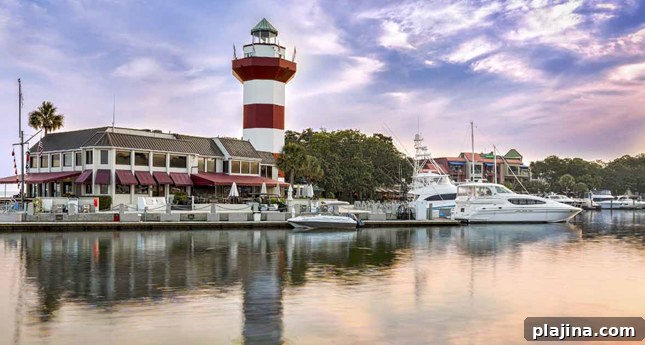
When English sea captain William Hilton landed in the Lowcountry in 1663, he found that Spanish explorers (as early as 1521) and French Huguenots from the 1560s had preceded him. By Hilton’s arrival the French had largely moved inland. The English crown began issuing land grants for the fertile coastal soil, and the plantation system took root on Hilton Head Island, South Carolina. After the Civil War reshaped the region, Hilton Head remained relatively isolated for nearly a century.
In the 1940s, lumbermen harvested the island’s abundant sea pines and established Sea Pines Resort, the first modern resort on the island. The arrival of air conditioning and the construction of a bridge to the mainland enabled developers to design and implement a master plan for a new type of resort community.
Today Hilton Head is home to roughly 39,000 residents and welcomes about 2.5 million visitors each year. The island is known for its environmentally conscious approach—no neon lights or oversized commercial signage—and a landscape where more than 20 golf courses have replaced former cotton fields. Visitors and locals enjoy 12 miles of pristine beach and a dining scene with about 250 restaurants. Many accommodations are organized within nine residential “plantations” that function similarly to homeowners’ associations.
Golf remains a major attraction: Hilton Head hosts the RBC Heritage tournament, the only PGA Tour stop in South Carolina. The island features world-class courses by noted designers such as Arnold Palmer, Pete Dye and Robert Trent Jones. Golf Digest readers consistently rank Hilton Head among the world’s premier golf destinations, although only about half of visitors play the game.
Beyond golf, the island offers a wide variety of outdoor activities: biking, hiking along nature trails, swimming and beachcombing, fishing and horseback riding. Eco-tourism has gained momentum, with new attractions like ZipLine Hilton Head drawing outdoor enthusiasts. For business travelers, 22 properties provide modern meeting and convention facilities. The island’s lodging inventory includes approximately 3,000 hotel rooms, 6,000 villas, 1,000 timeshare units and numerous bed-and-breakfast inns.
Recent years have seen nearly $200 million in development and renovation across the island. The Omni Hilton Head completed more than $17 million in upgrades encompassing 323 guestrooms and 20 oceanfront suites, along with 25,000 square feet of meeting space that includes the 7,000-square-foot open-air Shorehouse. The Hilton Head Marriott Resort & Spa, the largest full-service beachfront resort and conference facility on the island, finished a $12 million renovation of 513 guestrooms and meeting areas.
The Sonesta Resort invested about $30 million in renovations that added a new Arum Spa; the property offers over 22,000 square feet of meeting space and 340 guestrooms, including nine suites. The Sonesta is conveniently close to Coligny Plaza, a lively center with more than 60 dining, shopping and entertainment options. The Westin Hilton Head Island Resort & Spa completed a $30 million renovation, refreshing its 416 guestrooms and suites and adding the first Heavenly Spa by Westin in the United States, along with upgraded fitness facilities, golf and tennis amenities, and family-friendly programming.
Nearby in Bluffton, The Inn at Palmetto Bluff is expanding with more than $100 million in investments that will cover a 150-room hotel, spa and fitness facilities, expanded meeting space and new dining options. Closer to the beach, the Beach House recently completed a $5 million reinvention to update over 200 guestrooms, its Tiki Hut Bar and 6,000 square feet of meeting space; the property is within walking distance of Coligny Plaza.
Sea Pines—Hilton Head’s original resort community—continues to enhance its offerings. The Inn at Harbour Town, a 60-room, four-diamond property, provides intimate luxury and personal butler service. Sea Pines features three golf courses including Harbour Town Golf Links, home of the RBC Heritage. A new 19,000-square-foot clubhouse is scheduled to open in time for the tournament and will include expanded dining, locker and banquet facilities. The resort also includes Harbour Town Yacht Basin, five miles of Atlantic beach, upgraded meeting space and a new luxury pool.
The Sea Pines Beach Club recently opened a new facility that enhances the beach experience with improved dining and beverage options, meeting rooms and a rooftop bar connected by outdoor decks. The Sea Pines Plantation Golf Club now features a 23,000-square-foot clubhouse, including the 2,000-square-foot Magnolia Room and an additional 4,500 square feet of outdoor porch space overlooking the course.
Despite increasing investment and development, local leaders emphasize that Hilton Head has retained its character. Kelly Smith, a spokesperson for the local chamber of commerce, notes that while hotels, clubs and shopping centers have seen significant upgrades, the island remains committed to its low-profile aesthetic—no streetlights or neon signs and a focus on blending development with nature. The town has purchased land to serve as permanent green buffers and preserve the island’s natural environment.
Bluffton, just minutes over the bridge, offers a quieter, slower-paced glimpse of Carolina coastal life with farmers’ markets, art galleries, seafood fresh from the May River and seasonal festivals. Historic Savannah lies about an hour’s drive south and provides additional attractions such as picturesque squares, historic architecture and maritime museums while remaining close enough to return to Hilton Head by evening.
Daufuskie Island, accessible only by boat, preserves a simpler way of life reminiscent of Hilton Head before large-scale development. Popular with artists, golfers and outdoor enthusiasts seeking a quieter pace, Daufuskie offers time to relax before returning to the activity and amenities of Hilton Head Island.