It is a perfect day for a picnic, and I know just the spot. I’ve been in Helsinki a few days, long enough to assemble a scattering of favourite places around the city. One of them is Tervasaari, a small green island in the North Harbor connected to downtown by a manmade isthmus.
On the island’s southern shore, facing the Orthodox cathedral, a floating wooden platform holds four picnic tables. As I walk toward it with a rucksack bearing rolls, ham and cheese, my certainty falters. A woman in a bikini occupies one table. She is not lounging: she is pouring a bucket of soapy seawater onto a rug and scrubbing hard.
Not for the first time, I have misread Finland. What I thought were picnic tables are actually municipal cleaning facilities provided for residents to wash carpets and rugs during the summer. A short gangway connects the platform to the shore, where a mangle and a row of wooden drying frames await use.
Within weeks this sunlit platform will be surrounded by the ice of a frozen harbor, and the citizens who used it will be bundled inside their apartments, the faint salty scent from their freshly cleaned carpets the last reminder of these warm late-summer days.
Winter is the defining season in Helsinki. The robust, functional architecture is designed to withstand the annual Arctic blast. Five icebreakers lie moored in the harbor, ready for round-the-clock work as soon as the Gulf of Finland begins to freeze. Downtown shops are already clearing summer stock to make room for the latest thermal garments.
The historical imperative to prepare for the dark, freezing months has helped give Finland one of the highest standards of living in the world. Efficiency is not optional: communal survival depends on it, and Finns cooperate to make systems work smoothly for everyone.
This stoic practicality also helped Finns preserve a distinct cultural identity while under Swedish and Russian rule. Finland emerged as an independent republic in 1918 and, since then, has been as politically stable as the granite on which its capital rests.
Helsinki is a relatively young European capital, true to its label as the “daughter of the Baltic.” In 1812, during Russian rule, Czar Alexander I moved the capital from Turku to reduce Swedish influence.
Although it does not boast medieval layers, Helsinki has benefited from avoiding the tangled street patterns that complicate many older European cities. From the outset, the capital was laid out in an orderly grid.
At the heart of the city is Esplanadi Park, a leafy boulevard with clipped lawns and wide paths lined with benches. In Cold War years the esplanade was a popular meeting place for spies; today it is full of late-afternoon strollers. At the eastern end a Big Band plays Frank Sinatra classics while people linger in front of the bandstand, soaking up the relaxed atmosphere.
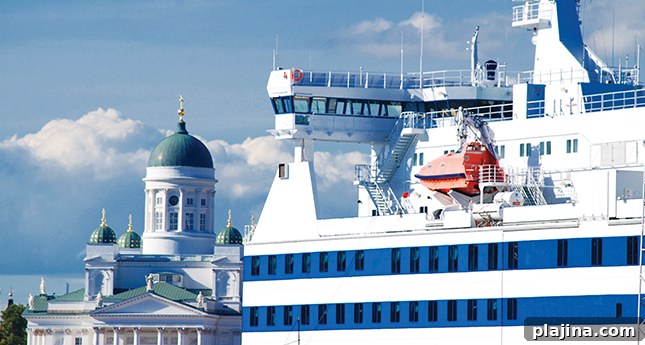
Helsinki’s strategic position, which once made it a center of intrigue, now places the city at the heart of the Baltic cruise scene. Esplanadi leads to the busy South Harbor, where cruise ships and ferries dwarf the nearby buildings.
While downtown remains deliberately low-rise, the broader metropolitan area includes Espoo, home to glass-and-steel headquarters for major companies, among them the Finnish telecommunications firm Nokia.
As I gain familiarity with the metropolitan geography and a sense of the city’s economic rhythms, one element remains baffling: the Finnish language.
Finland has two official languages: Swedish and Finnish. Swedish is a Germanic tongue similar to English, so many street signs and notices are readable at a glance. Finnish, however, is a Uralic language, utterly unlike anything I’ve encountered; its sounds and structures are dense and impenetrable to an outsider.
When the woman cleaning her rug notices me, she greets me in English. Through her I learn a little of everyday life in Helsinki — where she lives, what she does, and precisely how she cares for her carpets.
Just as I feel I’m tuning in to a new level of understanding, two newcomers arrive carrying rolled carpets. They begin speaking to the woman in Finnish; their conversation closes around them like winter fog, reminding me how much remains wonderfully, charmingly foreign.
DIVERSIONS
The Helsinki Card, available for 24, 48 or 72 hours, provides admission to many museums and attractions plus unlimited use of public transport. It can be purchased at the Central Railway Station or at the Helsinki Tourist Bureau near South Harbor.
From South Harbor, sightseeing cruises run through the archipelago that dots the city’s inner bay. The harbor is also the departure point for ferries to Helsinki Zoo and to the Suomenlinna Sea Fortress. The 18th- and 19th-century fortifications of Suomenlinna sprawl across six islands at the entrance to South Harbor and are a UNESCO World Heritage site, with a visitor centre, museums, restaurants and cafés.
Back on the mainland, once you’ve mastered the efficient tram network, all parts of Helsinki are within easy reach, and the compact centre is also very walkable. The Helsinki Tourist Bureau offers a concise English guide describing five walking routes. The de facto centre is Senate Square, where the city’s most recognisable landmark, Helsinki Cathedral, presides with five green domes and a restrained Lutheran interior. On summer evenings the cathedral’s steep steps are the ideal place to soak up the sun and watch city life unfold.
Overlooking the North and South harbors stands Uspenski Orthodox Cathedral; its incense-scented interior, rich with gilt-framed icons, contrasts strikingly with the Lutheran cathedral. Another standout is Temppeliaukio Church, carved into solid granite with a copper roof that suggests a flying saucer — an exceptional architectural experience.
The National Museum of Finland offers a thorough overview of the nation’s history. The Ateneum Art Museum and the Museum of Contemporary Art Kiasma are essential visits for anyone interested in Finnish art, past and present.
Info To GoInternational flights arrive at Helsinki–Vantaa Airport (HEL), about 10 miles north of downtown. While a metro extension to the airport has been planned for years, for the moment options include taxis or Finnair City Buses that connect the airport and central station at regular intervals. For practical travel details, consult the Helsinki Tourist Bureau. |
LodgingHotel FabianOpened in 2010, this stylish 58-room hotel sits in the Design District, a block from South Harbor. Fabianinkatu 7. $$$ Hotel GLO KluuviIn a superb central location, GLO Kluuvi offers contemporary, playful guestrooms with distinctive design touches. Kluuvikatu 4. $$$ Hotel KämpHelsinki’s historically prestigious address, the Kämp opened in 1887 and was restored to its former glory in the late 20th century. Pohjoisesplanadi 29. $$$$ |
DiningNamaskaar ExpressA no-frills spot offering fast, affordable and authentic Indian food—good value by Helsinki standards. Aleksanterinkatu 36 B. $$ Restaurant SaaristoOne of several island restaurants, Saaristo serves local favourites. Access is by boat from a pier beside the Olympic Terminal in South Harbor. Klippan Island. $$$$ Restaurant SavoyLong-established as a special-occasion venue since 1937, Savoy’s sumptuous interior was designed by Alvar Aalto. Eteläesplanadi 14. $$$$ |