As the mercury flirted with 100 degrees Fahrenheit and humidity hovered near saturation during our July stay in Hanoi, we walked past the long line of domestic tourists waiting to see Ho Chi Minh’s embalmed body in his mausoleum. We skipped the palace and instead visited the simple stilt house where he once lived. Just as the heat threatened to overwhelm us, we found a vendor selling coconut popsicles, handed to us by a man standing behind a napkin dispenser that read, “Work is glory. Happiness to everybody.”
While Ho Chi Minh City — still commonly called Saigon — is Vietnam’s commercial engine, Hanoi more readily seduces visitors. When I first came here in the late 1990s, bicycles outnumbered motorbikes; despite the city’s heavier traffic today, Hanoi remains human in scale and ideal for walking.
On this trip I returned with my wife and our 11-year-old daughter, who was seeing the chaos of Southeast Asia for the first time. Her favorite moment came on the overnight train from Hue: we took three of the four bunks in a first-class Livitrans compartment. She was thrilled to sleep in a bunk on a moving train; the teenage Vietnamese girl who occupied the fourth bunk seemed less excited, spending her time texting and chatting, perhaps resigned to three foreign roommates.
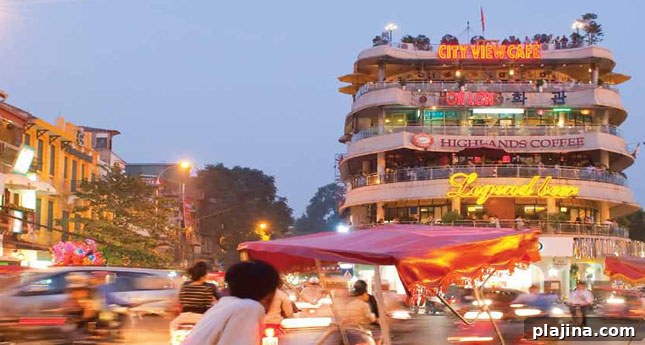
We headed straight for the Old Quarter on arrival. Hanoi’s main attraction is this compact neighborhood of colorful shops, twisting lanes and food stalls set up along sidewalks. Centered north of Hoàn Kiếm Lake — a shaded park with walkways and pagodas set in the water — the Old Quarter offers cheap, satisfying meals: spring rolls, pho bo and grilled seafood rarely cost more than a few dollars. Sit on a tiny plastic stool, point at what looks good and enjoy. Add a dollar for a beer, or even less for bia hơi, the local fresh draft beer.
Shopping is also concentrated in the Old Quarter. We browsed shops selling propaganda posters, hill-tribe handicrafts, silk clothing and playful T-shirts. The three-story Đồng Xuân Market caters more to locals, and the bustling Night Market that runs north from Hoàn Kiếm Lake is largely filled with inexpensive imported goods.
A must for families is the Thăng Long Water Puppet Theatre. Because shows often sell out, buying tickets early was our first errand. The small, air-conditioned theater provides good views from every seat, and the performances are enchanting. Rooted in village traditions, the skits portray harvest rituals and folk tales using puppets that move across a water stage, steered by puppeteers hidden behind a partition. People, farm animals and dragons come to life, accompanied by a live band playing traditional instruments.
On the way out we admired puppets displayed in the theater hallways and saw the wooden contraptions used to control them. Handcrafted and visually expressive from a distance, the figures range from infants cradled by mothers to large oxen and horses.
The Vietnam Museum of Ethnology also highlights water puppetry, though shows are less frequent there. This mix of indoor and outdoor exhibits explains the lives of the country’s 54 ethnic groups through costumes, interiors, handicrafts, tools and even a reconstructed Muong funeral scene. Videos show local dances and festivals alongside the costumes on display. One memorable exhibit featured a bicycle laden with 200 fishing traps and baskets, recreating the daily gear a fisherman would carry to his favored spot.
The museum’s outdoor section presents scaled homes and buildings built from the same materials used in their native regions. A water-puppet stage stands beside a Tây house with slatted bamboo floors—sweep and the dirt drops through the gaps. A Bahnar communal house rises nearly 60 feet with its sloping thatch roof.
“Yay!” our daughter exclaimed when we told her she could climb the notched logs into some of the houses and explore. She was less comfortable, however, with the Giarai tomb house’s fertility carvings: statues depicting copulating couples, pregnant women and men with erect features meant to symbolize birth and continuity.
Some Americans remain concerned about the legacy of the conflict Americans call the Vietnam War and Vietnamese call the American War. In truth, most people in Vietnam today are too young to remember those events firsthand; for many, it’s a chapter in a history book rather than a living memory.
With Cold War tensions long past, Hanoi now feels thoroughly modern. You still see the occasional propaganda poster and a Lenin Park, and some cafés use proxy servers to let customers reach blocked sites, but capitalism dominates the streets. Shops are rarely empty, goods spill onto sidewalks and vendors claim every available inch. The safest way to cross a busy avenue is a steady, calm shuffle, letting the stream of motorbikes part around you like a current.
Motorbikes are everywhere, perhaps as common as cellphones. Hundreds can be parked outside office buildings, and riders use them as seats, tables or even places to nap. Kem Tràng Tiền, a beloved local ice cream spot, resembles a motorbike parking lot more than a café: patrons park their rides on the ground floor near the Opera House and eat while standing beside their bikes.
Escaping the engine din is not easy, but Hanoi has peaceful pockets. We explored the five courtyards of the Temple of Literature, founded in the 11th century as Vietnam’s first university. With incense-smudged Confucian altars and rectangular ponds dotted with lily pads, the temple is a calm refuge from the city’s clamor.
Another quiet discovery came after we rented a swan-shaped paddleboat on West Lake. Following the shoreline led us to Trấn Quốc Pagoda, which stands on a small island and was originally constructed in the sixth century before being moved to its current site. Inside the pagoda complex it was easy to forget we were in a sprawling modern metropolis. But the city’s appetite for food brings us back to reality: lunchtime meant tasting another of the hundreds of Vietnamese dishes awaiting exploration.
Water puppets © Ina Van Hateren | Dreamstime.com
Info to Go
Hanoi International Airport (HAN) lies about 28 miles from the city center; travel time to central hotels is roughly an hour. To avoid taxi scams, arrange a hotel transfer in advance or use the prepaid car service inside the terminal. Driving in Hanoi is not recommended; local taxis are inexpensive and convenient, typically costing $2–5 per ride.
Lodging
Hotel de L’Opéra Part of Accor’s M Gallery, this chic modern option sits across from the historic Opera House and offers pool views. 29 Tràng Tiền St., Hoàn Kiếm District.
Hotel Sofitel Legend Metropole The city’s most prestigious address since 1901, known for refined service, elegant dining and luxurious accommodations. 15 Ngô Quyền St., Hoàn Kiếm District.
InterContinental Hanoi Westlake Set on a large lake west of the center, this sizeable business hotel provides a quieter location and lake-view rooms. 1A Nghi Tàm, Tây Hồ District.
Dining
Le Beaulieu Restaurant Located in the Sofitel Legend Metropole, this classic French restaurant is known for refined cuisine and an extensive wine list.
Highway4 With several Hanoi locations, Highway4 serves inventive northern Vietnamese dishes and small tastings of local Son Tinh rice liquors. Original location: 5 Hàng Tre, Hoàn Kiếm District.
Quán Ăn Ngon A popular sit-down spot offering a broad selection of Vietnamese street foods prepared in open kitchens. 18 Phan Bội Châu, Hoàn Kiếm District.