Human beings walking on water belongs to parable and myth more than daily life, yet at West Lake in Hangzhou the effect feels real. On warm, humid nights, elaborately costumed actors glide across a mirror-still lake from barely submerged barges and platforms as soft spotlights reveal their silhouettes. Hidden speakers fill the air with the celestial music of Japanese composer Kitaro, while spectators in bleachers record the scene with softly glowing smartphones. The result is delicate, beautiful and otherworldly.
This nightly, year-round spectacle is called “Impression West Lake,” an hour-long dramatic retelling of a legendary Chinese tale of love and loss created by Zhang Yimou, the director best known internationally for the 2008 Beijing Olympic ceremonies. The production reveals as much about Hangzhou (pronounced hung-joe) as it does about storytelling: an ancient city where tradition and modern life weave together.
Hangzhou, a city of about 6.8 million in eastern China roughly 110 miles from Shanghai, has long been celebrated by poets and painters. While recent suburban growth has added faux-French chateaus, neo-Tuscan villas and high-rise apartment towers, the historic core around West Lake (Xi Hu) retains the feel of a treasured garden city.
From a lake-view room at the Shangri-La Hotel, daytime vistas are lovely except on hazy days. Couples stroll beneath weeping willows while pleasure craft cross tranquil waters. Beyond West Lake, terraced tea plantations blanket rolling hills and misty mountains frame scenes that resemble classical Chinese landscape paintings. The Shangri-La, dating from 1956 and frequently renovated, was a favorite of the late Premier Zhou Enlai and remains popular with government officials. On one visit I was moved from the modern wing to the heritage wing while a diplomatic meeting occupied the newer rooms; stand-in security and discreet official activity were reminders that this city still hosts important national life.
Hangzhou swells with domestic tourists in spring and summer, drawn by its historic sites and subtropical greenery; international visitors tend to be mostly Japanese, with relatively few Western tourists, which enhances a visitor’s sense of discovery. West Lake itself is crossed by causeways and pedestrian bridges, some dating back 800 years to the Southern Song Dynasty (1127–1279). The longest causeway extends more than a mile into the lake.
Locals favor the lake for many pursuits: recreational boating, school outings, quiet moments for lovers, early-morning tai chi, and garden appreciation. Nearly all the land ringing the lake is public park with traditional Chinese landscaping—meticulously pruned trees and shrubs, quiet pools, stone statuary and pagodas. The park includes sights such as the Peony Pavilion and the restored house of scholar Ma Yi Fu, now a museum displaying his books, clothes and furniture with bilingual explanations. Nearby sits Villa No. 1, the restored villa where Mao Zedong spent time during his visits to Hangzhou.
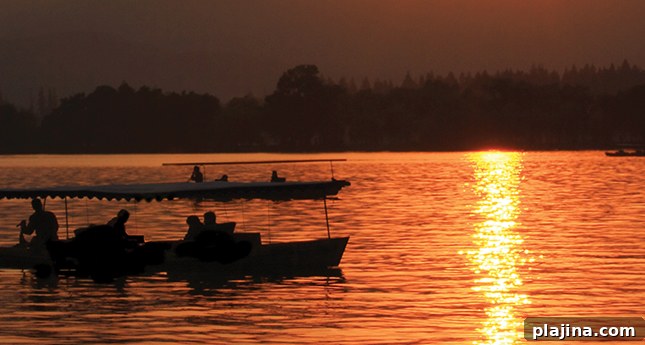
To best enjoy West Lake, take to the water. Boats range from two-person rowboats to decorated ferries that circle islets and scenic spots with evocative names: Lotus in the Breeze at Crooked Courtyard, Three Pools Mirroring the Moon, and Breeze-ruffled Lotus at Quyuan Garden. A slow circuit of the lake takes about an hour—unhurried, peaceful and refreshingly low-key.
Compared with Beijing’s imperial grandeur, Shanghai’s dazzling modernity or Hong Kong’s frenetic retail energy, Hangzhou’s appeal is subtler: slower, more reflective, steeped in tradition. International chains have imported a taste for coffee to a tea-centered culture, but green tea remains the local preference. Hangzhou is famous for producing some of China’s finest green tea—especially Dragon Well (Longjing)—grown on small family plots west of the city around villages such as Mei Jia Wu and Longjing, which hosts the China National Tea Museum. The museum is unassuming and informative, surrounded by terraced plantations where visitors can witness tea ceremonies and sample freshly brewed tea.
Hangzhou is also a major center of silk production. Shops sell silk purses, scarves and ties, and Hangzhou Silk City features hundreds of silk stores. The China National Silk Museum, opened in 1992, presents the history of silk-making, the Silk Road trade, and even live silkworms feeding on mulberry leaves.
Eating well is one of Hangzhou’s pleasures. Teahouses that once were private villas line West Lake and often incorporate tea into cooking. Local specialties include beggar’s chicken baked in clay, West Lake fish dressed in vinegar, and fried shrimp prepared with tea leaves believed to absorb oil and aid digestion. Snack streets add another layer of flavor to local life: He Fang Jie near Wu Shan Square is a bustling example where affordable Hangzhou treats, teahouses, antique stalls and traditional medicine shops line the street. Travelers should be aware that street sanitation standards vary; locals usually eat without issue, while visitors from countries with stricter food-safety norms may prefer dining in established restaurants or hotel venues.
For shopping and strolling, Wulin Road offers apparel and modern retail, while the preserved Qing He Fang Old Street invites a walk back through history with its traditional architecture and shops.
Info to Go
Hangzhou is easy to reach from major Chinese cities and Japan. The most convenient option is the non-stop bullet train between Shanghai South Station and Hangzhou Station, which takes about 78 minutes. Hangzhou Xiaoshan International Airport (HGH) lies roughly 17 miles from the city center, with taxi fares around $12 one way. Infrastructure upgrades have been underway to expand runways and terminals.
Diversions
Dragon Well tea has several harvests each year, but spring yields the finest leaves. Handpicked and hand-roasted, unfermented Dragon Well spring tea is prized for its long, delicate leaves and a fresh, slightly grassy flavor. Hotel lobbies sometimes feature artisan tea demonstrations, but a visit to nearby plantations offers deeper context.
On a countryside visit I met a family of tea growers who shared their farm and traditions. Their homes were substantial multi-story houses housing three generations, and about ten families worked the terraced fields. Tea pickers in conical hats bent to tend short, pruned tea bushes while free-range chickens pecked among the rows; the farmers explained that the chickens help by eating insects that could harm the plants.
Watching the hand-drying process—carefully moving leaves around a heated metal wok—brings home how much labor goes into each cup. Freshly brewed tea at the farm, prepared over a small stove fueled by twigs and leaves, tastes particularly memorable. Local brewing practice often involves rinsing and warming vessels before the cup that is meant to be enjoyed; tasting tea at its place of origin is both a sensory and cultural highlight.
Lodging
Four Seasons Hotel Hangzhou at West Lake
A lakeside 5-star hotel that opened in late 2010 with 78 guestrooms and suites. 5 Lingyin Road, tel 86 571 8829 8888.
JW Marriott Hangzhou
A downtown business hotel and high-rise opened in late 2010, offering an indoor pool and 24-hour fitness center. 28 Hushu South Road, Gongshu District, tel 86 571 8578 8888.
Shangri-La Hotel, Hangzhou
A lush West Lake retreat with extensive gardens, an indoor pool and an updated executive lounge. 78 Beishan Road, tel 86 571 8797 7951.
Dining
Lou Wai Lou Restaurant
A long-standing favorite established 163 years ago, known for Hangzhou and West Lake fish and chicken dishes, located at Solitary Hill on West Lake. 30 Gu Shan Lu, tel 86 571 8799 7416.
Shang Palace
Traditional Cantonese cuisine complemented by Hangzhou specialties, located in the Shangri-La Hotel. 78 Beishan Road, tel 86 571 8797 7951 ext 21.
Zhi Wei Guan
A lively multi-story restaurant with affordable options on the ground floor and higher-end choices above. 83 Ren He Lu, tel 86 571 8797 0568.