
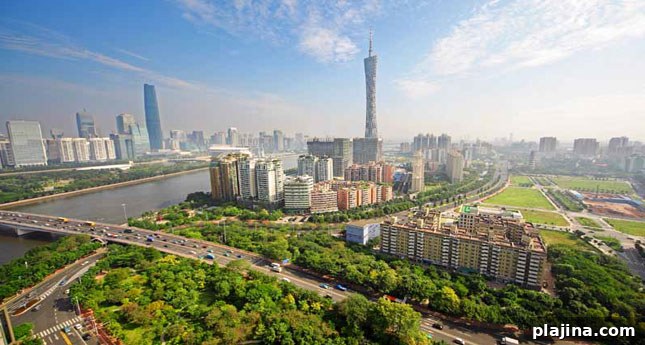
When the Moroccan traveler Ibn Battuta arrived in Guangzhou in the 14th century, the city was already evolving from an ancient port into a bustling manufacturing center. The large ships he described, built for voyages across the South China Sea, were an early sign of the trading and production activity that would later earn the Pearl River Delta city the nickname “the world’s workshop.”
Over the past century Guangzhou experienced rapid industrialization and urban growth, which brought both economic opportunity and environmental and social challenges: informal housing, hastily constructed buildings and significant pollution. As the city increasingly targeted tourism and international events, municipal leaders launched programs to improve the urban environment and public infrastructure.
Preparing to host the 2010 Asian Games, Guangzhou invested more than $1.7 billion in cleaning the Pearl River and its tributaries, long affected by lax industrial controls. Authorities tightened air pollution regulations and created a green belt along the Jiaomen River—an estuary of the Pearl River—adding roughly 15 miles of walking and cycling paths in Nansha District.
Urban policy changes included restrictions on motorcycles in central districts and incentives for cleaner vehicles; today Guangzhou has one of the largest fleets of LPG-fueled vehicles in the world. Rapid transit expansion raised the number of subway lines to eight, with plans to double lines and track length by the decade’s end. The Guangzhou Bus Rapid Transit System, launched in 2010, now carries some 800,000 passengers daily in a city of around 13 million.
Visitors outside the entrance of the Canton Trade Fair, Pazhou Complex © Pindiyath100 | Dreamstime.com
A major driver of Guangzhou’s attention to tourism and international business is the Canton Trade Fair, which attracts more than half a million foreign business visitors annually. Held each April and October at the Pazhou Complex, the trade fair—now in its sixth decade—hosts roughly 24,000 exhibitors and draws buyers from around the world.
The Canton Trade Fair is China’s largest comprehensive trade event, featuring the widest range of products, the highest attendance and a substantial volume of trade deals. Hundreds of national and regional trade delegations participate, and the fair contributes nearly $5 billion a year to Guangzhou’s economy. During fair weeks hotel occupancy often reaches capacity and rates for rooms and services rise sharply.
With the largest comprehensive port in South China and the world’s fifth-largest port by volume, Guangzhou’s global trade connections underpin its status as a Beta-level world city. High-speed rail links connect the city to Shenzhen and Hong Kong, and a recent route to Wuhan covers roughly 608 miles at an average speed that dramatically shortens travel time between the Pearl River Delta and central China.
Financial district © Liufu Yu | Dreamstime.com
Guangzhou has also pushed to become a regional financial center. Changdi Road, once the city’s bankers’ row, was revitalized in 2012 with the opening of Bund Financial Street, a half-mile avenue housing more than 30 financial firms specializing in securities, investment and venture capital. This development is part of a broader plan to increase the finance sector’s contribution to the city’s GDP.
One of the most ambitious projects under development is the Sino-Singapore Guangzhou Knowledge City (SSGKC), a collaboration between Guangdong authorities and the Singapore government. Covering about 47 square miles roughly 15 miles from Guangzhou Baiyun International Airport, the knowledge city aims to shift the regional economy from labor-intensive manufacturing to knowledge-intensive sectors. Initial investments prioritize information and communication technology, creative industries, science and education services, biotechnology and pharmaceuticals.
When complete, SSGKC is expected to host a resident population of around 500,000 and serve more than 2 million people in surrounding areas. Planned amenities include advanced healthcare facilities and a cancer research center affiliated with Sun Yat-sen University. The development supports Guangzhou’s strategy to move from low-cost manufacturing toward higher-value production and innovation.
Things to Do in Guangzhou
Shamian Island offers a tranquil walk through a leafy enclave shaped by 19th-century foreign trade. Once designated for British and French merchants after the First Opium War, the restored colonial mansions, tree-lined lanes, teahouses and small parks create a pleasant setting for a morning stroll.
A 19th-century Western-style building, Shamian Island © Jianhua Liang | Dreamstime.com
Ersha Island, another river island, is home to the Guangdong Museum of Art, which exhibits important regional paintings and sculptures. Shangxiajiu Pedestrian Street, north of Shamian Island, preserves arcade-style shops from the 1920s and is a lively place to shop for souvenirs and local specialties. Xiguan Antique Street remains a favored market for antiques and decorative objects, while the Bahe Academy area reflects Guangzhou’s historical role as a commercial and cultural hub.
The Chen Clan Ancestral Hall, a fine example of Lingnan architecture built in 1894, features ornate courtyards, stone carving and ceramic art. Another archaeological highlight is the Mausoleum of the Nanyue King, discovered in 1983; the well-preserved tomb dates back two millennia and contains remarkable funerary artifacts.
For modern panoramas, visit Canton Tower. The 108-story TV tower is one of the city’s tallest landmarks, illuminated in vibrant colors at night and offering dramatic views from its observation platforms. Across the river in Zhujiang New Town, the Guangzhou Opera House—designed by architect Zaha Hadid—and the nearby Guangdong Provincial Museum provide cultural and architectural highlights. An evening Pearl River dinner cruise presents the city’s illuminated skyline and is a popular way to close a day of sightseeing.
Checking in with Grace Lau
General Manager, Hilton Guangzhou Tianhe
What advantages does the Hilton Guangzhou Tianhe offer business travelers?
Located in Guangzhou’s Central Business District, the Hilton Guangzhou Tianhe offers contemporary design, efficient service and well-equipped meeting facilities. The hotel’s restaurants and bars, along with ample workspace and expansive city views, make it a preferred option for both business and leisure visitors.
What do you recommend visitors see and do in Guangzhou?
Guangzhou is renowned for its culinary culture. A must-experience is yum cha and dim sum: yum cha refers to the social ritual of morning tea, often accompanied by a wide variety of small dim sum dishes. Traditional yum cha venues offer many different dim sum items daily, reflecting the city’s deep culinary traditions.
How do you expect Guangzhou to grow and change in the next few years?
Major industry sectors include electronics, automobile manufacturing and petrochemicals. Regional transport integration between Guangzhou, Foshan and Zhaoqing is expected to create a large economic zone, supporting continued modernization. Air connectivity has expanded, and several international routes are increasing service from Guangzhou, reflecting growing demand from business and leisure travelers.
Guangzhou Opera House © Li Wenzheng | Dreamstime.com
Guangzhou: Just the Facts
Time Zone: GMT +8
Phone Code: Country code 86, city code 20
Currency: Renminbi (yuan)
Entry/Exit Requirements: U.S. citizens must obtain a visa to enter China; one-month tourist and business visas are commonly available before travel.
Official Language: Mandarin; Cantonese is widely spoken locally.
Key Industries: Automobiles, electronics, finance, garments, international trade, manufacturing, pharmaceuticals, textiles and shipping.
Info to Go Guangzhou
Guangzhou Baiyun International Airport lies about 17 miles from downtown. A taxi ride costs roughly $20—insist the meter be used. Metro Line 3 links the airport to the city center in about 50 minutes for a low fare; airport express buses also serve major hotels. High-speed trains to Shenzhen (about one hour) and Hong Kong (around 90 minutes) depart frequently from Guangzhou East Station.
Where to stay in Guangzhou
Hilton Guangzhou Tianhe Ample workspaces and city views make this Central Business District hotel a favorite among executives. 215 Linhe Xi Heng Lu, Tianhe District $$$
The Ritz-Carlton, Guangzhou Luxury accommodations and a full-service spa near the Guangzhou International Convention and Exhibition Center. 3 Xing’an Lu, Pearl River New City, Tianhe District $$$$
The Westin Guangzhou Contemporary guestrooms and business-friendly amenities adjacent to major office towers. 6 Lin He Zhong Lu, Tianhe District $$$
Restaurants in Guangzhou
Panxi Famous for dim sum served in a garden setting beside Liwan Lake. 151 Longjin Xi Lu, Liwan District $$–$$$$
Il Ponte Italian cuisine and an open kitchen located in the Hilton Guangzhou Tianhe. 215 Linhe Xi Heng Lu, Tianhe District $$$–$$$$
Summer Palace Elegant Cantonese dining with private rooms at the Shangri-La Hotel Guangzhou. 1 Hui Zhan Dong Lu, Hai Zhu District $$$–$$$$
Read more about Cantonese cuisine.