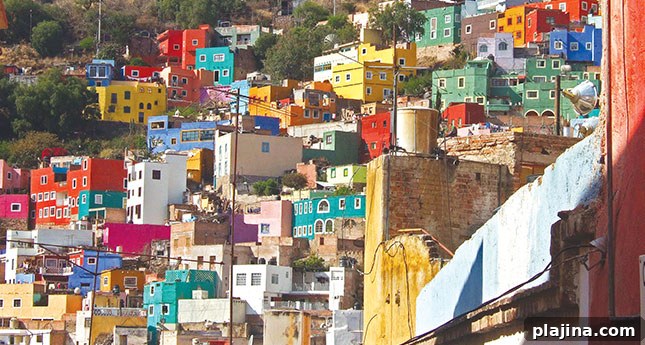
When I first arrive in Guanajuato, I feel compelled to climb to the ridge above the city and take in the panorama of winding streets and alleys that seem to avoid straight lines. To acclimate to the altitude, I buy a ticket for the funicular that climbs the steep slope to the massive stone statue of El Pípila, a local hero celebrated for his role against Spanish rule in this hotbed of revolutionary activity.
Over the years Guanajuato has earned other distinctions: it is the birthplace of painter Diego Rivera, the hometown of former president Vicente Fox, a vibrant college center and the site of a major annual arts festival. What draws me most, though, is the cool mountain climate and the pedestrian-friendly atmosphere of this UNESCO World Heritage city.
After admiring the colorful houses clinging to the hills and the grand churches clustered near the center, I descend on foot through a maze of alleys and stairways, occasionally glimpsing inside a home as someone passes. Apart from the occasional barking dog, my walk is peaceful. Much of the automobile traffic runs beneath the city through a network of tunnels originally built to divert floodwaters and later expanded so the streets above could retain their historic dimensions.
This is not a city of sedentary, car-loving residents. It’s common to see people in every plaza eating ice cream or a street snack, yet daily life here guarantees exercise: carrying home purchases from the butcher or the tortilla shop involves climbing steps and ramps. Each morning I hear the calls of the water vendor shouting “¡Agua!” and the propane deliveryman calling “¡Gas!” as they haul containers and tanks up stairways with handcarts.
City planners have built on the natural advantages of the terrain and the elegant architecture to enhance the city’s charm. Ornate iron benches and potted shrubs fill even the smallest plazas, terra-cotta pots of geraniums line stairways and ramps leading to the tunnels, and street signs mounted on building facades are often carved from stone or glazed clay.
In the evenings the main Jardín de la Unión comes alive. A band plays in the gazebo—salsa, chamber music or even Sousa marches performed by brass and flute ensembles. At night a troupe of students dressed in the attire of 17th-century Spain parades through the streets and alleys, performing minstrel music and telling jokes for a crowd that pays to join the revelry.
One evening I dine outdoors with Tony Cohan, a novelist and travel writer who lives locally and has written several books about Mexico. “This is a great city for a writer,” he says. “There are interesting scenes and characters almost everywhere you look.”
At first I’m puzzled by the T-shirts in the shops—many display frogs, while others show Don Quixote and Sancho Panza. The town’s original name, Quanax-juato, meant “the place of frogs.” The literary figures reflect the annual Cervantino festival held each October in honor of Miguel de Cervantes, often called the world’s first novelist. Although I’m not here during the festival, I visit the Don Quixote Museum and am struck by the diverse works inspired by a single novel: abstract pieces by Mexican artists, a surrealist painting by Salvador Dalí and a print reminiscent of Picasso.
The Museo de las Momias, or Mummy Museum, is the other major attraction. Guanajuato’s mummies differ from the linen-wrapped remains of Egypt; here, bodies were sometimes exhumed when families could not pay a burial tax, and local soil conditions led to remarkable natural preservation. The result is a chilling but fascinating display of bodies whose skin and features remain intact.
The minerals in Guanajuato’s soil did more than preserve its dead—they created the city’s wealth. Roughly half a century before Jamestown, silver mining began here and thrived for about three centuries, providing a substantial share of the Spanish crown’s riches. I don a hard hat and, guided through the shafts of the old Valenciana Mine—one of history’s richest silver finds—get a vivid sense of the brutal labor required. My guide speaks only Spanish, but his descriptions and the dim, cramped passages convey the harsh reality: indigenous miners worked by hand without modern safety measures or lighting, and many who began in adolescence did not live long lives.
The ornate Templo de la Valenciana next to the mines is tied to a local legend: the Spanish mine owner supposedly promised Saint Cayetano that if God made him wealthy, he would build a magnificent church. The gilded Baroque church, completed in 1778, is the monument to that pledge. Its gold-laminated altar, vast original oil paintings and intricately carved gilded woodwork testify to the enormous resources and craftsmanship poured into the building.
On my final night, everything seems to come together. I enjoy enchiladas and a Negra Modelo beer at a café facing the Basilica—the city’s centerpiece church completed in 1796. I stroll past the 19th-century Teatro Juárez and, to my surprise, catch a guest performance by a U.S. children’s choir in the splendid auditorium. The hall’s acoustics are magnificent. As I return to the apartment I’ve been renting, I pass the same street accordion player I’ve encountered every night. Feeling a twinge of sadness about leaving, I drop my remaining coins into the cup held by his wife and climb a few steep alleyways.
I didn’t spot a single frog during my stay, but as I pack my bag I tuck in one new item: an English translation of Don Quixote de la Mancha, a fitting souvenir from a city that celebrates literature, music and a lively public life.