
At the port of Piraeus in Athens, we boarded a privately chartered 25‑cabin yacht that would be our home for the next ten days. Built in Greece, the vessel is designed to cruise the Mediterranean under motor power or with the wind filling her dusky red sails. Compact enough to slip into small harbors, she is a sleek, dark‑blue craft with burnished wooden railings and three tall masts.
More than 6,000 islands—227 inhabited—dot the azure waters off Greece’s coast. We were bound for the Cyclades, a dense cluster of islands in the Aegean Sea. The islands form a rough circle around Delos, a place steeped in myth: according to legend, Poseidon punished the Cycladic nymphs by turning them to stone. Because of their central location in the Mediterranean, the Cyclades were important centers of ancient Greek civilization.
Paros streets © Olivier Meerson | Dreamstime.com
Our first stop was Paros, an island once favored by Lord Byron and, more recently, home to a vacation house owned by Tom Hanks on nearby Antiparos. The waterfront is lined with shops, bars and eateries, their colorful awnings flapping in the sea breeze. In summer the outdoor cafés fill with windsurfers and kiteboarders attracted by the island’s strong winds and big waves. White houses climb the hillside amphitheater‑style, all sharing the idyllic harbor view. We climbed to a clock tower we had seen from the ship, following a maze of stone steps and paths past white‑walled courtyards. Well‑fed cats dozed in shaded nooks while bees buzzed around a mulberry tree, dropping juicy fruit onto the whitewashed cobbles.
That evening we were invited to dine with locals. Our hosts chatted in Greek as they piled plates with chicken in tangy tomato sauce, thick bread, rich pasta, cheeses made from goat’s milk and fresh eggs. Dessert was a luscious, nutty baklava. Open windows let the evening breeze into rooms furnished with heavy carved pieces and walls hung with religious icons and dark paintings—an intimate, traditional setting.
The next morning we sailed for Milos, a horseshoe‑shaped island with terraced gardens on its hillsides. In the countryside we descended into shadowy catacombs where first‑century Christians were laid to rest. A winding trail led to a well‑preserved Roman amphitheater with a magnificent sea view. Nearby a small sign marks the spot where a farmer discovered the Venus de Milo (Aphrodite of Milos). Like many Greek treasures, the famous statue now resides in the Louvre; a replica stands in the island’s modest archaeological museum.
Milos is known for more than 80 beaches, many of them secluded. After a taverna lunch, four of us took a taxi to Sarakiniko, a former Saracen pirate hideout. Cresting a hill along a smooth stone path, we paused to take in a coastline sculpted by the sea into a moonscape of rounded boulders and fragile pillars ready to topple.
A path wound down a 100‑foot cliff to a tiny cove where the ocean pulsed through a keyhole into a sheltered pool—our private swimming spot for the afternoon. We swam and sunned, then explored bluffs streaked with black obsidian and pitted with blowholes that sprayed seawater. Ancient iron mooring rings remain embedded in the cliffs near a labyrinth of pirate caves.
From there we sailed to Folegandros, one of the smaller Cycladic islands. It lies off the main tourist trails and has become a retreat for couples and artists seeking privacy. Only about 750 people—mostly fishermen and their families—live on the island. Beaches are isolated and the locals are welcoming. Perched on a ledge 656 feet above sea level sits Chora, a medieval town that once served as a fortress. It’s one of the loveliest villages we visited: spotless white buildings and courtyards trimmed in turquoise and draped in bougainvillea.
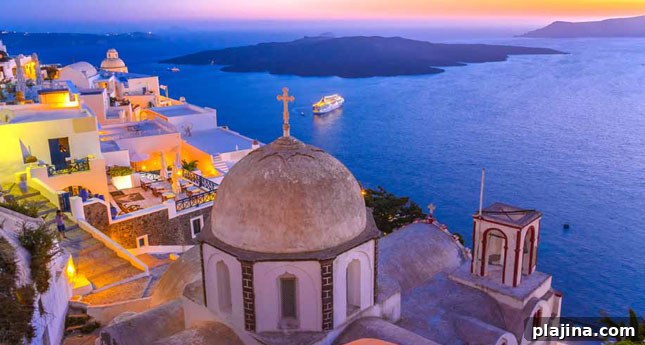
Everyone knows Santoríni, and it lives up to its reputation. In the 17th century B.C. a volcanic eruption blasted away the island’s center, leaving a deep caldera. Our ship motored into the picturesque harbor among yachts and small craft. Rising from the water’s edge was a 980‑foot cliff punctuated with bright blue doors and cave houses. We reached the summit by funicular, avoiding the mule ride or the steep staircase.
Clinging to the bluff edge is the village of Fira, a cluster of whitewashed houses and shops selling fine jewelry. On the northern tip lies Oia, the old town famous for cave houses and churches topped with blue domes.
Across Santoríni’s countryside, vineyards grow with vines trained low and woven into basket shapes to shield them from harsh winds. Rainfall is scarce, but the volcanic soil absorbs moisture from the air, producing wines with a distinctive character. We sampled several varieties at the Boutari Winery, noted for its Vinsanto dessert wine.
Naxos, the largest and most fertile of the Cyclades, claims mythological ties: it is said to be the birthplace of Dionysus, the god of wine. Today Naxos produces excellent wine along with vegetables and dairy products. The island supplied marble for the kouros statues now in the Athens Archaeological Museum. Naxos is dotted with charming villages and old churches—more than 40 small towns, each with a central square where locals still gather in traditional dress.
Octopi drying in the sun, Naxos © Ivan Jelisavcic | Dreamstime.com
Not far from Naxos is Delos, the legendary birthplace of Apollo and Artemis. Once a major religious center and later an important Roman port, Delos is now uninhabited. Walking the island feels both fascinating and haunting: 5,000 years of history lie exposed in markets, fountains, towers and temple ruins as far as the eye can see. A UNESCO World Cultural Heritage site, Delos attracts crowds by day and only a few guardians and archaeologists after sundown.
By contrast, Mykonos is vibrant and energetic, especially in summer when international visitors flock to its nightlife. Fewer than 11,000 people live on the island year‑round, but thousands arrive to party, shop, sunbathe and explore Mykonos Town. Highlights include the Venetian windmills and Little Venice, where houses and cafés perch over the sea.
A brewing storm kept us from berthing in Mykonos, so the captain steered west to Aegina, a short distance from Athens favored by residents with summer homes and private yachts. Approaching the island, we could see the Temple of Aphaia on a high promontory. Several shrines occupied the site over time, the latest dating to the fifth century B.C. The temple sits roughly equidistant from the Parthenon and the Temple of Poseidon at Sounion—a deliberate triangle planned by ancient builders. Most of the site’s 32 Doric columns remain; the sculptures that once adorned it are housed in Munich’s Glyptothek.
The next morning we would head to Athens International Airport for our flight home, but the evening remained and we made our way to a taverna on the harbor. At a nearby seafood restaurant, fresh octopi dangled in the breeze like banners—a scene evocative of Zorba the Greek. The island was also linked to Nikos Kazantzakis, who made his home on Aegina.
My attraction to Greece was not driven by Zorba or Mamma Mia but by a long fascination with Alexander the Great. At last I walked in his homeland and sailed waters once traversed by his ships. I saw countless artworks that sought to capture his image and met Greeks who still celebrate the legacy of fairness and cultural exchange he helped spread. I left the islands satisfied yet eager to return and explore even more of the Greek isles.
Greek Islands Info to Go
Many islands have airports—Milos (MLO), Naxos (JNX), Paros (PAX), Santoríni (JTR)—but the most rewarding way to visit the Cyclades is by boat, preferably on a chartered yacht with an English‑speaking guide. Multiday tours depart from Piraeus harbor, 30 to 50 minutes from Athens International Airport. Tour companies typically arrange transfers, but it’s also possible to catch a taxi or the airport bus from the arrivals level.
Where to Stay in the Greek Islands
Kivotos Club Hotel Known for attentive service and a secluded setting, Kivotos offers one of Mykonos’s best private beaches. Most rooms have balconies or terraces with sea views. Ornos Bay, Mykonos.
Mystique Hotel Thirty‑five luxury suites and villas with an infinity pool overlook Santoríni’s caldera. Many guestrooms are carved into the cliff face for a distinctive island experience. Oia, Santoríni.
Naxian Collection Traditional villas with private pools, within walking distance of beaches and the town; personable innkeepers and a chef make it special. Stelida, Naxos.
Restaurants in the Greek Islands
M‑Eating A popular Mykonos Town restaurant—book ahead for a garden table. The island‑born chef offers refined cuisine and attentive service. 10 Kalogera St., Mykonos.
Restaurant Anna In Drios Village, Paros, Chef Anna prepares homemade dishes—eggplant, grilled fish, moussaka—and captures “Greece as it used to be.”
Windmills Restaurant and Café A local favorite for authentic Aegean dishes made with organic Santoríni vegetables, Naxian veal and homemade pasta. Ano Meria, Folegandros.