
The most common name in the Donegal phone book is Gallagher, so it felt appropriate to stay at the charming Lough Eske Castle while visiting. Equally important was playing a round at Donegal Golf Club to share another golf report from around the world.
Donegal Golf Club began in 1959 with its original course and clubhouse at Tullycullion just outside Donegal Town. Some years later the membership identified a superior parcel of land on the Murvagh Peninsula that better suited a true links-style course. They engaged Eddie Hackett, one of Ireland’s leading designers of the era, to create an 18-hole championship layout in 1970. The new course and clubhouse opened in 1976.
More recently, Pat Ruddy, widely regarded as Ireland’s foremost links designer today, refined several holes and improved the greens, enhancing the course’s strategic and visual qualities.
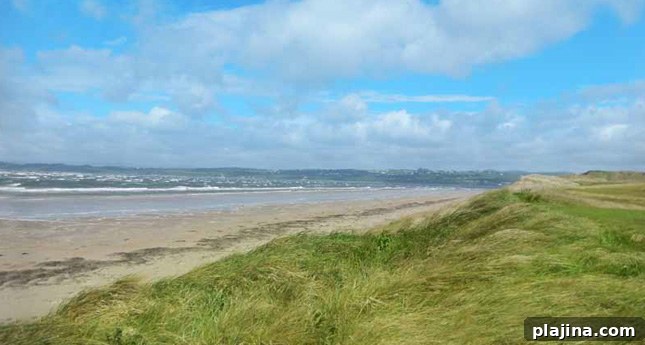
The Murvagh Peninsula is classic windswept links terrain, backed by pine forest with the Atlantic Ocean on one side and Donegal Bay on the other. “Windswept” is no exaggeration. The day I played sustained gusts over 40 mph, meaning I was almost alone on the course. A few members abandoned play as I gathered my clubs in the car park. My hat blew off and I chased it about 100 yards to the amusement of the remaining players. “You need a woolly hat on a day like today,” one of them called — shortly before his driver headcover took the same windy journey. I chased that, too, earning more cheers.
I started on an open course cleared by nature, walking alone until a threesome waved me through on the second hole — a courtesy usually reserved for special guests.
Hole 1 | 530 yards, par 5
“The Road to the Isles”
The club notes that birdies are possible for long hitters, but on my windy day that was wishful thinking. The course is spectacular, framed by the Bluestack Mountains and a stone’s throw from Donegal Bay. Hole 1 serves as an introduction to Murvagh’s challenges. My drive found the center, but the wind knocked my approach into a forward bunker and ended any hope of an opening-hole par.
Hole 2 | 463 yards, par 4
“Westward Ho”
Approaching the tee I was waved through by a threesome searching for a ball in high fescue about 90 yards left, which let me advance quickly and be back in Donegal Town for lunch. My first tee shot flew low and left toward the threesome as I shouted “Fore!” — a call that the roaring wind largely swallowed. Fortunately no one was struck, though it came close. I played a provisional, which I sent toward a right-side bunker, then made a quick exit to my cart. Even in calmer conditions this hole ranks among the course’s most difficult; in gale-force winds it plays like a long par 5 and requires conservative decisions.
Hole 5 | 196 yards, par 3
“Valley of Tears”
The name is apt. This nearly blind long par 3 is guarded by numerous bunkers and finishes on an elevated green. Many consider it the start of one of the finest front nines in Ireland. It will humble even confident players.
Hole 8 © Francis X. Gallagher
Hole 8 | 549 yards, par 5
“Moyne Hill”
If you doubt Donegal’s length, Hole 8 will remind you. It ranks among the longest holes in Ireland. It’s visually stunning, with Donegal Bay to the right — a perfect spot for a brief pause and a photo. Beyond the scenery lies a narrow fairway with subtle hazards: small bunkers and moguls left of the landing area. From the high dunes the wind lifted sand from the beach and stung my face as I prepared to tee off. The second shot is blind and often tempts visitors to aim for the 10th green by mistake. The green sits lower than the fairway and slopes front to back, demanding an accurate approach.
Hole 12 | 593 yards, par 5
“Runway”
I privately call this one “The Destroyer.” Nearly 600 yards from the tips, it contains a drainage ditch that cuts diagonally across the hole and remains hidden from both tee and fairway until you reach it. Bunkers flank the landing area, so the correct strategy is to lay up to the right, avoid the ditch, and then attack the green in three. Wind aside, it’s a long, testing hole and represents one of Ruddy’s notable modifications at Murvagh.
Hole 14 | 566 yards, par 5
“Hare’s Croft”
Another formidable long hole that rewards a near-perfect drive to reach a safe layup position. Like 12, a drainage feature weaves from the left side of the fairway, crosses in front of the green and continues up the right side, making local knowledge useful. The green is best approached from the left side of the fairway.
Murvagh is a must-play links course. Despite the challenging weather the day I played, the conditioning and design made the round memorable — and provided a fine golf story to tell.
Donegal Golf Club
Murvagh
County Donegal
Ireland
tel 353 74 97 34054
donegalgolfclub.ie