
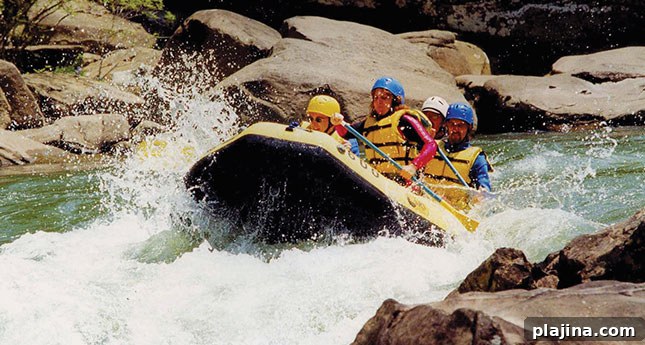
I once rafted the Gauley River,” said Eddie Bennett. In the golden dusk we sat on the porch of his bed and breakfast in Fayetteville, W.V. Eddie, a retired school principal, was immaculately dressed in a linen suit and bow tie. It was hard to imagine him hurtling down one of North America’s most dangerous rivers.
“This was a couple of years back,” he continued. “There was a very attractive young woman in the boat. When we hit the first rapid, she fell right on top of me.” He paused to sip his drink and savor the memory. “Best day of my life.”
The calm of Eddie’s porch stood in sharp contrast to the inflatable raft that had occupied much of my day. I was still buzzing with adrenaline. A gash on my shin throbbed; my muscles ached; my right shoulder was heavily bruised. Like Eddie, I had taken on the Gauley River — the “Beast of the East” — and come back to tell the tale. But it had been a close-run thing.
I hadn’t planned to tackle such a violent stretch when I left the house that morning. My original plan was a lazy float down the nearby New River. But at the ACE Adventure Center, plans changed.
“Have you rafted a Class V?” asked the guide, Fred, when I arrived. I thought he was making conversation.
“Yes,” I answered. “The Zambezi and the Orinoco.”
“Great, you’re in. We’re one person short. You’re coming with us on the Gauley.”
“But I didn’t enjoy either river,” I said, trying to back out.
“You’re not meant to enjoy a Class V,” Fred replied. “It’s a survival thing. Come on, let’s kit you out.” An hour later I was in the boat, committed. We launched beside the outflow pipes of Summersville Dam. For six weekends each fall the dam’s floodgates open and flotillas of rafts run the river in what has become known as “Gauley Season.”
“It’s easier then,” Fred said. “During the season, it’s like those big-water rivers you’ve been on. You go with the flow and hold on. But today the river’s at its spring low, so it will be highly technical. We’ll need all our paddling skill to get down safely.”
Rafting rivers are graded by an international classification system. Class I is the simplest, with gentle ripples. Class V is the most demanding, with regular raging torrents. Until the 1960s the Gauley was considered a Class VI — officially unraftable. By comparison, Niagara Falls is a Class VI.
A handful of reckless pioneers gradually explored the Gauley, seeking routes that could be navigated. Through trial and error — sometimes with fatal consequences — a viable course was established and the river was reclassified as a severe Class V.
We paddled hard every time our craft was pulled toward a set of rapids. Only later did Fred tell me how near we’d been to disaster. “Remember when we were pinned against Pillow Rock? We were almost sucked into a hydraulic. If that had happened, we’d still be there — like being in a washing machine. But deadly.”
Sitting on Eddie’s porch that evening, I let my battered body relax and adjusted to a quieter world that didn’t consist entirely of angry water.
“Best day of your life, would you say?” Eddie asked.
I raised my beer. “I vow that I will never again raft a Class V river.” We clinked glasses. “It is now.”