
On foot and on horseback, people have been crossing Galicia in northwest Spain for millennia. When the Romans reached Cape Finisterre, the westernmost point, they believed their empire could go no further and named the place finis terrae—“end of the earth.”
On a misty winter day that label can feel apt. The gray Atlantic smashes against the rocky headland; sea and sky merge into a somber horizon. This landscape is far from the sun-drenched image many associate with Spain.
Much of Galicia challenges common preconceptions. Although politically part of Spain, the region differs scenically, culturally and linguistically. Rolling green hills and a rugged coastline often evoke comparisons with Ireland, a similarity reinforced by a strong Celtic heritage.
Recent DNA studies have shown close genetic links between Galicians and the Irish. Traditional music frequently features bagpipes, an instrument played in the region for centuries. Around 85 percent of the population speak Gallego, a language with roots close to both Spanish and Portuguese.
Life in this remote corner of Spain has long been demanding, prompting waves of emigration. Like Ireland, Galicia sent many of its people to the Americas, especially to Cuba, Uruguay and Argentina. So many Galicians settled in Buenos Aires that there are said to be more people of Galician descent in that city than in Galicia itself.
Wherever they settled, Galicians retained a strong attachment to their homeland. Local legend holds that when God rested on the seventh day, his hand pressed into Galicia, creating four fjord-like inlets between Finisterre and the region’s largest city, Vigo—Galicia’s first blessing.
The second blessing arrived in 813, when the reputed tomb of St. James was discovered a short distance inland. A city grew around that site: Santiago de Compostela. The name, derived from Latin, is often translated as “St. James of the Starry Field,” reflecting a story in which a farmer was guided to the hidden tomb by a field of stars.
From the Middle Ages onward, up to half a million pilgrims from across Europe—Britain, Scandinavia and even distant Constantinople—made their way to Santiago each year. It soon became recognized as the third most holy site in Christendom after Jerusalem and Rome.
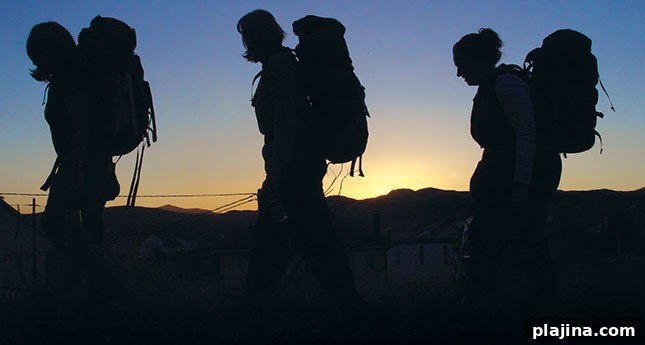
Pilgrims continue to arrive today, with roughly 70,000 completing the routes annually. The Camino de Santiago consists of a network of converging trails. Walkers and riders carry a credencial, a passport-like document stamped along the journey; a finished credencial earns a compostela certificate and a spiritual indulgence. To qualify for a compostela, pilgrims must walk at least the final 62 miles or cycle or ride at least the final 124 miles.
While many still travel for religious reasons, the Camino has attracted growing numbers of secular walkers drawn by the experience itself. The routes wind through varied and often beautiful terrain, shaped over centuries by the footsteps of countless pilgrims.
Hardier travelers sometimes begin their overland trek from across Europe, passing through France and the Pyrenees. The Spanish section most commonly begins near Roncesvalles, where four main French routes—from Paris, Vézelay, Le Puy and Arles—converge. These paths historically served pilgrims from Britain, the Netherlands, Germany and Italy. In France much of the pilgrimage infrastructure has vanished, but from Roncesvalles into Spain a network of pilgrim hostels provides simple, inexpensive accommodation to anyone presenting a credencial. Many of these refugios have welcomed travelers for centuries.
The hostel at Roncesvalles is one of the largest, offering a single dormitory with bunks for around 120 people. In summer, demand often exceeds capacity and a temporary campsite springs up around the ancient building.
From Roncesvalles the trek to Santiago typically takes four to five weeks on foot, with shorter durations by mountain bike or horseback. Bikes and horses are available to rent along the way, and guided group options can be reserved in advance.
The outer reaches of the Camino often provide the most rewarding experiences. Pilgrims tend to bond easily—regardless of their reasons for walking—and a strong sense of camaraderie develops. There is a palpable connection to history: every step echoes those taken by generations before.
During the final 62 miles the character of the route changes as new walkers join for the last stretch, altering the intimate atmosphere of earlier stages. Even so, the countryside remains attractive, and anticipation builds with every step, wheel turn or hoofbeat. Few moments match the sight of Santiago de Compostela’s spires appearing after days on the trail.
Many pilgrims aim to arrive in time for the Festival of St. James on July 25. Years when that date falls on a Sunday are designated Holy Years and attract special significance.
Even for visitors who do not walk the Camino, Santiago de Compostela is compelling. Much of the city, including its magnificent cathedral, is built from pink granite that gleams when wet, lending an almost otherworldly quality to the streets on rainy days.
The region’s weather also shapes the surrounding countryside. At dawn, with dew on the patchwork fields and wisps of Atlantic fog among the trees, the low sun can turn everything a soft, golden hue. In those moments, Finisterre begins to feel less like an ending and more like a beginning.
INFO TO GO
Specialist tour operators offer a range of guided options, from multiweek mountain bike journeys across northern Spain to shorter walking or horseback itineraries covering the final stages of the Camino. Prices vary by operator, duration and included services; travelers should consult tour providers directly for current offerings and availability.