
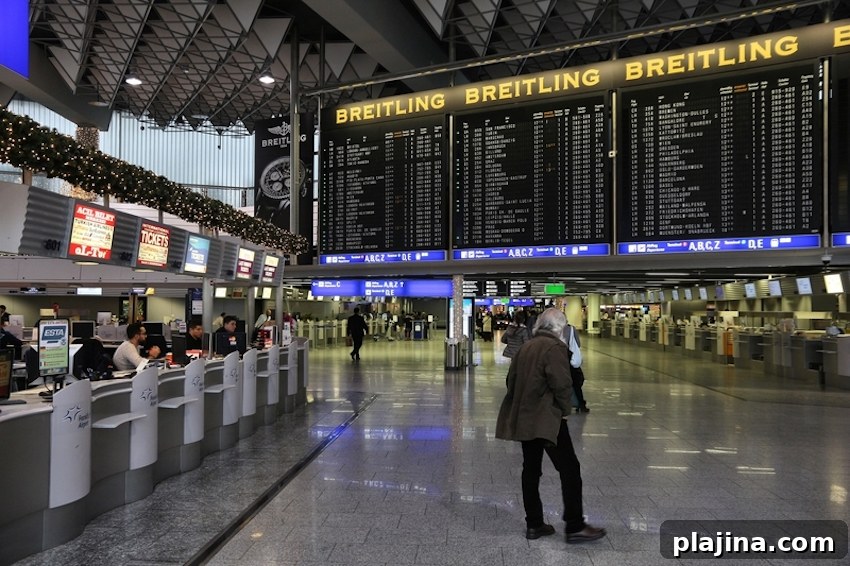
Frankfurt Airport is piloting a new AI assistant presented as a talking head called Franny. The system speaks German, English and seven additional languages, and is designed to help travelers with flight information, gate locations, dining options and Wi‑Fi access.
Franny combines artificial intelligence with a cloud-based interface to interpret questions from passengers and respond using the airport’s live information database. The assistant aims to offer quick, multilingual support and reduce the time passengers spend searching for essential travel details.
“Being able to interact with international travellers in multiple languages is one of the most ambitious attempts to use social robots to date, and we are very excited to see our technology being used and tested in this partnership,” said Samer Al Moubayed, CEO of Furhat Robotics, the company that developed the robot’s operating system. The statement highlights the focus on natural conversations and practical utility in busy transport hubs.
The trial runs for six weeks at Frankfurt Airport and will also take place at Berlin’s central railway station. The initiative is a joint project between Fraport AG, the operator of Frankfurt Airport, and DB Systel GmbH, the IT subsidiary of Deutsche Bahn. By testing the assistant in both airport and rail environments, the partners aim to assess real-world performance, language handling and the assistant’s usefulness across different passenger flows.
During the pilot, Franny will be evaluated for accuracy of information, response speed, language fluency and ease of interaction. The cloud-based setup allows updates to the assistant’s knowledge base and language models, enabling continuous improvement based on passenger feedback and observed interactions. Airport staff will monitor the deployment to ensure information stays current and to collect data on how travelers use the service.
Beyond basic queries about departures, arrivals and gate assignments, the assistant can guide users to amenities such as restaurants, shops and lounges, and provide details about Wi‑Fi access and connection procedures. This breadth of functionality is intended to streamline the traveler experience by offering a single point of contact for common needs.
The pilot also tests how well a social-robot interface integrates with existing information systems. If successful, the technology could be expanded to more locations or retained as a permanent service to complement staffed information desks, especially during peak hours or in multilingual contexts where human staffing is limited.
As the trial proceeds, airport operators will review performance metrics and passenger feedback to decide whether to extend or scale the service. The collaboration between an airport operator and a national rail IT provider demonstrates growing interest in deploying conversational AI and social-robot technologies across transportation networks to improve passenger guidance and operational efficiency.