
By my third kava ceremony I had learned the proper rhythm: clap once, accept the bilo (half a coconut shell), say “Bula!” and drink the mixture in a single gulp. Clap again and say “Maca,” meaning “empty,” then return the bilo and clap three times as everyone joins in.
The numbing taste of kava—known locally as yaqona—became familiar. Made from the pounded roots of a native pepper plant mixed with water, yaqona is a mild sedative and an important part of Fijian social life.
We were participating in the sevusevu, the kava welcoming ritual. Seated across from our hosts in a community hall, we joined what felt like the whole village of Mavua, one of about 15 communities visited on rotation by the Sigatoka River Safari tours.
We arrived with a gift of kava root. Our guide presented it to the village head, who sat before a large wooden bowl called a tanoa. He added water, strained the mixture through cloth, and the muddy brown drink was passed to our side of the hall while villagers watched the proceedings closely.
Historically, young girls softened the root by chewing it into a pulp before adding water; that practice has ended. Still, villagers maintained ritual hospitality by placing leis on us and dusting baby powder on our faces, a symbolic gesture meant to show guests the same care given to infants.
Villagers serving lunch © Marlene Goldman
After the kava ceremony some men picked up guitars and ukuleles, and singing spread through the hall. Villagers invited us into dancing and soon formed an exuberant conga line. Meanwhile, the women prepared a generous lunch featuring local staples like taro, fresh fruits and roasted chicken.
Before the ceremony our guide Gus led us on a walk through the village, with schoolchildren in uniform lining the riverbanks to greet us. Gus helped the women in our group tie sulus, the Fijian sarong, for the village visit. As was customary across Fiji, every passerby greeted us with a warm “Bula!”
We peeked into a Methodist church where villagers sometimes attend multiple services on Sundays. Outside the building rested a lali drum, a hollowed log beaten to summon people to worship or to mark important events.
Homes in the village are modest, often with clothing hung out to dry. After a destructive cyclone in the early 1980s, residents rebuilt using sturdier materials—concrete, tin and wood—rather than the earlier bamboo and thatch construction.
Gus explained that many villagers are related and families tend to be large. “We used to have arranged marriages, but now we marry for love,” he said. He added that the biggest families can include ten children, with five being more common.
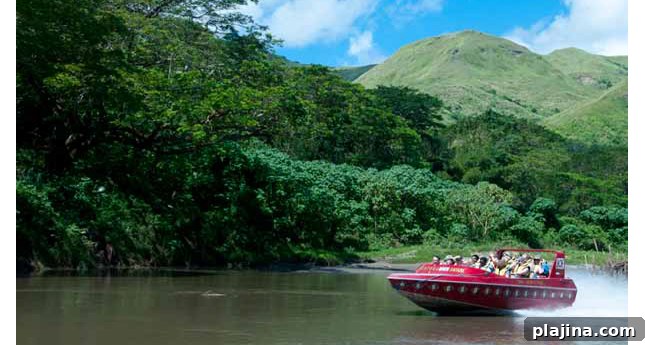
We were exploring the Sigatoka Valley, often called Fiji’s Salad Bowl for its abundance of fruits, spices, vegetables and cassava. The Sigatoka River, the island’s longest, flows from the hills of Navosa Province to the coastal sand dunes at Kulukulu on the Coral Coast. Our boat ride to the village was lively, accelerating up to 45 miles per hour and even including a few 360-degree spins for adventurous riders.
Fiji comprises 333 islands, with more than 100 inhabited. The Mamanuca archipelago, roughly 20 islands, is famed for pristine beaches and excellent water sports such as diving, snorkeling and kayaking. The quieter Yasawa islands attract backpackers and budget-minded travelers in search of simpler beach experiences.
Viti Levu’s Coral Coast is considered the birthplace of Fiji tourism. Its easily accessible beaches near Nadi provide many day-trip options, and visits to outlying villages are often the highlight for travelers seeking authentic cultural experiences.
Besides the river safari, I took a half-day trip on the Coral Coast Railway, a refurbished sugar-cane locomotive that winds through plantations. The ride includes stops at a kindergarten and a cave, and children from nearby villages ran alongside the train, nearly keeping pace.
Destination World runs day tours to Biausevu Waterfall near Biausevu village, where we again offered kava to the village leader. Our guide told us, “We believe Mother Nature has eyes and teeth, so we ask permission before entering a village,” explaining that the kava presentation was made on our behalf.
On the way to the falls we learned about traditional plant medicines. The waterfall plunges about 120 feet into a peaceful lagoon framed by red ginger, hanging vines and large ferns. Guides dove from cliffs while visitors cooled off in the clear water.
For a darker slice of history, the Off-Road Cave Safari offers trips to the Naihehe Caves, once known as the Cannibal Caves and associated with Fiji’s last cannibal tribes. The caves contain a priest’s chamber, a ritual platform, a traditional oven and impressive stalactites and stalagmites.
On Viti Levu’s east coast I spent a few restorative days at Natalei Eco Lodge, a community-run project near Nataleira village. A handful of private bures along a black-sand beach face the surrounding hills, and the lodge focuses on village immersion and local cuisine.
Meals at Natalei were abundant—pancakes, coconut dishes and puddings among them—and evenings featured Fijian songs and a fully costumed mele dance on the beach performed by local men for our small group.
Nataleira offers many activities. Moon Reef near the lodge is one of Viti Levu’s most colorful snorkeling spots, home to giant clams and clownfish, with pods of spinner dolphins often leaping nearby.
I also hiked to Tova Peak, a steep climb through tall grass and muddy slopes that rewards hikers with sweeping views. Tradition suggests finishing the climb with a dip in a waterfall pool, though I cooled my tired feet first in the lodge’s waters before heading out.
A Taveuni waterfall © Marlene Goldman
To contrast my mainland stay, I visited Taveuni, the “garden island,” known for diving and lush trails. A small plane landed on the island’s modest airstrip, and a bumpy hour-long 4×4 ride took me to Paradise Taveuni on the southern tip, where fresh coconut water and a foot massage awaited. Thatched bures offered a simple, disconnected rhythm—no clocks or electronics, just the roosters calling at dawn.
On an excursion to Vuna Village, our guide Maikeli pointed out palm trunks browned by sun. At Wairiki Village we visited the 19th-century Holy Cross Catholic Mission Church, built after villagers allied with a French missionary to repel invading Tongans. Local lore says that before converting to Catholicism the victorious warriors cooked their enemies in a traditional lovo oven.
When we returned on a Sunday, the church overflowed with worshippers. Though the Mass was in Fijian, the harmonized singing communicated deeply. Later we hiked Bouma National Heritage Park to the Tavoro Waterfalls. The falls, featured in a film scene, consist of three tiers—the first cascading 600 feet into a welcoming pool.
Many visitors swim at the base; I followed my guide to the top, traversing rocks and rope-assisted crossings to reach the upper tier and inspecting small wildlife like blue crabs before returning to cool off in the lower pool.
With daylight waning we visited Waitavala natural waterslide, where our guide Big Ben led us up a slippery path. I took the exhilarating ride down smooth rock formations while others chose to sit out.
On my last day in Taveuni I snorkeled Rainbow Reef from a dive boat. Although I didn’t see the famed corals from the surface, colorful tropical fish filled my view. We lunched on a tiny white-sand islet that felt like the ideal tropical escape.
My final night at the resort concluded as my journey began—with a kava ceremony, singing and shared hospitality. The warmth and welcome of the villagers are what make Fiji feel like a true island paradise.
Fiji Info to Go
The most direct route to Fiji from the United States is Fiji Airways, which operates non-stop flights from Los Angeles to Nadi International Airport on Viti Levu. Nadi connects to destinations across Fiji, and ferry services operate regularly to resorts in the Mamanuca and Yasawa island groups.