
Fès captures the essence of Morocco and then some. The city is actually three distinct areas: Fès el-Jedid, which holds the royal palace and the historic Jewish quarter; Ville Nouvelle, the modern district; and Fès el-Bali, the ancient medina that draws most visitors.
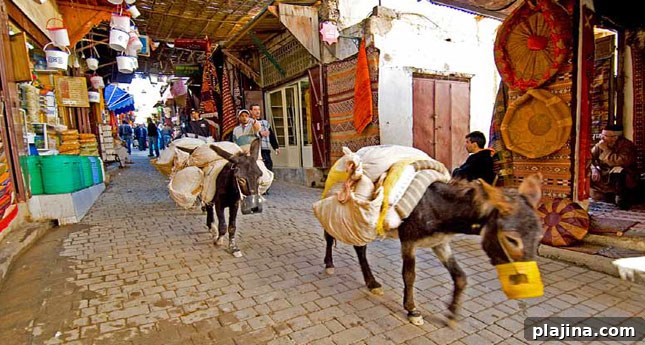
Fès el-Bali, reputed to be one of the largest car-free urban zones in the world and home to more than 200,000 residents, was designated a UNESCO World Heritage site in 1981. Its narrow streets are crowded with shops and market stalls. Tiny alleyways open onto surprising scenes, and you often find yourself pressed against a display of fruit or ducking into a spice or leather shop to avoid loaded donkey carts carrying carpets, clay water jugs, or sacks of onions.
Except for the occasional cellphone, and the sight of teenagers and tourists in contemporary clothing, the medina can feel like a place where time has stood still for centuries. It’s an ideal setting for discovering superb handicrafts and experiencing the thrill of getting delightfully lost in a maze of winding lanes.
Café Clock, tucked away in the medina, is a lively spot worth seeking out. You can enjoy a well-made cappuccino, a reasonably priced meal, attend cultural events, or relax on the rooftop terrace with sun and panoramic views across the medina and city rooftops.
For shoppers, Fès el-Bali is unmatched for carpets, leatherwork, jewelry, and textiles. Bargaining is part of the experience: local merchants are practiced negotiators, and prices often start high to leave room for haggling. With patience and skill you can reach a satisfying deal, but expect the seller to be a formidable opponent at the bargaining table.
Staying in a riad inside the medina is one of the most authentic ways to experience Fès. A riad is a traditional home arranged around a central courtyard, typically with a fountain at its heart. These intimate guesthouses offer genuine Moroccan hospitality and often include an on-site hammam. Riad Laaroussa, for example, is a carefully restored 17th-century palace that blends historic charm with modern comforts. La Maison Bleue occupies an elegant 19th-century residence and provides upscale accommodations; its restaurant serves traditional Moroccan fixed-price dinners in richly decorated surroundings. While there, try a tajine, the classic slow-cooked stew prepared in a conical clay pot—an essential taste of Moroccan cuisine.