
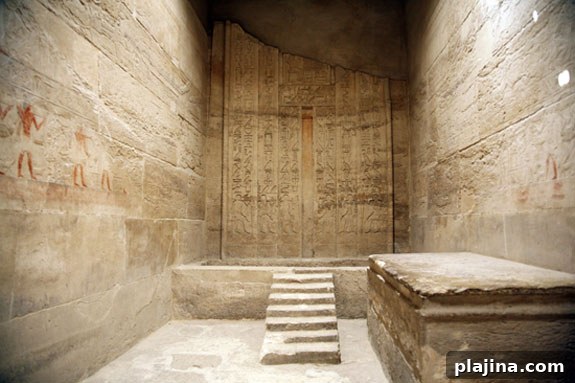
Recently reopened in the expansive necropolis of Saqqara is the mastaba of Mereruka, the vizier to King Teti, dating to about 2300 B.C. This monumental tomb, with a complex of 32 rooms and passages spanning nearly 11,000 square feet, is the largest private tomb known from Egypt’s Old Kingdom. Its interior is exceptionally well preserved, offering vivid painted bas-reliefs that illustrate scenes from daily life.
The wall decorations portray a broad range of activities: girls playing a board game, peasants harvesting grain and carrying water to irrigate gardens, and craftsmen working with molten metal. Many scenes are notable for their realism and detail. One depiction shows a lioness killing a cow by biting at its mouth and nose to suffocate it; another dramatic carving captures men in boats spearing three enormous hippos, their jaws open and teeth exposed.
Architectural features inside the mastaba are equally striking. A pillared cult chamber houses a statue of the tomb owner, providing a focal point for funerary rituals. In the chamber floor lies a large ring set into the stone, likely used to secure sacrificial animals during offerings. Together, the artwork and architectural elements provide a rich, tangible glimpse into the religious practices, social roles, and everyday activities of an elite household in Old Kingdom Egypt.
Beyond its artistic value, Mereruka’s mastaba offers important archaeological insight. The scale and sophistication of the tomb reflect the high status of its owner and the administrative complexity of the early pharaonic state. The variety of scenes — from agricultural labor to hunting and ritual — underscores the interconnected spheres of economy, religion, and elite display that defined life at the time. Preservation of pigments and carved detail allows researchers to study ancient techniques of painting, relief carving, and architectural planning.
Visitors and scholars examining the mastaba encounter a vivid visual narrative carved into stone: family members and servants depicted in hierarchic proportions; animals shown with careful attention to anatomy; and daily tasks rendered with practical detail. These elements combined create an immersive record of the material culture and belief systems that sustained elite tomb construction and funerary practice.
As conservation and study continue, Mereruka’s mastaba promises to deepen understanding of Old Kingdom artistic conventions, funerary ideology, and the social organization of ancient Egypt. The tomb stands as a testament to both personal devotion and state-supported mortuary architecture, preserving scenes that bridge the everyday and the sacred for modern viewers.