
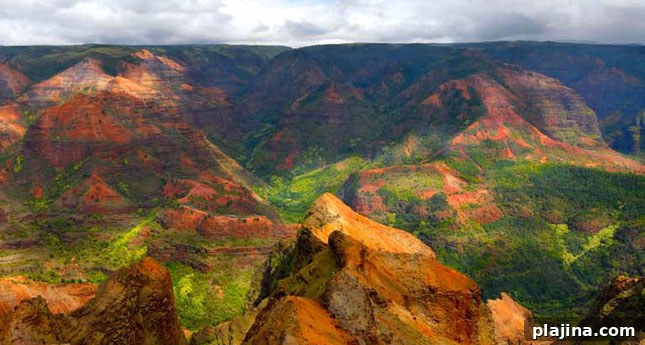
It’s me and my rental car against the elements. Over the course of the morning I endured wind, sand and blazing heat. I climbed the flank of a volcano and was pummeled by driving rain near the summit. On the way back down, I stopped at a scenic viewpoint and forgot the most basic natural force of all: gravity.
I stepped out, slammed the door and walked to a fence that protects the rim of the immense Waimea Canyon. Behind me I heard gravel crunching. Strange — there was nobody else around. I turned and watched in horror as my car began rolling down the slope. I had left the parking brake off.
Luckily, the wheels were pointed toward the road rather than the sheer 3,000-foot drop into the canyon. I sprinted, lunged for the open door and flung myself into the driver’s seat. I brought the car to a halt just as another vehicle approached. Lights flashed and a horn blared. A small price to pay for dodging a potentially catastrophic mistake.
Waimea Canyon © Jerryway | Dreamstime.com
The Chevy Impala was the latest in a string of rental cars on my island-hopping tour of Hawai’i. While other travelers lounge by pools or relax on beaches, I’m determined to see as much of these islands as possible, and that means having wheels.
I matched my rentals to each island’s character. On the Big Island I chose an SUV to traverse stark lava fields and climb the cinder tracks up Mauna Kea. On Maui I drove a convertible — perfect for coastal runs to Lahaina with the radio on, wind in my hair and humpback whales breaching offshore. In Oahu I took a compact Chevy Aveo, ideal for squeezing into busy Honolulu and Waikiki parking.
Kauai posed a tougher choice. The island offers a bit of everything: dramatic coastlines, dense rainforest and high, often wet summits. Knowing that Kauai’s interior includes some of the wettest spots on Earth ruled out a convertible. The roads are good enough that an SUV wasn’t necessary, and I didn’t plan to spend much time in town centers.
So the Chevy Impala it was. After rescuing it from gravity’s pull, I reversed back to the viewpoint, engaged the brake and, for extra security, wedged a volcanic rock under one of the front tires.
With the car secure, I could fully take in the landscape. This canyon marks the beginning of Hawai’i’s geological decline. The valley formed when the island’s main volcanic dome collapsed and was deepened over time by relentless wind and water erosion. The process continues; over millennia the highlands will wash away, leaving fragments of land ringed around lagoons.
Geological narratives operate on time scales that dwarf human experience, yet the visual consequences are immediate and staggering. Every time I descended the slopes I stopped to restrain the car and appreciate the view from different angles.
On the flatter coastal roads later, I noticed a police car suddenly following me. I checked my speed, fastened my seat belt and obeyed every traffic sign as if on autopilot. After a short stretch the officer passed and drove on.
A traffic cop is one force of nature I’m not willing to test.