
It’s nearly 3 p.m. in Bern. At the end of an uneven stone street in the city’s medieval center, the Zytglogge tower—with its famous 15th-century “time bell”—juts into view. A small crowd gathers at the tower’s base as the clock prepares to mark the hour. A golden rooster crows, music plays, and mechanical figures perform: a tiny parade of characters that includes an assortment of cheerful bears.
The tower’s facade also features an Astrolabium, an astronomical calendar that offers a different way of telling time—one less bound to human hours and more attuned to the movement of constellations, planets, the moon and the sun. It suggests a broader sense of passage through the immediate cosmos.
The music fades and Zytglogge returns to silence. A short walk away on Kramgasse is the apartment where Albert Einstein lived while developing his theories of space and time. The clock was a familiar landmark for him and, in its way, part of the backdrop to his thinking.

© Debra Bokur
I reach into my day bag and touch a well-worn copy of Alan Lightman’s Einstein’s Dreams. Each short chapter imagines a different reality for time, and Lightman’s vignettes offer a poetic echo to the towers’ own mechanical calculations—the weights and gears that grind out a soundtrack to theoretical leaps.
A few days later in Vienna, at noon in Hoher Markt, I stop at the Ankeruhr on the bridge connected to the former Anker Insurance building. Like Zytglogge, the Anker Clock features mechanical figures that parade across its face, devised by artist Franz Matsch.
Gerald Sabath from Facility Management Helvetia Austria, an authority on the Ankeruhr, shared a chilling story that underscores the power of a single moment: Holocaust survivor Inge Ginsberg once hid successfully inside the clock for one night to escape the Nazis. The clock’s original purpose, however, was as much about marketing as timekeeping.
“When Anker Versicherung commissioned Matsch to design the Anker Clock, the intention was clear,” Sabath said. “They wanted to draw attention to life’s transience and subliminally promote the need for precautions—precautions in the form of insurance.”
The clock’s imagery delivers that message: a child with a butterfly on one side of the roof, Death holding an hourglass on the other, a smiling sun and a scale symbolizing precious time. Sabath explained that Matsch created one of Vienna’s best-known landmarks and a lasting advertising medium.
He added that the Anker Clock—nicknamed the “Old Lady”—doesn’t always keep perfect time, especially in hot weather. Each of its 12 figures can weigh up to 300 kilograms and the mechanism still runs on its original 1914 chain. “Despite regular maintenance, the Anker Clock is therefore never completely on time,” Sabath said. “As a Swiss-oriented company with a strong sense of punctuality, we find this particularly amusing.”
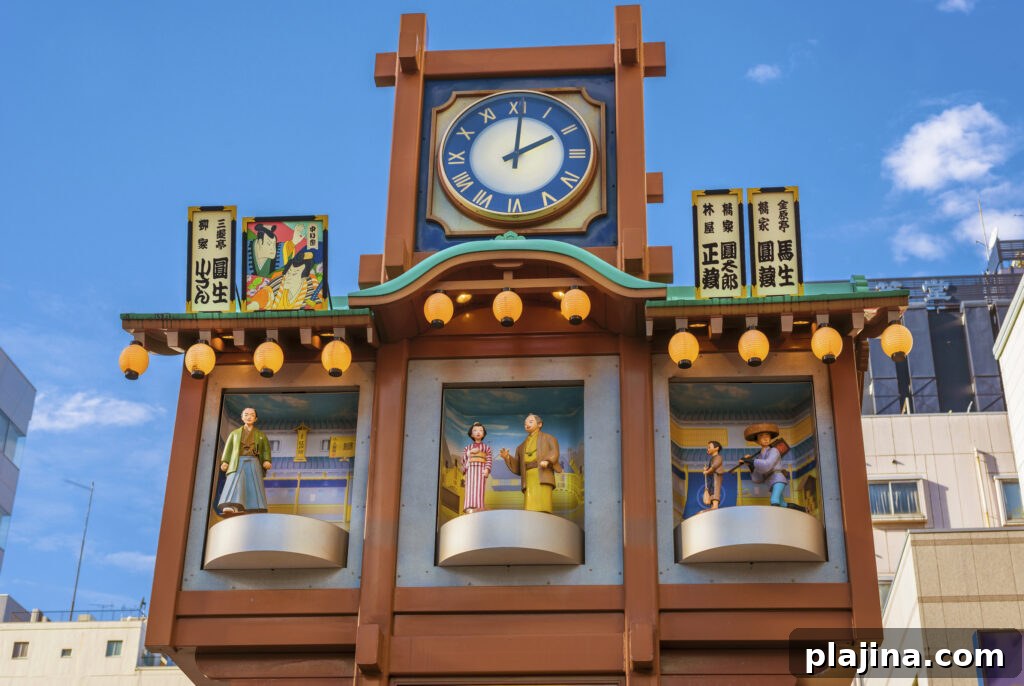
Ningyocho, Tokyo © Crisfotolux | Dreamstime.com
The next day I nearly miss my train to Munich—ironic, since my solar wristwatch had run out of power. In Marienplatz, on the facade of New City Hall, the Glockenspiel prepares to mark 5 p.m. Like Zytglogge, its mechanical show includes a golden bird. The Glockenspiel’s performance—jousting knights, a dance of barrel-makers and music played on 43 bells—concludes as the golden bird appears and chirps three times.
Traveling toward Prague, I try to imagine, as Lightman’s narrator does, what it would mean if time were a sense. Tired, I sleep on the train and arrive feeling slightly disoriented. In Old Town Square, the Old Town Hall houses the Prague Orloj, a clock dating to 1410 and created by imperial clockmaker Mikuláš of Kadaň. Damaged, repaired and revived over centuries, the Orloj presents an intricate astrolabe and an astronomical dial brimming with the sun, moon, a zodiac wheel and figures of saints and stars—a timepiece that feels almost magical.
These remarkable mechanical clocks are scattered across Europe and beyond. Italy and France host numerous artistic clocks; Norway’s Oslo Rådhus features an astronomical clock; Belgium has the Aimmer tower clock in Lier; Croatia displays Dubrovnik’s moon ball belltower clock; Sweden has the Lund clock; Poland’s Gdańsk and Wrocław boast impressive timepieces; Latvia offers a blue-and-golden Riga clock; Slovakia preserves Stará Bystrica’s clock; and Malta’s Grandmaster’s Palace presents a clock struck by four mechanical figures.
Other cities display mechanical marvels in towers, churches and civic buildings. Batumi’s astronomical clock peers over Europe Square from a former bank building. Moscow’s Kremlin Clock on Spasskaya Tower, part of a tradition dating to 1491, now runs on a mechanism installed in 1852—a complex assembly of gears, weights and enormous bells that has announced New Year celebrations for generations.
In Tokyo’s Ningyōchō district, mechanical clock towers stage puppet-like narratives with animated figures. In Kyiv, the facade of Holy Trinity Monastery hosts a clock tied to a legend about Honoré de Balzac transporting a timepiece from Paris to present to his wife, Evelina Hanska.
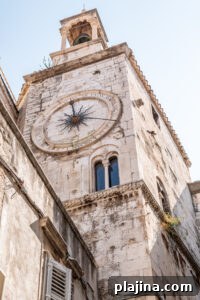
Dubrovnik Bell Tower © Mirko Kuzmanovic | Dreamstime.com
The final stop on my route is Salisbury, England. Inside Salisbury Cathedral sits a faceless medieval clock thought to be the oldest working mechanical clock in the world. Standing beneath it in the cool stone interior, I try to make sense of the network of gears and levers. The clock was lost for years, rediscovered in 1928 and restored.
Emily Naish, the cathedral archivist, explained that a document indicates the clock existed in 1386, though it may be older. “Bishop Erghum ordered the clock to be made by three clockmakers from Delft,” she said. “It’s of exceptional horological importance, one of the few surviving examples of medieval clock-making. It originally sat in a separate belltower, and when that tower was demolished in the 1790s the clock was moved into the cathedral. It was operated until the 19th century, later restored and relocated to the ground floor. The fact it has survived and still works is remarkable.”
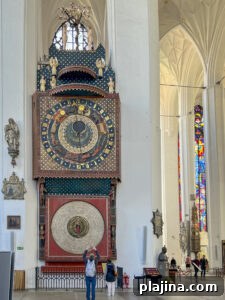
St. Mary’s Basilica in Gdańsk, Poland © Ryszard Parys | Dreamstime.com
Outside in the crisp air, I sit on a bench facing the cathedral and open Lightman’s paperback to the chapter titled “14 May 1905.” In his story a traveler enters a place where time stands still and pendulums float mid-swing. I want to find a cab, get warm and sleep without setting an alarm, but I have one more day before a long flight home and feel my time slipping away.
Or does it slip? Time’s apparent speed seems tied to our state of mind. Is it linear, pushing us toward some future point, or might it loop through space like the circular face of a clock?
Whatever time’s true nature, clocks remain a way to measure seconds, minutes and hours of our lives and to mark larger moments in history. The visible beauty of intricately crafted mechanical clocks invites passersby to look up and consider time’s fleeting nature. In doing so, these timekeepers encourage a deeper appreciation for our own brief, invaluable moments.