
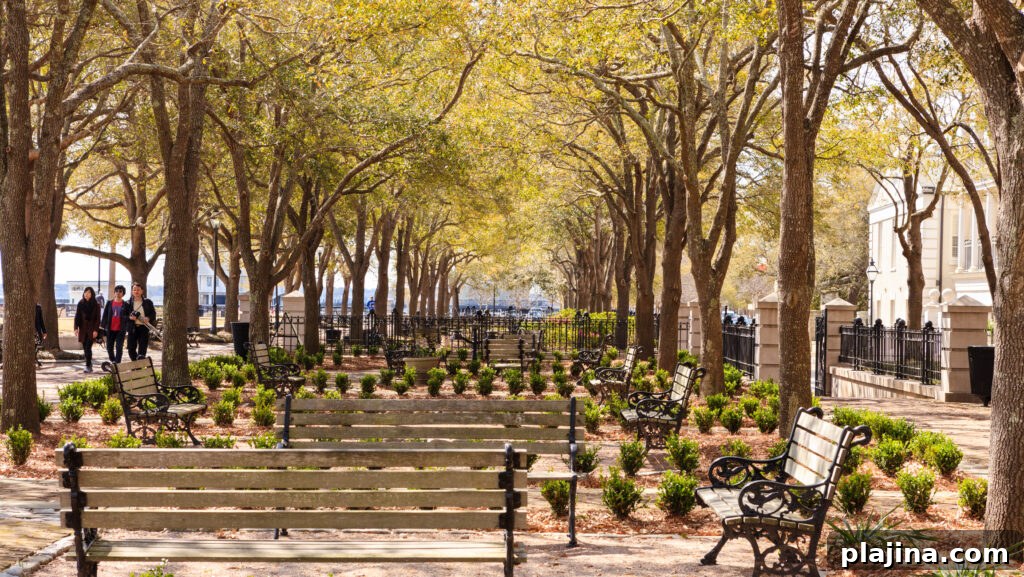
Charleston’s waterfront Historic District, with its unmistakable Southern charm and striking architecture, has long been synonymous with warm hospitality and fine dining. But the city offers far more than elegant streets and gracious manners. Before the pandemic, Charleston welcomed more than seven million visitors each year—drawn not only to its cultural landmarks but also to an expansive network of parks. Across the city, 120 parks preserve more than 1,800 acres of largely natural recreation. As interest grows in Charleston’s wilder, outdoor side—an aspect locals have treasured for years—the city is actively expanding and improving its park system to provide even more experiences for visitors and residents alike.
“Efforts to update and broaden parks around Charleston allow us to offer more diverse experiences for residents and visitors,” said Doug Warner, vice president of Media and Innovation at Explore Charleston. “The Charleston area is a year-round destination, and our numerous outdoor spaces offer residents and visitors an easy way to enjoy the natural beauty of our coastal location.” He added that these public spaces frequently host cultural and sporting events, markets and festivals that enrich the local experience.
© Cvandyke | Dreamstime.com
Planned renovations, such as those at North Charleston’s Park Circle, will bring more than standard amenities like sports fields and walking trails. These projects include community-focused features—public performance and event spaces among them—that appeal to visitors seeking memorable and unique experiences. Thoughtful upgrades make parks destinations in their own right, adding attractions that complement Charleston’s historic and culinary draws.
Updating park facilities also gives cities the chance to respond to modern needs and a wider awareness of accessibility. Park Circle is set to open the Southeast’s largest inclusive playground in late 2023. Designed for cross-generational play, it accommodates people of varying abilities and sensitivities—physical, developmental and otherwise—so families and visitors of all kinds can participate. The Park Circle project represents roughly a $20 million investment in reimagining urban recreation, and it is one of several park initiatives planned across Charleston and nearby counties.
Parks can also reclaim and transform underused urban spaces. Charleston’s Lowcountry Lowline—a project inspired by successful linear parks elsewhere—will convert an old railway corridor into a 1.7-mile linear park. Estimated at around $30 million, the Lowline is expected to open in phases over the next decade. The project aims to improve safe commuting by foot or bike, create inviting “pocket parks” for community programming, and serve as an important flood-management asset in a city frequently affected by stormwater and tidal flooding.
Megan Mills, project coordinator for Friends of the Lowcountry Lowline, explained that the park will mitigate stormwater flooding by creating storage and displacement areas in flood-prone spots. The pocket parks will provide community gathering spaces with programming designed to welcome everyone. Beyond flood resilience and recreation, the Lowline will reconnect neighborhoods divided by I–26 since the 1960s and offer residents and visitors safer routes to reach shops, restaurants and workplaces.
© Anthony Heflin | Dreamstime.com
SCENIC DRIVES
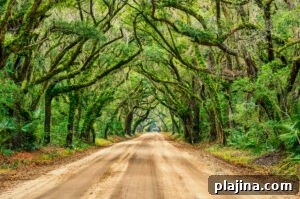
Just over an hour southwest of Charleston, Botany Bay Road offers one of the region’s most atmospheric drives and makes for a perfect half-day outing. The road winds through Botany Bay Plantation Heritage Preserve—a free, state-managed park—and includes a scenic three-mile loop with historic sites and striking coastal vistas. The highlight is a roughly one-mile tunnel of mature oak trees accented by king sago palms. On a sunny day, the shaded, sandy road under this live-oak canopy is unforgettable. Note that the preserve is closed on Tuesdays.
Another must-see is the Angel Oak on Johns Island, one of the area’s most iconic trees. Believed to be between 400 and 600 years old, the Angel Oak’s sprawling canopy covers more than 17,000 square feet, with branches that can extend up to 187 feet. Located less than a half-hour from downtown Charleston, the tree is accessible from multiple routes; consider traveling via Bohicket Road, a scenic, foliage-lined highway that adds to the experience. If time allows, explore further along this ten-mile stretch to enjoy more of the Lowcountry’s lush landscapes.