
Valletta, the capital of Malta, was designed to keep invaders out. The compact old city sits on a peninsula protected by formidable limestone ramparts and guarded by two natural harbors, giving it an unmistakable fortress feel.
Approaching by water taxi from Sliema, the fortified skyline offers no obvious easy entry, underscoring the city’s strategic importance through the ages.
The Maltese islands — primarily Malta and neighboring Gozo, along with several smaller uninhabited isles — occupy a central position in the Mediterranean. This location made them a coveted prize in countless conflicts, controlling sea routes between the Middle East and Western Europe and between Southern Europe and North Africa. As a result, the islands are rich in military architecture and historical sites that vividly reflect European history.
From the landing point a winding road leads up through a stone arch into a dense maze of narrow streets. A good introduction to the island’s past is the Malta Experience, a family-friendly 45-minute audiovisual presentation at St. Elmo’s Fort that summarizes some 7,000 years of Maltese history and helps set the scene for exploring Valletta.
Much of Valletta was built by the knights of the medieval order in the 16th century. Their legacy is visible at the Grand Master’s Palace, where the Armoury displays banners, weapons and suits of armor. The palace is undergoing a multi-phase restoration but the Armoury remains accessible to visitors during the work.
For a livelier, more theatrical take on medieval history, The Knights of Malta Experience in the inland walled city of Mdina blends waxworks, sound-and-light effects and 3-D exhibits to engage younger visitors and families.
Through the centuries Malta endured repeated sieges and battles and later withstood intense bombing in World War II. The island’s bravery during the war earned it the George Cross, which is proudly incorporated into the national flag. The Lascaris War Rooms — an extensive complex of tunnels and chambers beneath the city walls — served as the British military’s wartime control center. Today the preserved rooms offer an immersive glimpse into the wartime command operations, where aircraft movements were plotted and crucial decisions were made that influenced Allied campaigns in the Mediterranean.
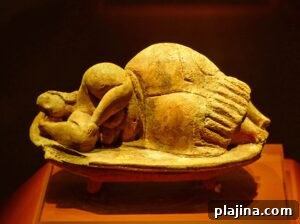
PHOTO: © ZEYTUN IMAGES | DREAMSTIME.COM
Below the islands lies another world. Guided tours reveal tunnels, grain stores and cisterns beneath Valletta. There are also deeper, far older archaeological treasures. Near Valletta, in Paola, workers in 1902 discovered a manmade underground complex now known as the Hal Saflieni Hypogeum. This remarkable Neolithic temple and burial site, dated to around 3300–3000 B.C., features carved pillars and intricate doorways. Priceless artifacts, including the famed Sleeping Lady statuette, were recovered there. To protect the site, visits are strictly limited and advance booking is essential.
More accessible to visitors are St. Paul’s Catacombs beneath Rabat, adjacent to Mdina. Excavated originally by the Phoenicians more than two millennia ago, this vast underground cemetery has a spooky atmosphere that captivates children and adults alike.
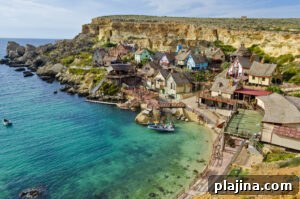
PHOTO: © LENISE CALLEJA | DREAMSTIME
On Malta’s northwest coast a very different attraction awaits at Popeye Village. Built as a film set for Robert Altman’s 1979 movie Popeye, starring Robin Williams, the wooden village has been preserved and turned into a quirky family attraction with interactive shows, a small assault course and water-based activities in the bay and pool area.
From the Cirkewwa ferry terminal near Popeye Village you can cross to Gozo. Compared with the fortified bustle of Valletta, Gozo feels open and pastoral, dotted with goat and sheep farms and small, welcoming villages. Victoria (also known as Rabat), Gozo’s compact capital of about 7,000 residents, centers on a medieval citadel whose walls offer panoramic views over the island.
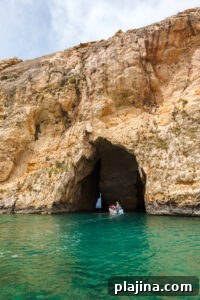
PHOTO: © MIKHAIL STARODUBOV | DREAMSTIME
Gozo offers many secluded swimming spots. The Dwejra Inland Sea is a clear lagoon connected to the Mediterranean through a natural tunnel, ideal for swimming and snorkeling. Nearby the Blue Hole sits at the base of dramatic cliffs and provides a sheltered spot for watersports. A once-famous natural arch known as the Azure Window collapsed in 2017, but the coastline remains striking and popular with visitors.
Back in Valletta, the city walls draw visitors again. On the ramparts above Grand Harbour the Saluting Battery presents a daily spectacle: ceremonial cannon firings at noon and 4 p.m. After the cannons roar and the crowds disperse, the elevated vantage point offers a peaceful spot to watch water taxis and cruise ships come and go beneath the protective embrace of the city’s fortifications.
LODGING
db Seabank Resort + Spa
A large all-inclusive resort facing a popular sandy beach, with a kids’ club, fitness center, multiple restaurants and nightly entertainment in the hotel theater.
Marfa Road, Mellieha, Malta
$$$
Hotel Calypso
A modern, family-friendly hotel overlooking a charming port on Gozo’s north coast. Scuba courses are offered for guests from age 8 upward.
Marsalforn Bay, Gozo
$$$
The Phoenicia Malta
An iconic hotel blending historic character and contemporary comforts: stylish rooms, a vintage palm court lounge and an infinity pool adjacent to Valletta’s medieval walls.
The Mall, Floriana, Malta
$$$$
DINING
The Black Pearl
A fun dining experience aboard a converted 100-year-old schooner at Ta’ Xbiex Marina. The international menu highlights seafood and burgers.
Ta’ Xbiex, Malta
$$
Gozo Picnic
Luxury picnic experiences arranged by a local resident, ideal for enjoying Gozo’s scenic spots without the planning. Contact via the listed Instagram handle to arrange services.
$$
Ranieri Restaurant & Café
An unpretentious café offering pavement or indoor seating. The menu includes pizza and pasta as well as Maltese specialties like grilled squid and rabbit stew.
39 Republic St., Valletta, Malta
$$
INFO TO GO
International flights arrive at Malta International Airport, about 6 miles south of Valletta. Regular bus service connects major towns and resorts, and car rental is widely available, though parking in Valletta can be limited. Ferries run from Cirkewwa at Malta’s northern tip to Gozo; crossings take about 20 minutes with departures roughly every half hour.