
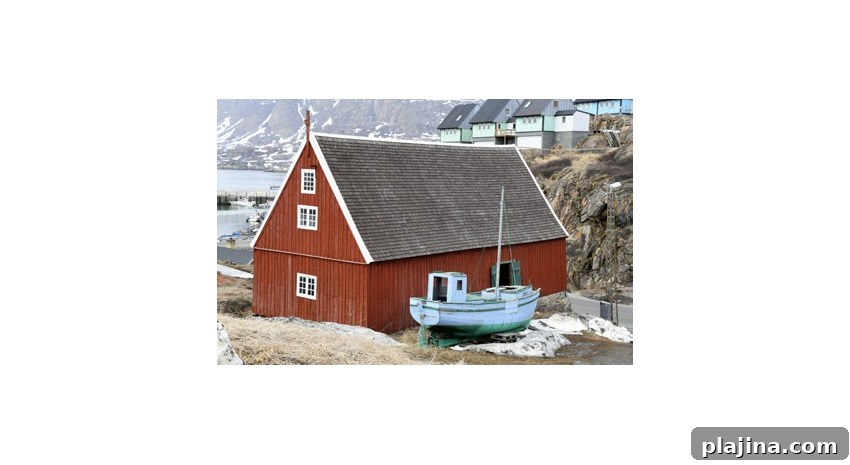
GREENLAND IS MASSIVE. Even on a world map it immediately commands attention. Despite its enormous size, Greenland is not a continent but the world’s largest island, with the only permanent ice sheet outside Antarctica covering much of its interior. People live mainly along the coastal fringes where steep mountains meet the sea and habitable valleys provide shelter.
Depending on the map projection, Greenland’s scale can appear even more striking. The island spans roughly 836,330 square miles — about ten times the size of Minnesota — yet it has no roads linking towns, few cars and no railways. Movement around Greenland is typically by plane, boat, helicopter, snowmobile or dogsled, and many residents own boats to connect communities and access rich fishing and hunting grounds.
© KARIN LEPERI
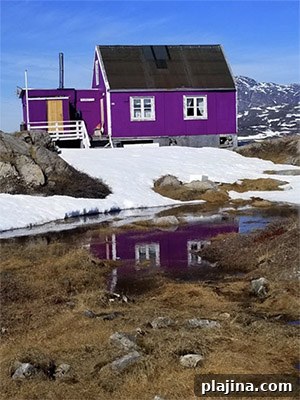
Most international visitors arrive at Kangerlussuaq Airport on Greenland’s west coast, a settlement tucked into the head of the Kangerlussuaq fjord. The airport is only minutes from the vast ice cap, making it an ideal entry point for travelers who want a close look at the inland ice. The surrounding tundra supports diverse wildlife including muskox, caribou and raptors such as gyrfalcons.
In southern Greenland the largest town is Qaqortoq, in a region inhabited for around 4,300 years. Archaeological and historical traces show the area was home to the prehistoric Saqqaq culture, later settled by Norse colonists in the 10th century, followed by the Thule people in the 12th century and Danish colonial presence in the 18th century.
Near Qaqortoq lie well-preserved Norse ruins, including Hvalsey Church, built in the 14th century as one of Greenland’s earliest Christian churches. The last known written record of the Norse in Greenland documents a church wedding in 1408; after that, written evidence of the Norse settlements disappears.
The most practical way to experience the populated coastal regions is by boat. For comfort, many travelers choose mainstream cruise ships; for a more intimate and adventurous experience, expedition cruises and smaller vessels offer closer encounters with fjords, icebergs and remote communities.
Because coastal waters can be clogged with winter sea ice, most Greenland cruises operate from early summer through early autumn. Cruise operators visiting or calling at Greenland include several major and specialty lines, with itineraries typically focused on the west coast and southern ports. Larger trans-Atlantic ships sometimes call at Nanortalik, Qaqortoq and occasionally Nuuk, Greenland’s capital.
Disko Bay, on the west coast, is one of Greenland’s most popular visitor destinations. Its principal town, Ilulissat — whose name means “iceberg” — is well known for the Ilulissat Icefjord, a UNESCO World Heritage site where immense icebergs calve from the Sermeq Kujalleq glacier. The bay also attracts numerous whale species and is home to Hotel Arctic, noted as the world’s northernmost four-star hotel.
Accommodation options across Greenland are limited and often more expensive than travelers might expect. Many hotels offer modest facilities; private bathrooms are not guaranteed in all properties, and Wi-Fi may be available for an extra fee and can be unreliable. While there are no five-star hotels on the island, several four-star properties cater to business travelers and visitors seeking comfortable, well-appointed rooms. Prospective visitors should consult official Greenland tourism resources for up-to-date information on weather, activities, culture, lodging and dining.
On a Poseidon expedition to West Greenland and Disko Bay, I experienced dramatic fjords, calving glaciers and steep coastal mountains dusted with snow. Polar guides led Zodiac excursions, hikes and optional kayaking trips, and the expedition staffing ratio provided ample guidance and education for passengers exploring fragile Arctic environments.
Beyond its ice cap and glaciers, Greenland offers phenomena and cultural experiences unique to the High North: the midnight sun north of the Arctic Circle, traditional Inuit communities and culture, abundant marine life including whales and fluking tails, and small abandoned settlements that hint at former lives and changing times.
© KARIN LEPERI
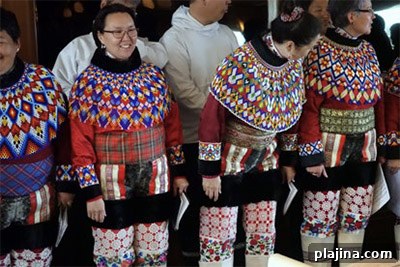
One memorable visit took me to Itilleq, a tiny settlement on a small island on Greenland’s west coast. With roughly 125 residents who rely mainly on hunting and fishing, Itilleq offered a glimpse of daily life far from urban centers. My small group — travelers from Taiwan, Germany and the United States — was welcomed into the home of Pauline Dahl for a traditional kaffemik and pastries. Despite language differences, hospitality and shared smiles bridged the cultural gap. Pauline proudly showed a photograph of her daughter, son-in-law and granddaughter; I photographed her holding it, capturing three generations of Greenlanders in a single frame.
Greenland Info to Go
Travel between settlements is mostly by boat or air since road connections are minimal. Greenland’s earliest airports were constructed for military purposes during World War II and the early Cold War years: Kangerlussuaq (1941), Narsarsuaq (1942) and Kulusuk (1956). Civilian air travel expanded after the founding of Greenlandair in the early 1960s. Today Air Greenland operates key domestic and international services, and Kangerlussuaq (SFJ) remains the primary hub for international travelers, handling hundreds of thousands of passengers annually.
Where to Stay in Greenland
HANS EGEDE HOTEL — The largest hotel in Nuuk, the capital, this four-star property serves business and leisure travelers and offers a breakfast buffet. Aqqusinersuaq 1-5, 3900 Nuuk. Price range: mid to upper.
HOTEL ARCTIC — Located near Ilulissat Icefjord, this four-star hotel offers modern Scandinavian design and many rooms with icefjord views. It includes conference facilities and is a popular choice for visitors to Disko Bay. Mittarfimmut Aqq. B1128, 3952 Ilulissat. Price range: upper mid.
HOTEL KANGERLUSSUAQ — Conveniently adjacent to the airport terminal, this comfortable hotel is ideal for transit travelers and business guests, with conference areas and restaurant service. P.O. Box 1006, 3910 Kangerlussuaq. Price range: mid.
Restaurants in Greenland
CHAROEN PORN — A vegetarian-friendly restaurant in Nuuk that serves Thai-inspired cuisine using Greenlandic ingredients, including fresh fish. Aqqusinersuaq 5, 3900 Nuuk. Price range: moderate.
RESTAURANT ICEFIORD — Located at Hotel Icefiord in Ilulissat, this restaurant focuses on Scandinavian fare with an emphasis on local fish and seasonal specialties; a children’s menu is available. Hotel Icefiord, Jørgen Sverdrupip Aqq. 10, 3952 Ilulissat. Price range: moderate.
RESTAURANT ROKLUBBEN — Highly rated in Kangerlussuaq, the buffet highlights Scandinavian seafood and local dishes such as smoked musk ox, mattak, reindeer sausage, shrimp and seasonal vegetables. Lake Ferguson Shore, 3910 Kangerlussuaq. Price range: moderate.