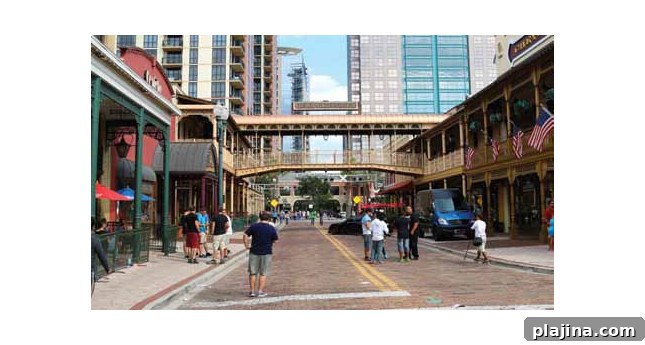
Many of the more than 60 million visitors who come to Orlando treat the city as a stopover on their way to theme parks or beaches. Skipping what Orlando itself offers, however, overlooks a dynamic, growing destination with much to discover.
“Our downtown is on fire,” says Mayor Buddy Dyer. “We’ve had the most incredible year ever. I’m the happiest mayor in America right now.”
There are clear reasons for that optimism. Orlando has opened a major performing arts center and is building a new Major League Soccer stadium. The Orange County Convention Center is undergoing a multi-year transformation, and Orlando International Airport is expanding and renovating to become Florida’s first intermodal transportation facility, integrating air, ground and rail connections.
Downtown Orlando is highly walkable and served by a free bus that runs a three-mile loop with 21 stops. The commuter rail SunRail has been extended to cover 31 miles with multiple city stops, and a bike-share program gives visitors easy, car-free options for getting around.
Amway Center © Giprico9 | Dreamstime.com
The Church Street District is one of the liveliest nightlife areas, offering dining, bars and entertainment, and it sits adjacent to the Amway Center, the city’s primary arena for sports and major events. The Amway Center is home to the NBA’s Orlando Magic, the ECHL’s Orlando Solar Bears and the AFL’s Orlando Predators. Orlando recently welcomed an MLS expansion team, the Lions, who currently play at the Orlando Citrus Bowl and will move to the new downtown soccer-specific stadium when it opens.
Public art has become a priority for the city. In 2011, See Art Orlando installed eight permanent contemporary sculptures around Lake Eola, the heart of the 43-acre park. Nearby Thornton Park’s brick-lined streets invite visitors to browse boutique shops and dine outdoors at locally owned restaurants.
Last November the $514 million Dr. Phillips Center for the Performing Arts opened across two city blocks. The center includes the 2,700-seat Walt Disney Theater, the 300-seat Alexis & Jim Pugh Theater, an outdoor plaza and education and event spaces; plans for a 1,700-seat acoustical theater are underway.
“Orlando recently experienced one of the most significant expansion periods in our destination’s history,” says George Aguel, president and CEO of Visit Orlando. “Six months ago, the Four Seasons joined Orlando’s stable of luxury properties that already includes The Ritz-Carlton and Waldorf Astoria.”
The major theme parks remain central to Orlando’s identity and economy. Walt Disney World Resort is transforming Downtown Disney into Disney Springs, vastly increasing retail and dining options. Universal Orlando expanded its offerings by completing Diagon Alley and connecting attractions across Universal Studios and Islands of Adventure. SeaWorld Orlando is also adding new experiences.
The Orlando Eye © Csproductions | Dreamstime.com
Mayor Dyer emphasizes the collaborative relationship between local government, the tourism industry and private business. That partnership, he says, has driven many civic improvements and helped support the city’s growth.
I-Drive 360 on International Drive is another recent addition to Orlando’s attractions. Merlin Entertainments introduced the 400-foot Orlando Eye observation wheel, alongside Madame Tussauds and SEA LIFE Orlando Aquarium. Nearby, Mango’s Tropical Café has opened a larger venue that brings a South Beach–style nightlife experience to the area.
The Orlando Economic Development Commission launched a campaign last December with the tagline, “Orlando. You don’t know the half of it.” With continued investment and new attractions opening, visitors are likely to keep finding fresh reasons to explore the city itself, not just the nearby parks.
SCENIC DRIVES
For visitors who want to drive on the sand, Daytona Beach—about an hour from Orlando—remains one of the few U.S. beaches that allows cars in designated areas along its 23 miles of shoreline.
Cars on Daytona Beach © Boreccy | Dreamstime.com
Just north of Orlando, the Ormond Scenic Loop & Trail is a more than 30-mile double-loop route that passes diverse coastal and inland habitats, offering ocean, river and marsh views, dunes and occasional wildlife sightings including dolphins. It provides numerous photo stops and an immersive way to experience Florida’s coastal landscape.
East of the city, the Green Mountain Scenic Byway follows roughly 14 miles of Lake Apopka’s shoreline and climbs to hills with views of the Orlando skyline. Notable stops along the route include Sugarloaf Mountain, the highest point in peninsular Florida at 312 feet; the historic 19th-century Harper House; and the scenic town of Montverde.