
China’s crowded, traffic-clogged cities make escaping to a peaceful refuge appealing, and Hainan Island answers that call. Designated the country’s premier vacation destination, Hainan is a mountainous, tropical isle fringed with white-sand beaches and lush rainforest.
In 2009, the State Planning Council launched an ambitious program to transform the island into a world-class resort destination—often billed as “the Hawai’i of the East.” The comprehensive “2010–2020 Hainan International Tourism Island Development Planning Outline” set goals to expand tourism zones, add international air routes, upgrade infrastructure, promote eco-friendly options and raise living standards, all aimed at positioning Hainan as a top global island resort.
About the size of Puerto Rico, Hainan sits roughly 20 miles south of Guangdong’s Leizhou Peninsula across the shallow Qiongzhou Strait. Almond-shaped and covering about 13,000 square miles, the island measures near 100 miles in both length and width. It hosts cocoa and coffee plantations, surf-ready beaches, colonial towns, cultural sites, large shopping centers and two modern cities. Located at a latitude similar to Hawai’i, Hainan enjoys reliably warm weather year-round.
Two international airports serve the island, and a well-maintained highway network plus a high-speed rail line running along the north-south corridor at speeds up to 120 mph make Hainan easy to reach and navigate. Taxis are affordable, many resorts offer shuttle service, and travelers can move around comfortably by car or public transit. The main challenge is choosing where to start exploring.
Hikers and sightseers often head to the central highlands. Verdant plantations line roads shaded by palms and hedges, leading to the tranquil town of Tongshi/Wuzhishan, whose main street is shaded by enormous banyan trees. Nearby Wuzhishan (Five Finger Mountain), the island’s highest peak, offers trails through pine-scented forests and scenic valleys. Guides and a range of accommodations— from rustic chalets to upscale spa resorts such as DoubleTree’s Qixianling Hot Spring—are available.
The highlands are home to the Li and Miao ethnic groups, and several villages welcome visitors interested in local customs. The Hainan Nationality Museum houses prehistoric tools, woven textiles and cultural artifacts, and has been recognized for its quality exhibits.
For more adventurous trekkers, the Jiangfeng Primeval Forest Reserve in Hainan’s less-developed southwest provides rugged trails and dense, older-growth forest. Created to counter deforestation, the reserve is harder to access and offers limited lodging, but rewards dedicated hikers with abundant plant and insect life and sightings of native deer, partridges and gibbons.
Lake in the mountains, Yalong Bay Park © Aleksander Karpenko |
Dreamstime.com
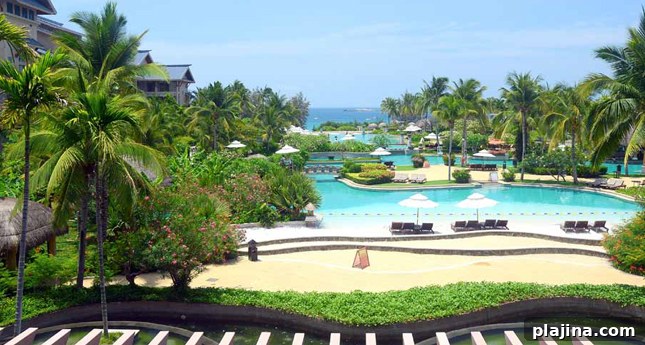
Most visitors come to Hainan to relax on the island’s spectacular beaches. The eastern coastline is ringed by white sand from north to south. Surfers find good breaks at Qingshuiwan and Shimei Bay, but many travelers fly to Sanya or take the high-speed train from Haikou to reach southern bays such as Haitang, Yalong, Houhai and Dadonghai. These beach strips are dotted with luxury international resorts—Marriott, Ritz-Carlton, St. Regis, Shangri-La, Sheraton, Westin and Conrad—each offering sea views, upscale accommodations and diverse dining options.
Travelers seeking a more urban experience may base themselves in the capital, Haikou, which blends historic attractions with seaside parks and modern resorts. Home to about a million people, Haikou features a lively Old Quarter centered on a reconstructed clock tower and a bustling market selling clothing, souvenirs and local snacks like dim sum and hot pots.
The Hainan Provincial Museum presents major local artists and traces the island’s artisanal traditions—porcelain, embroidery, bronze work, pottery and calligraphy. The Temple of Five Lords commemorates exiled dignitaries who contributed to the city’s cultural and educational life. Nearby, Leiqiong Global Geopark highlights Hainan’s volcanic past with displays of twisted lava flows, lava tubes, quirky rock formations and the crater of the extinct Fengluling volcano, whose stairways lead visitors down into a lush crater-jungle.
Despite its high-rises, Haikou remains a seaside city. A wide beach lined with greenery, golf courses and pavilions stretches along the coast; the three-mile Holiday Beach west of town is popular with cyclists, joggers and picnickers. The Shangri-La Hotel Haikou, located near the convention center, is a favored retreat for business and leisure travelers. Its marble lobby and rooms offer sea and garden views, while an outdoor pool area includes natural hot springs. The hotel’s seaside restaurant serves Mediterranean dishes, and guests can sometimes join the chef to select fresh seafood from local fishermen at a nearby cove.
Front balcony of CDF Mall, the world’s largest duty-free shopping center © Tassaphon Vongkittipong |
Dreamstime.com
After becoming a separate province and a Special Economic Zone in 1988, Hainan developed into a freer trading hub. Today the economy includes large outlet malls and duty-free centers that attract tourists and locals alike. South of Haikou in Wanning, Capital Outlets features up to 300 international brands and offers amenities such as bars, a children’s playground and serviced apartments near several five-star hotels. Near Sanya, the swoop-roofed CDF Mall houses luxury names like Prada, Gucci, Dior, Chanel and Rolex, and is one of the world’s largest duty-free shopping centers.
Currently, only about 10 percent of Hainan’s visitors come from outside the Far East, and resort operators are actively courting international travelers by expanding flight options and providing more English-speaking staff. Visitors are welcomed warmly as the island continues to develop its appeal as China’s leading vacation destination.
Hainan Info to Go
Haikou’s Meilan International Airport (HAK) and Sanya’s Phoenix Airport (SYX) handle numerous domestic and international flights. The high-speed railway connects at Meilan’s terminal; Sanya’s train station is roughly six miles from Phoenix Airport. Taxis are inexpensive, with a small initial drop charge covering the first two kilometers. A half-hour taxi ride typically costs around $30. An extensive and reliable bus network serves short trips; for example, a 35-cent public bus fare covers the roughly hour-long journey from Haitang Bay into downtown Sanya.