
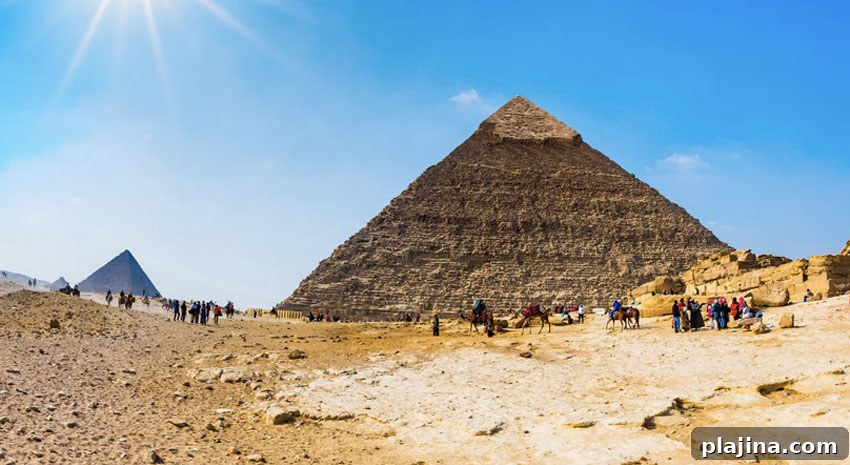
FORTY-THREE YEARS represents a large portion of my life, though it is a blink compared with the age of the Pyramids of Giza. Those monuments stood above the surrounding desert for some 4,500 years before I first visited them as a boy in 1976.
We traveled from Cairo by taxi, crossing fields and open desert. The Yom Kippur War had taken place less than three years earlier, and tourism had not yet recovered. At the pyramids, local guides, souvenir sellers and camels far outnumbered the visitors.
On my next trip there in 2008, the city felt much closer. A coach from my downtown hotel took me to Giza, where the urban sprawl of Africa’s largest city already reached the pyramid complex. Coaches filled the parking area and I joined the larger crowds walking to the base of the nearest pyramid. The Saharan sun shone strongly, and hawkers were busy selling cold drinks and souvenirs.
That boom in visitors ended after the 2011 Egyptian revolution. For a while the pyramids were nearly as empty as they had been in 1976. Visitor numbers slowly rose again, with more tour groups arriving from China and other parts of Asia, though they have not returned to their pre-revolution highs.
A renewed tourism surge is likely once the new museum near the site opens. About a mile and a quarter from the pyramid complex, the Grand Egyptian Museum is taking shape and will provide a proper home for Egypt’s priceless ancient artifacts.
Until recently, most of these treasures were kept in the Egyptian Antiquities Museum in downtown Cairo, displayed in old glass cases in somewhat neglected exhibition halls. Missing panes of glass and crumbling plaster gave the place an Indiana Jones feel, but the collection clearly needed a more secure, modern setting.
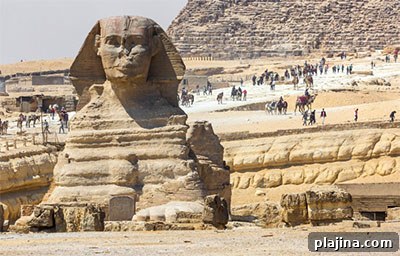
Great Sphinx © MARIUSZ PRUSACZYK – DREAMSTIME.COM
Last year the careful work of moving exhibits from the old museum to the new Giza facility began. There is still no fixed opening date for the Grand Egyptian Museum: the original target of 2012 was missed, and subsequent delays — including a construction-site fire — pushed the timetable back. Current plans suggest a partial opening in 2020, with highlights such as the treasures of Tutankhamun among the first items to be displayed. When fully open, the museum will be a world-class attraction and a fitting complement to the nearby pyramids and Sphinx.
For now, the pyramid complex alone is reason enough to visit Giza. Your first view of these immense stone structures gives the uncanny sense of seeing something once thought mythical brought into the present. From a distance, their smooth slopes seem almost intact; up close the rugged reality is revealed. The Great Pyramid alone comprises roughly 2.3 million massive, weathered limestone blocks, many weighing three tons or more. At 481 feet high, it remained the tallest man-made structure in the world for about 3,800 years until surpassed by Lincoln Cathedral in 1311.
Giza contains three main pyramids and six much smaller ones, several tombs and temples, and the Great Sphinx on the eastern side. Everywhere you turn, the views are instantly recognizable and iconic.
Hawkers can be persistent, and visiting the Sphinx at peak times may mean jostling among coach-loads of tourists. With patience, however, you can find quieter moments. Staying at one of the hotels in Giza helps: you can be on site before the coaches arrive from downtown Cairo in the morning and after they depart in the late afternoon, enjoying more peaceful stretches of the complex.
At the right spot in the right light, history feels immediate. The Pyramids of Giza allow you to bridge millennia in a way few modern places can, and that is why they belong on many travelers’ bucket lists.
Giza Info to Go
International flights land at Cairo International Airport, roughly nine miles northeast of downtown Cairo and about 18 miles northeast of the pyramid complex. As the downtown Egyptian Antiquities Museum transfers its collection to the new Grand Egyptian Museum at Giza, staying in downtown hotels becomes less essential. Many Giza hotels offer airport shuttles for around $70 one way, while private transport companies at the airport typically charge about $30 for a return transfer.