
My son and I arrived in Dublin after driving through fog and sleet on the motorway from Galway. The warm glow from The Gibson Hotel’s glass-cube façade felt like a welcome beacon on a dreary late-winter afternoon. With its contemporary design and original Irish modern art displayed throughout the guestrooms and public areas, The Gibson is one of many designer-driven buildings that now line the River Liffey in the revitalized east Dublin district known as the Docklands.
Dublin is still celebrated for its literary giants — Jonathan Swift, James Joyce, Oscar Wilde and George Bernard Shaw — and for musical icons like U2 and the lively pubs of Temple Bar. But the city’s most striking recent transformation is the 1,300-acre Docklands, an ambitious urban renewal project led by the Dublin Docklands Development Authority. The area now features public plazas, new office buildings, river bridges, converted warehouses, and riverside promenades that have reshaped the eastern riverfront.
The city’s economic surge during the “Celtic Tiger” era of the 1990s brought returning expatriates and a wave of financial and tech firms establishing offices in Dublin and beyond. The subsequent financial collapse that began in the late 1990s hit Ireland hard, yet funds set aside under the 1997 Docklands Development Authority Act allowed a number of landmark buildings to be completed between 2007 and 2010. These included headquarters for banks and corporations, theaters, galleries, hotels, high-end residential developments, and a post-modern convention center. Many of these structures, created by internationally renowned architects, drew the attention of planners and architecture enthusiasts worldwide and helped give the Docklands a modern, polished identity even as the wider country endured austerity measures.
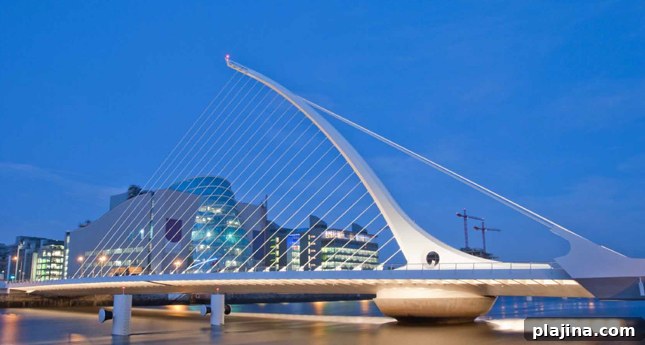
For visitors who enjoy urban renewal and thoughtful redevelopment, Docklands is especially rewarding. Once a 19th-century ship-loading area, the site later hosted a fertilizer plant and served as a dumping ground for sewage. Today it stands revitalized. On the north bank of the Liffey sits the Convention Centre Dublin, designed by Irish-born architect Kevin Roche. Opened in 2010, the building resembles an overturned glass drum — or, to some observers, a Guinness bottle leaning against a concrete block — and offers impressive views of Santiago Calatrava’s Samuel Beckett Bridge and the city skyline. Roche, a Pritzker Prize winner who built much of his career in the United States, delivered his first Irish commission with the Convention Centre, which also stands out as a carbon-neutral facility.
Across the river on Grand Canal Square is the Bord Gáis Energy Theatre, a 2010 creation by Daniel Libeskind. Its sharply angled stainless steel and glass façade draws pedestrians into a brightly lit lobby on performance nights. Grand Canal Square, completed in 2007 and designed by Martha Schwartz Partners, is the district’s vibrant centerpiece: a playful paved plaza with a cascading marble fountain and tall, angled red light sticks that illuminate the square and create a dynamic evening atmosphere.
As sports fans, my son and I were drawn to the curving form of Aviva Stadium, completed in 2010 on the site of the historic Lansdowne Road Stadium in Ballsbridge. Lansdowne Road, which dated back to 1872, was demolished in 2007 to make way for the modern replacement. Designed by Populous and Scott Tallon Walker, the new stadium features a transparent, shingled exterior that was visible from our hotel in Docklands. We joined a public tour to explore the venue usually used for rugby and soccer, and which has also hosted international events such as the American college football game between Navy and Notre Dame.
Those projects marked some of the last major completions in Docklands as the Irish economy began a slow recovery. When we visited, several construction sites were paused: cranes stood idle on the skyline and blue tarps flapped over unfinished roofs and empty window openings, a reminder that development can be uneven.
Still, signs of renewed confidence began to appear. Tech giants like Google, which established a presence on Barrow Street in 2004, and Facebook, which operates its European headquarters in Docklands, announced plans to expand. Along with LinkedIn, Zynga, and many other internet firms, the area — often nicknamed “Silicon Docks” — regained momentum. The long-anticipated opening of The Marker, a deluxe hotel on Grand Canal Square, was also announced, signaling continued investment in the neighborhood.
Beyond architecture, Docklands hosts a growing contemporary art scene, with galleries such as Green on Red and The Loft Gallery offering engaging exhibitions. For a different perspective, the Spirit of Docklands river cruise runs March through October: a glass-roofed boat provides a 45-minute narrated trip along the Liffey with views of the new buildings and bridges, rain or shine.
The city’s bike-sharing program, Dublinbikes, makes exploring easy with dozens of stations where users unlock bicycles with a credit card and return them to any station along their route. Over several days of walking and cycling, my son and I covered all of Docklands and many central neighborhoods, appreciating the mix of contemporary design, public space and urban life.
The Docklands project succeeds as a forward-looking inner-city district that blends cultural, commercial and residential uses into a cohesive neighborhood. Yet because it borders more rugged parts of north Dublin and the working port to the east, the area retains character: narrow alleys, windswept corners and an edge that prevents it from feeling like a sanitized theme park. The glowing light sticks on Grand Canal Square and Calatrava’s white bridge are striking, but the district’s context keeps them grounded in real city life.
Info To Go
The three-mile Dublin Port Tunnel reduces drive time from Dublin Airport to the city center by avoiding local street congestion. Transfers from the airport to downtown take about 20 to 30 minutes by Airlink bus service or by taxi. Major car rental companies operate from the airport. Docklands is close to the city center and well served by public transit, including intercity and commuter trains, Dublin Bus services and the LUAS light rail network.
Lodging
Dylan Hotel
This family-owned, five-star boutique hotel occupies a restored Victorian building and offers 44 guestrooms with modern amenities, plus an excellent restaurant and bar.
Eastmoreland Place $$$–$$$$
The Gibson Hotel
An eclectically designed hotel with a bar and restaurant overlooking the O2 amphitheater and a nearby light rail stop. Point Village, North Wall Quay, Docklands $$–$$$
The Merrion Hotel
Made up of historic Georgian townhouses in a fashionable neighborhood, this five-star property includes a spa and top-tier dining. Upper Merrion Street $$$$
Dining
Ely Bar & Brasserie, IFSC
Set in a converted 200-year-old tobacco and wine warehouse, the menu highlights locally sourced and organic produce. Irish Financial Services Centre $$–$$$
L. Mulligan Grocer
A restored Irish pub with a welcoming atmosphere, offering gourmet sausages, fish and lamb dishes, plus a broad selection of craft beers and whiskeys. 18 Stoneybatter $$–$$$
Thornton’s Restaurant
Chef Kevin Thornton’s acclaimed restaurant presents creative menus focused on local produce, available as lunch and dinner tasting menus. The Fitzwilliam Hotel, 128 St. Stephen’s Green $$$$
Practical Notes
Docklands illustrates how thoughtful urban planning and investment can transform former industrial ground into a lively, mixed-use district that complements Dublin’s historic core. Whether you’re interested in architecture, contemporary art, sports venues or simply exploring a rejuvenated neighborhood, the Docklands area offers a compelling blend of modern design and authentic city life.