
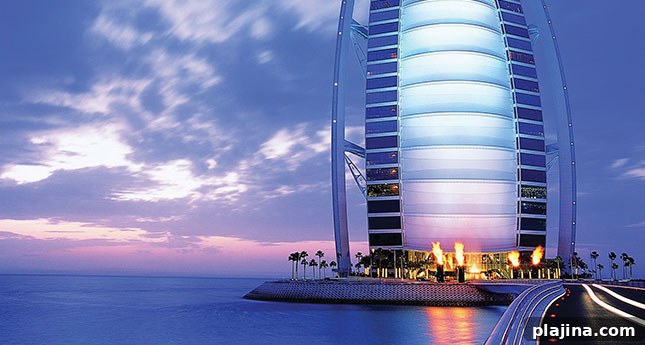
During a trip to Dubai a few years ago, I remember feeling surprised when a crowd gathered outside my hotel, all staring up at its highest point. I was staying at the iconic Burj Al Arab, the sail-shaped landmark that defines much of Dubai’s coastline and markets itself as more than a five-star hotel. That morning the attention was unusual—but harmless: Andre Agassi and Roger Federer were on the hotel’s helipad to promote the upcoming Dubai Open in a highly publicized exhibition.
Dubai can feel like Las Vegas meets a futuristic theme park. It boasts glittering hotels (though no casinos because of Islamic law), an indoor ski slope, pristine beaches, championship golf courses and a vast selection of gourmet restaurants. Shopping malls here rival small towns, with some housing more than 600 stores.
“I would describe Dubai as East meets West, or tradition meets the 21st century,” says Frederic Bardin, senior vice president of Arabian Adventures, a destination management company that arranges travel and events across the emirate.
The city retains elements of its past: the traditional souk along Dubai Creek, a waterway that made the city a key stop on the ancient spice route, and traces of Bedouin culture. Yet modern architecture rises constantly, producing a striking juxtaposition of old and new. As one observer noted, “If you want to see the future, go to Dubai.”
That future includes ambitious projects such as the Palm Islands and the World Islands—land reclaimed from the sea—along with luxury enclaves, the world’s tallest building and infrastructure designed to stay ahead of rapid growth.
Tourism, meetings and conventions have expanded steadily over the past decade, and an increasing share of visitors come from the United States. In 2008, Dubai hosted meetings for many major international associations, including the World Economic Forum, the World Association of Chefs’ Societies and the Global Travel and Tourism Summit.
The meetings and conventions sector fits Dubai’s long-term economic strategy. After oil was discovered in the U.A.E., local leadership decided to use energy revenues to diversify the economy into technology, tourism and transportation—aiming to become a regional air and sea hub similar to Singapore.
Dubai’s geographic position—convenient to both Europe and Asia—drives much of its development. Weekly, around 120 airlines connect Dubai to more than 200 destinations. Emirates, the rapidly growing national carrier, expanded nonstop service to cities such as San Francisco, Houston and New York. The emirate also hosts a large hotel inventory, comparable in room count to a city like San Francisco, with options across a wide price range.
Why choose Dubai for a meeting? “Convenience and safety,” says Bardin. The U.A.E. is frequently rated among the safest destinations globally, and service standards are world-class.
Despite being a Muslim country, Dubai maintains a relaxed and tolerant atmosphere. Beachwear varies from bikinis to more conservative attire, and alcohol is available in hotels and hotel restaurants. Nearly 89 percent of Dubai’s workforce comes from abroad, contributing to a cosmopolitan environment.
Beyond the indoor ski slope, Dubai offers top-tier sports facilities and golf courses, plus expansive desert landscapes where visitors can enjoy eco-tours, four-wheel-drive rallies and bird-watching. The climate provides year-round sunshine: winters are mild (about 68–77°F), while spring and autumn can reach into the mid-80s and 90s; summer, however, can be extremely hot.
Luxury lodging extends well beyond the Burj Al Arab. Every major international hotel brand operates in Dubai, alongside homegrown names such as Jumeirah International. As demand for meetings has increased, so has local capacity to deliver comprehensive services—from airport and cruise transfers to meetings staged in dramatic desert locations or even recreated desert settings inside hotel ballrooms.
Arabian Adventures, for example, manages historic fort ruins used for events of up to 4,500 people and offers tented desert venues with air conditioning for summer months. The company has accommodated up to 15,000 conference participants in a single week.
CONVENTION CENTERS
DUBAI AIRPORT EXPO
This facility provides about 110,000 square feet of exhibition space, primarily for trade and consumer shows. It includes office space within the hall, extensive external storage, and multipurpose rooms that seat 25 to 180 people. Full services, including catering, are available. The venue is located just two minutes from Dubai International Airport.
DUBAI EXHIBITION CENTRE
A major new venue under construction and scheduled to open in October, the Dubai Exhibition Centre is being developed near Al Maktoum International Airport. Located roughly 30 minutes from downtown Dubai and about 90 minutes from Abu Dhabi, it will be an integrated destination for business, events, trade and retail, offering a permanent home for many enterprises and a meeting point for international executives.
DUBAI INTERNATIONAL CONVENTION AND EXHIBITION CENTRE
Situated in the heart of the city, this state-of-the-art facility is approximately 15 minutes from Dubai International Airport (DXB) and is convenient to many city hotels, with some properties connected directly to the center. Opened in 2003, the center offers more than 1 million square feet of exhibition space and full audiovisual, office and storage services. Onsite dining ranges from mobile food stations and cafés to fine dining; the center’s culinary team can serve a five-course banquet for up to 6,000 guests.
OTHER VENUES
A wide variety of smaller venues and business facilities leverage Dubai’s resources and location. Examples include Al Boom Tourist Village, Dubai Creek Golf and Yacht Club, Emirates Golf Club, Dubai Internet City, Dubai Media City and Dubai Knowledge Village.
MEETING HOTELS
BURJ AL ARAB
This attention-grabbing five-star hotel features duplex suites, personalized butler service and lavish amenities. It hosts celebrities, world leaders and business groups, offering meeting rooms that range from boardrooms to ballrooms, supported by exceptional dining options.
CROWNE PLAZA DUBAI FESTIVAL CITY
Connected to the Festival Centre along Dubai Creek and a short ride from the Dubai International Convention and Exhibition Centre, this five-star hotel has 316 rooms and extensive conference facilities, including 22 meeting rooms. The adjacent Festival Centre features hundreds of shops and dining options.
HILTON DUBAI CREEK
Located on the water, this luxury hotel offers 154 rooms, meeting facilities and an executive lounge. Several onsite restaurants—including a venue by a Michelin-level chef—serve a range of international cuisines.
HOTEL IBIS WORLD TRADE CENTRE DUBAI
A three-star business hotel connected to the International Convention and Exhibition Centre, the Ibis provides 210 rooms, conference facilities, WiFi and multiple dining and bar options—an economical choice for business travelers.
HOTEL NOVOTEL WORLD TRADE CENTRE DUBAI
This four-star property, also connected to the International Convention and Exhibition Centre, features 412 rooms, eight meeting rooms, restaurants and fitness facilities, catering to conferences and seminars.
KEMPINSKI HOTEL MALL OF THE EMIRATES
Linked to one of the region’s largest shopping centers, this five-star hotel offers 393 rooms, conference facilities and a full range of leisure amenities, with international dining and entertainment options onsite.
SHANGRI-LA HOTEL DUBAI
Located in downtown Dubai near the Convention and Exhibition Centre, this five-star hotel provides 301 rooms and several dining venues, including an acclaimed Cantonese restaurant for guests and delegations.