
Forty-one years of communist rule left a visible imprint on Dresden, but the city’s most devastating wounds were inflicted in just 48 hours. From February 13–15, 1945, British and American bombers passed overhead, thousands of explosives fell, and one of Europe’s most beautiful cities was transformed into rubble and ash.
The physical and emotional scars remain visible. On the edge of Neumarkt, the cobbled square at the heart of the Old Town, excavations have revealed soot-blackened cellar remains where frightened residents sought shelter during the raids.
At least 30,000 people lost their lives in the assault. Once celebrated as “Florence on the Elbe,” Dresden became synonymous with mourning: for many in Germany and beyond, the name now carries the tolling weight of a funeral bell.
When Germany was divided after the war, Dresden found itself in the communist East. Authorities lacked the will and resources to restore the bomb-shattered Old Town fully, and large swaths remained as ruins. Those ruins were exploited in propaganda as evidence of the supposed threat from the capitalist West.
Outside the historic core, neighborhoods were flattened and rebuilt as a showcase of socialist planning: apartment blocks, wide boulevards, and a new civic center. Where palaces and churches once dominated, the modernist Kulturpalast (Culture Palace) rose, its façade decorated with a mural of heroic workers.
The socialist era ended in 1990. With reunification came energetic plans to revive Dresden’s historic center. The ambitious centerpiece was the Frauenkirche, Dresden’s celebrated domed church. Although it withstood the bombing, it collapsed the day after the attack.
Restorers meticulously sorted through ruins and recovered 3,634 original limestone blocks to use in an extensive reconstruction that cost about $250 million. Work began in 1994 and concluded in 2005.
The restored Frauenkirche is striking: roughly 45 percent of the masonry is original, its darkened surfaces a witness to the firestorm of 1945. These charred fragments are interwoven with new stone so that the building reads as both a memorial and a living reconstruction. The moment of destruction seems preserved, yet the interior invites renewal.
Stepping through the doors, visitors encounter Dresden’s golden age: soaring columns, curved balconies and pastel-painted surfaces recreate the exuberant Baroque interior. The nave evokes the church as it might have appeared in the 1730s—restored, bright and renewed rather than a dusty relic.
A spiraling ramp between the dome’s inner and outer shells leads to a viewing platform about 200 feet above the city. From there, cranes hover over the Old Town as red-tiled roofs and historic townhouses are gradually brought back to life along the medieval maze of streets.
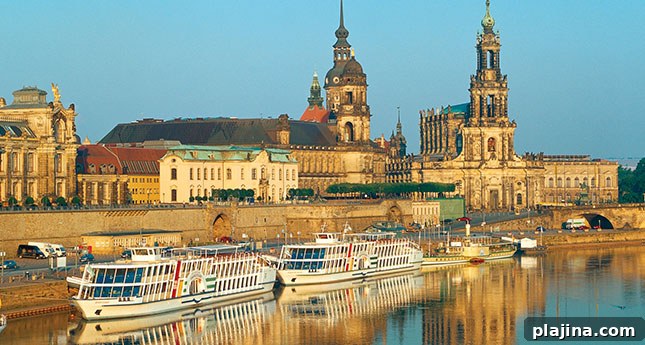
Many major palaces and churches have been reconstructed and now line the Elbe. Yet Dresden was planned as theatrical scenery: its cluster of Baroque façades, ornate spires and domes is best appreciated from the river.
Tourist boats ply the Elbe, offering the postcard view of Dresden’s skyline. Despite the occasional crowded commentary, the river perspective can make the 1945 devastation feel like a distant nightmare, with the rebuilt city rising anew.
Above the southern bank, the Brühlsche Terrasse—once called the Balcony of Europe—provides an elevated promenade with sweeping views of the Old Town. As you stroll, reminders of the past are unavoidable: many buildings still bear the marks of the firestorm.
The decision to bomb Dresden remains a matter of debate. Today the city stands as a stark example of how fragile cultural achievements can be: centuries of artistic and architectural labor can be destroyed in an instant.
Although Dresden is being reborn, the shadow of 1945 endures. Atop the Frauenkirche a golden cross gleams in sunlight; it was donated by the United Kingdom and forged in London by the son of a bomber pilot who participated in the raid. Against the blue sky it serves as a quiet reminder to forgive but not forget.
LODGING
DRESDEN HILTON
Excellent Old Town location overlooking the Elbe. Large, modern hotel with full amenities. $$$$
An der Frauenkirche 5
tel 49 351 86420
HOTEL MARTHA HOSPIZ
Fifty traditionally furnished rooms within easy walking distance of the main attractions. Good value. $$
Nieritzstraße 11
tel 49 351 81760
KEMPINSKI HOTEL TASCHENBERG PALACE
Set in a restored palace, the Kempinski offers 214 luxurious rooms in the Old Town. $$$$
Am Taschenberg
tel 49 351 49120
DINING
MANGOO
A surprising and successful mix of German and Caribbean flavors. $$
Kreuzstraße 1–3
tel 49 351 49766
PATTIS
Chef Mario Pattis creates modern cuisine informed by Saxon traditions. About ten minutes from the center. $$$
Romantik Hotel & Restaurant Pattis, Merbitzer Strasse 53
tel 49 351 42550
RISTORANTE BELLOTTO
Classic Italian dishes served in a historic building on Theaterplatz, conveniently close to the Opera House.
Italian Village, Theaterplatz 3
tel 49 351 498160
DIVERSIONS
How authentic is the Old Town today? After such comprehensive destruction, questions of authenticity are inevitable. Even the most careful restoration cannot fully restore the continuous historical timeline, so surviving treasures carry extra significance.
One remarkable survivor is the 335-foot Fürstenzug, a mural composed of 24,000 porcelain tiles that depicts 93 rulers and dignitaries of Saxony. It decorates the side of Langer Gang, a narrow street leading toward the cathedral.
The Langer Gang leads to the Hofkirche, built in 1751 as the private church of King Augustus III. Its tower survived the bombing; the rest of the church was reconstructed and in 1973 was dedicated as a memorial chapel to Dresden’s war dead.
Nearby is the Schloss, the Renaissance palace of the Saxon royal family. Its west wing houses the Grünes Gewölbe (Green Vault), restored to eighteenth-century splendor in 2006 and home to a priceless collection of documents, gold and jewels that endured the war.
The Frauenkirche, once Dresden’s greatest architectural loss, now stands as a source of civic pride. It dominates Neumarkt, the central square immortalized in 18th-century paintings by Canaletto. Although the surrounding buildings were almost entirely destroyed, they are being carefully rebuilt.
Neumarkt remains a traditional gathering place, while the Brühlsche Terrasse offers sweeping views over the Elbe. On a sunny day both spots are ideal for watching the city pass by. Cross the Augustus Bridge and you can relax on the grassy Elbe Meadows across from the Old Town.
Restoration efforts and new cultural attractions help evoke Dresden’s past. The Asisi Panometer displays an immersive 360-degree panorama of the city in 1756, painted inside a nineteenth-century gas storage building for dramatic effect.
Within walking distance of the Old Town is the Transparent Factory, Volkswagen’s visitor-friendly assembly plant. With glass walls revealing the production line, it blends industrial transparency with modern design.
INFO TO GO
Dresden Airport (DRS) is about 7.5 miles north of the city. A taxi to the Old Town costs around $25; by rail or bus the one-way fare is approximately $2.50.