
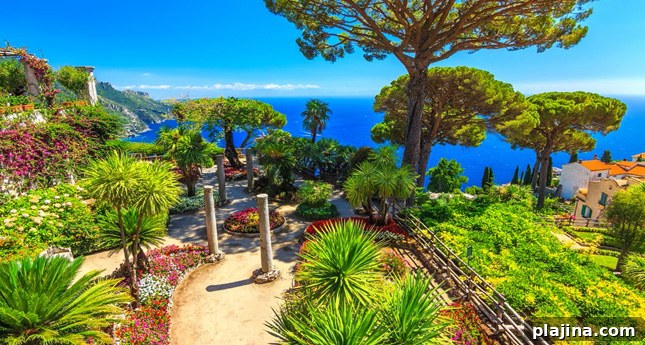
Iconic images come to life along Italy’s Amalfi Coast, one of the world’s most breathtaking regions. Clusters of cube-shaped houses in peach, pink, yellow and terracotta appear to tumble down steep cliffs in charming towns such as Positano, Ravello and Amalfi. The sea is brilliantly clear and blue, sometimes turquoise, sometimes sapphire. Lush palms, flowering terraces and citrus groves create a landscape that feels both cultivated and wild. Once favored by Roman emperors, this fabled stretch south of Naples in Campania—where myth says the Sirens of The Odyssey lured sailors—emerged from a sleepy fishing economy to become a must‑visit on the 19th-century Grand Tour. Artists, writers, composers and intellectuals have long come here for inspiration; plaques throughout the towns mark their presence. Richard Wagner was moved by Villa Rufolo’s gardens in Ravello and used them as inspiration in his opera Parsifal. D.H. Lawrence completed Lady Chatterley’s Lover here, and Henrik Ibsen worked on A Doll’s House while visiting. Gore Vidal, a Ravello resident, famously called the view from Villa Cimbrone “the most beautiful view in the world.”
Summer draws crowds, so plan several days rather than a single day trip to truly absorb the atmosphere. The terrain dictates one direction: up. Streets comprised of stairways—scalinatelle—are common and many paths are steep. Wear comfortable shoes and, when possible, take buses uphill and walk down. If you consider driving the Amalfi Drive (Statale 163), the roughly 30-mile route between Positano and Vietri sul Mare, reconsider: narrow lanes, hairpin turns, steep drops and oncoming buses make driving stressful. Instead, ride as a passenger and enjoy the engineering carved from the Lattari Mountains without worrying about the wheel.
Ravello sits well above the shoreline, more than 1,000 feet over the Bay of Salerno, and its gardens and terraces offer jaw-dropping panoramas. Villa Rufolo’s geometric gardens, 14th-century tower and Moorish-style cloister are famed for their beauty and atmosphere. During summer, an orchestra platform is sometimes erected, cantilevered over the sea for the Ravello Music Festival, where classical concerts and ballet performances take place against a spectacular backdrop. Nearby Villa Cimbrone, rebuilt in the early 20th century, is celebrated for the Belvedere of Infinity, a stone parapet lined with classical busts that frames an unusually expansive view of the bay. Ravello is also home to several grand hotels housed in palatial villas—properties that blend antique décor with sweeping views and traditional ceramic tiles.
Amalfi itself, just a few miles from Ravello, was Italy’s first maritime republic during the 11th and 12th centuries, trading with North African and eastern Mediterranean ports. The Arab influence endures in narrow market-like alleys, a cathedral with a striped façade and an Arab-Sicilian cloister, and a long local tradition of papermaking. Visitors can learn about this craft at the Museo della Carta, housed in an old paper mill, and witness demonstrations of traditional techniques. Each year the town stages a historic regatta, a colorful reenactment of maritime battles between Italy’s ancient republics with participants in ornate period costumes.
View of the Faraglioni Rocks in Capri © LTORMA | DREAMSTIME.COM
Capri may carry a glamorous reputation, but it also offers quiet, rustic paths and secluded viewpoints just minutes from the designer shops of Capri Town. From the bustling La Piazzetta, reachable by funicular from Marina Grande, visitors can quickly find peaceful trails lined with bougainvillea and jasmine. The Gardens of Augustus provide splendid views of the Faraglioni, three towering limestone stacks rising from the sea. The island’s history includes Roman emperors Augustus and Tiberius; Tiberius governed Rome from Capri for years and left behind cliff-top ruins such as Villa Jovis. The Blue Grotto remains an unforgettable sight—an inner cave illuminated by an intense blue light caused by sunlight filtering through an underwater opening. Villa San Michele in Anacapri, built by a Swedish physician and antiquities collector in the late 19th century, features Roman-style courtyards, marble walkways and panoramic terraces with classical sculptures overlooking the Bay of Naples. From Anacapri you can reach Philosophical Park, where ceramic panels display quotes by thinkers and writers along shaded paths, or ride a short chairlift to Monte Solaro, the island’s highest point, for sweeping views.
Positano’s steep vertical townscape inspired John Steinbeck when he called it “a dream place that isn’t quite real when you are there and becomes beckoningly real after you have gone.” The town is divided into lower, middle and upper neighborhoods, with rainbow-colored houses clinging to the hills above Spiaggia Grande and the quieter Spiaggia del Fornillo. Positano hosts renowned hotels set in former palaces or cliffside estates, each offering postcard views of the coast.
In contrast to the coast’s intimate charm, Rome presents monumental scale and a dense layering of history. The city’s major sights range from the sublime to the brutal: Michelangelo’s ceiling in the Sistine Chapel and masterpieces in the Vatican Museums; the Colosseum, where gladiatorial contests once enthralled and horrified crowds; and archaeological sites that recall the city’s imperial past. For a panoramic perspective, visit one of Rome’s seven hills—Palatine Hill offers ruins linked to the city’s legendary founding and looks down over the ancient Forum. Iconic fountains like the Trevi and the Fountain of the Four Rivers in Piazza Navona enrich the city’s streets, while the Spanish Steps and the Keats-Shelley House evoke the era when many English writers made Rome their creative home. For a quieter retreat, Villa Borghese’s pine groves and galleries shelter important works by Titian, Caravaggio and Raphael, along with notable Bernini sculptures.
The Roman Forum as seen from Palatine Hill © DMITRY VARTANIAN | DREAMSTIME.COM
Amalfi Coast Info to Go
Rome’s Leonardo da Vinci International Airport (Fiumicino) is about 22 miles southwest of the city; the Leonardo Express train reaches Termini station in roughly 30 minutes. Trains run from Rome to Salerno in about two hours, and from Salerno SITA buses connect to Amalfi (about 75 minutes) and Positano (about two hours). Seasonal ferry services run April through October between Salerno and Amalfi (approximately 35 minutes) and Salerno and Positano (about 70 minutes). High-speed Frecciarossa trains link Rome and Naples in about 70 minutes. From Naples, the Circumvesuviana train serves Sorrento, and SITA buses connect Sorrento with Amalfi, stopping near Pompeii and Herculaneum. Ferries and hydrofoils operate year-round to Capri from Naples and Sorrento, with additional summer connections from Positano, Amalfi and Salerno.