
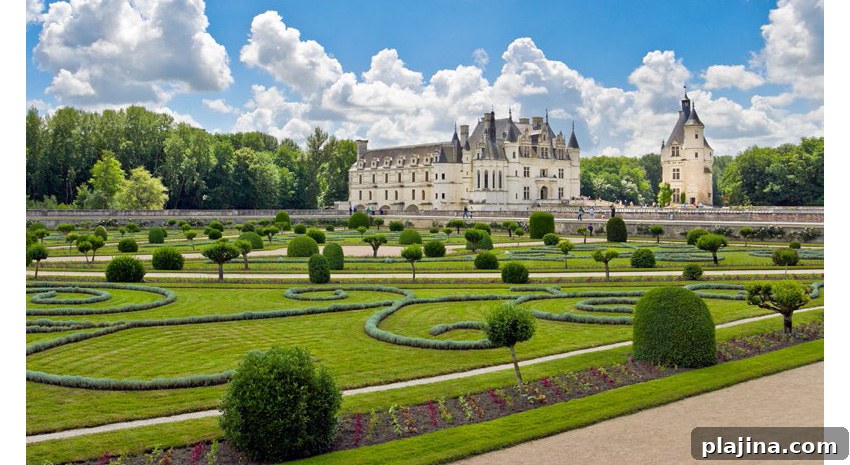
Once upon a time, before the kings and queens of France saw their power—and in many cases their heads—taken during the French Revolution, the nobility perfected the art of spending months in lavish countryside châteaux in the Loire Valley. Hunting was a major attraction, but so was escaping the formalities and pressures of court life.
Today’s visitors seeking a blend of relaxation, history and rural charm will find the Loire Valley much as the royals once did: sunny, picturesque and serenely countrified. The region’s story goes deeper than aristocratic retreats. The Loire was a center of power as far back as Roman times, and many early châteaux were built with fortifications. Still, what continues to captivate visitors is the valley’s scenic beauty and leisurely pace. A portion of the region is designated a UNESCO World Heritage site, and many celebrated châteaux remain open to the public; some operate as hotels or restaurants, while a few are private residences.
The appeal of the Loire—an approximately 15,000-square-mile area in central France—extends well beyond its famous residences. The countryside is the region’s heart: fields of sunflowers, pastureland dotted with farm animals, endless vineyards and tiny villages that often boast little more than a bakery and a café. Locals are generally welcoming. English may not be as widespread as in Paris, but people in tourism and hospitality are usually happy to speak English when they can. The Loire’s proximity to Paris is another advantage—you can reach parts of the region in as little as an hour by high-speed train.
Tours is the most convenient base for exploring the valley. More of a gateway than a destination in itself, Tours provides car rentals and rail connections to the surrounding countryside. The Loire is densely packed with attractions, so rather than trying to see everything, choose a few highlights and savor them.
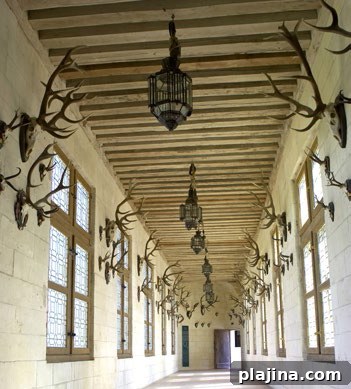
A corridor displaying hunting trophies at Chambord © GYNANE | DREAMSTIME.COM
If châteaux are your priority, Chambord is arguably the most famous and certainly one of the largest: a 16th-century Renaissance masterpiece where King Francis I hunted red deer on the grounds. The château’s dramatic double-spiral staircase—attributed by some to Leonardo da Vinci—adds to the lore and intrigue. Despite periods of neglect and looting during the Revolution, Chambord survived and even sheltered national treasures during World War II. Restored to its former grandeur, it remains one of the Loire’s best-known icons.
Another standout is Chenonceau, famed for both its fairy-tale beauty and its unique position spanning the River Cher. Visitors enter on one bank and leave on the other as water flows beneath the château’s elegant arches. Chenonceau has a colorful history: Catherine de’ Medici hosted lavish gatherings there in the 1500s, the corridors served as a hospital during World War I, and during World War II the château provided an escape route to the free zone across the river. Open year-round, Chenonceau is one of the region’s most visited sites.
Some castles tailor experiences for families. In Langeais, for example, oversized playing-card displays on the inner walls pose simple bilingual questions—“In the Middle Ages, did people eat with a fork or with their hands?”—making history approachable for children.
There are roughly 1,000 châteaux throughout the Loire Valley, so it’s impossible to see them all in a single trip. Notable names include Chinon, Amboise, Villandry and Azay-le-Rideau—each with distinct architecture and history. When planning, consider travel time and group interests, and allow several hours at each site to appreciate them properly. It’s also common to experience “château fatigue,” particularly when traveling with young children, so balance visits with other activities.
Wine tasting provides a pleasant counterpoint to château touring. Guided cellar visits, tastings and wine-pairing lunches are widely available, and many estates welcome visitors for independent tasting sessions. Drinking age in France is lower than in some countries—16 for certain beverages—so families should decide whether to include older teens in tastings.
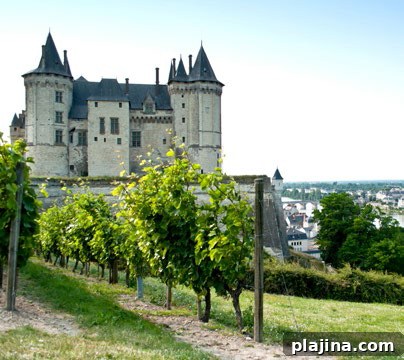
Saumur château and vineyard © NEYDTSTOCK | DREAMSTIME.COM
Explore cellar doors and wine shops in towns known for specific varietals. In Chinon, for example, the Cave de M. Plouzeau in the medieval quarter offers tastings in a vaulted, oak-barrel-lined cellar; English-speaking staff often explain the wines and sell bottles from nearby vineyards like Le Château de la Bonnelière. Other well-known Loire wines include Muscadet, Sancerre and Saumur.
Food markets are another highlight. Most towns host weekly markets, usually in the central square, where locals shop for cheeses, fish, produce, artisanal olive oil, pastries and breads. Markets vary by town and often take place one or two mornings a week. In Richelieu, a well-preserved walled town, market days are Monday and Friday and frequently include local vintners offering tastings.
For something unusual, visit a troglodyte site such as Rochemenier. This troglodyte village features ancient farms carved into rock with historical furnishings, an underground home and a chapel—an intriguing glimpse into a very different way of life.
The Loire and its tributaries, especially the Loire and the Vienne, make the valley ideal for kayaking and canoeing. Rentals are plentiful, and some operators combine cycling and paddling outings—cycle to a meeting point, then paddle back downriver. Much of the countryside is flat, which makes cycling easy for families and groups; distances between villages and attractions are short, allowing for leisurely stops and tastings along the way.
Music and art enrich the cultural landscape. Fontevraud Abbey in Anjou hosts concerts and art exhibitions throughout the year, and summer evenings bring sound-and-light shows and other outdoor cultural events across the region. The American sculptor and painter Alexander Calder spent part of his life here; one of his mobiles sits in the center of Saché, a village also associated with novelist Honoré de Balzac.
For a memorable perspective of the valley, consider a hot air balloon ride offered near several major châteaux, including Chenonceau, Blois, Chaumont, Azay-le-Rideau and Villandry. Drift above the patchwork of vineyards, rivers and gardens for a truly cinematic view.
INFO TO GO
Most travelers arrive via Tours Val de Loire Airport, just under four miles from Tours; taxi fares to the city center are roughly $17–34. Tours has two train stations: Gare de Tours, which links the region’s towns, and Saint-Pierre-des-Corps, serving most TGV high-speed trains to and from Paris. A high-speed trip from Paris can take about an hour and fares typically start near $60. TGV service from Charles de Gaulle Airport takes about an hour and 45 minutes and is generally priced around $70.
Where to Stay in the Loire Valley
CLARION HOTEL CHÂTEAU BELMONT A 65-room, 4-star property about 10 minutes from Tours airport with family-friendly amenities such as an indoor heated pool and free stays for children 12 and under.
57 Rue Groison, Tours $$$
HÔTEL AU CHARME RABELAISIEN A 10-room boutique hotel within walking distance of Amboise château and the market, welcoming to families with children.
25 Rue Rabelais, Amboise $$
HÔTEL SAINT-PIERRE, SAUMUR A 4-star, 14-room hotel near Saumur château offering airport shuttle service, free train-station pickup, complimentary parking and on-site childcare.
8 Rue Haute Saint-Pierre, Saumur $$
Restaurants in the Loire Valley
LES ANNEES 30 A stylish restaurant tucked into a cobblestone street in medieval Chinon, serving traditional dishes with a refined touch.
78 Rue Haute Saint-Maurice, Chinon $$$$
LE BISTROT DU BALTO A classic brasserie popular with locals, offering regional specialties just steps from Loches château.
11 Place du Marché au Blé, Loches $$
LA TABLE DE MARÇAY Dine in a château restaurant with gastronomic menus and wine pairings, or enjoy a lighter lunch in the garden.
Château de Marçay, Route du Château, Marçay $$–$$$$$