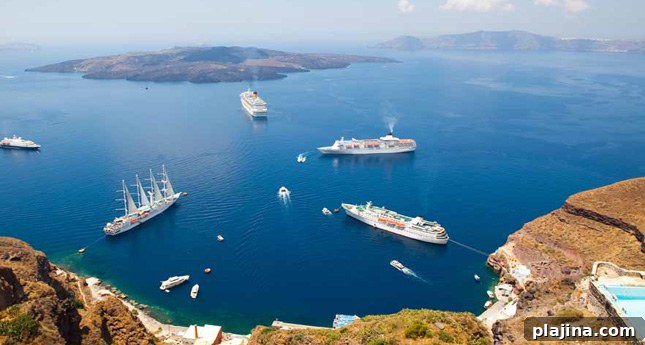
As our ship nears the vast, semi-circular rim of Santoríni’s volcanic caldera, the island’s chalk-white buildings come into clearer view, clinging to the cliffs. Sailboats dot the sheltered waters near small islets, dark volcanic outcrops that remain from one of the Mediterranean’s most powerful eruptions.
Our cruise vessel, the Celestyal Olympia, slows as tender boats assemble to ferry passengers ashore. Once we disembark, a bus winds up the steep hillside and delivers us to Oia, the village at the island’s northern tip. Known for its blue-domed churches and spectacular sunset views over the caldera, Oia draws photographers and travelers from around the world. Watching the sun sink and bathe the volcanic cliffs in orange and pink makes its popularity easy to understand.
Blue-domed church in the island’s village of Oia © Mikael Damkier | Dreamstime.com
Santoríni is perhaps the best-known of Greece’s roughly 100 permanently inhabited islands scattered across the Aegean and Ionian seas. These islands sit at the meeting point of millennia of history, with layers of ancient civilizations and more recent empires leaving visible traces. Today, historic sites coexist with contemporary restaurants, boutique hotels, upscale shopping and marinas filled with yachts.
While Greece’s economic troubles have been more visible on the mainland, especially in Athens, the islands often feel a world apart. Tourism has helped sustain many island communities, and infrastructure geared toward visitors ensures that short stays are comfortable and enjoyable.
Cruising is a popular way to explore the islands, with the main season running from April through October and peak sailings between July and September. Options range from large lines to smaller boutique yacht operators, offering both high-capacity ships and intimate excursions to quieter destinations.
The Greek islands are traditionally grouped by region. The Cyclades, located in the central Aegean, and the Dodecanese, near the Turkish coast in the southeast, are among the most visited. Many itineraries feature Santoríni and Mykonos, two highlights of the Cyclades.
In Santoríni, most visitors head to Oia for its postcard views. The island also holds archaeological treasures such as Akrotiri, a well-preserved Minoan settlement buried by volcanic ash. Nearby islands like Sikinos preserve a quieter, more traditional way of life, while spots such as the village of Kastro, the Manalis Winery and the dramatic Agios Nikolaos beach offer a mix of culture, cuisine and scenery.
Mykonos is renowned for its cosmopolitan energy and vibrant nightlife. Little Venice, where colorful buildings meet the sea, is a must-see. Wander the maze of alleys in Hora, the island’s port and main town, relax at a seaside bar or choose from beaches that range from serene to lively.
Naxos, the largest of the Cyclades, combines a lively town center with peaceful beaches, hilltop villages and ancient ruins. The Vallindras Distillery provides free tours and tastings, and the Melanes Valley contains impressive kouroi, the giant stone statues from antiquity.
The Dodecanese feel more remote and reveal a distinct historical blend: Byzantine churches, Ottoman influences and traces of Italian rule layer over ancient Greek remains. Rhodes, the largest island in the group, offers a compact mix of history and contemporary life. Disembark near Rhodes’ Old Town and stroll its cobbled streets within formidable medieval walls, where cafés and shops line passages once traveled by knights. Lindos, on the island’s eastern coast, is famed for its white houses clinging to cliffs and an Acropolis accessed by a pleasant uphill walk.
Tourists on the cobbled streets of Rhodes © Rangpl | Dreamstime.com
Kos boasts substantial archaeological sites, including the Asklepion—an ancient healing center associated with Hippocrates—and the Castle of the Knights. Mountain villages like Zipari, Asfendiou, Zia and Pyli offer traditional charm, while the island’s many beaches provide plenty of options for relaxation.
Samos combines myth and history: it is linked to Hera in legend and to philosophers such as Epicurus and Pythagoras historically. Highlights include the Heraion sanctuary and the remarkable Evpalinos Tunnel, an ancient engineering feat stretching over 3,300 feet underground. The Samos Wine Museum offers free tours and tastings for visitors interested in local viticulture.
Patmos is quieter and known for its religious significance. The Cave of the Apocalypse, where Saint John is said to have received visions recorded in the Book of Revelation, can be visited along with the adjacent Monastery of Saint John the Theologian.
Crete, Greece’s largest island, remains a major attraction for history lovers. The Palace of Knossos, center of Minoan civilization around 1900 B.C., is a top draw. Heraklion, the island’s bustling capital, hosts the Archaeological Museum, which showcases many important Minoan artifacts.
Greece Info to Go
Most island cruises begin and conclude in Piraeus, Athens’ main port, so flying into Athens International Airport is often the most convenient option. Direct flights to Athens are available from major U.S. gateways, or you can connect through European hubs. Ground transportation from the airport to Piraeus is available via taxis and private transfers.
Where to Stay in Greece
Kivotos Luxury Boutique Hotel A beachfront, art-focused property offering a spa, hammam and a private yacht available for guest charters. Ornos Bay, Mykonos.
Lindos Blu Luxury Hotel & Suites A contemporary hillside hotel with sweeping water views and attentive service, close to historic sites. Lindos, Rhodes.
Mystique, a Luxury Collection Hotel An adults-only retreat perched on the caldera rim with cliff-edge pools, sea-facing terraces and stunning vistas. Oia, Santoríni.
Restaurants in Greece
1800 In Oia, this acclaimed restaurant occupies a former sea captain’s mansion and serves modern Greek cuisine with dramatic caldera views. Oia, Santoríni.
M-eating A creative take on Greek cuisine in Mykonos; try regional specialties such as Mykonian honey pie. 10 Kalogera St., Mykonos.
Marco Polo Café A top choice in Rhodes for seafood and desserts, set in a charming courtyard with an extensive wine list. 42 Agíou Fanuríu St., Old Town, Rhodes.