
Most visitors to the Canadian province of Québec head to Montréal or Québec City, but since 1924 there has been a distinctive destination for travelers seeking public art in remote settings.
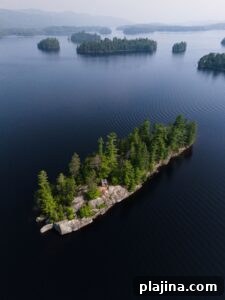
Perched on a rocky promontory of a secluded island, the public art installation Faire le vide unfolds within the wide landscape of Poisson Blanc Regional Park in the municipality of Notre-Dame-du-Laus, Québec.
© Maryse Béland
Located in Québec’s Laurentians, about 1.5 hours north of Ottawa, Poisson Blanc Regional Park offers year-round outdoor experiences. The park is a true escape: wilderness camping on islands, waterfront cabins, natural rock climbing on cliffs above the Poisson Blanc reservoir, fishing, hiking and a singular artwork on an island. In winter, frozen waters and trails invite cross-country skiing and snowshoeing on Montagne du Fort. With sandy beaches, scattered islands, clear water and dramatic viewpoints, the park is a memorable stretch of wilderness.
Launched in 2024 as the first in a series of artistic interventions across the park’s islands, this project aims to turn the reservoir into an open-air destination that combines nature and culture.
The installation appears as a wooden cube: a minimalist, nearly monolithic exterior that conceals an interior shaped by flowing curves and textured surfaces. It is the winning entry of a design competition developed by a team led by artist-architect Luca Fortin in collaboration with Atelier mock/up.
© Maryse Béland
Respectful of its setting, the monolithic form was designed to sit quietly within the island landscape. Accessible only by water—canoe or kayak—the installation reveals itself like a secret tucked into the reservoir. From the lake it reads as a subtle landmark, piquing curiosity and encouraging visitors to explore Island No. 22.
The site’s logistical constraints became design advantages. The structure was fully prefabricated off-site and installed without heavy machinery. Individual wooden slabs were ferried by boat, carried ashore and assembled by hand. Faire le vide was deliberately positioned and constructed to minimize impact on the rocky outcrop and surrounding environment.
Built from laminated cedar, the piece was assembled on location, slab by slab. Two distinct geometries coexist: a rectilinear outer shell and an expressive, organic inner chamber. The exterior is clad in vertical slats that echo the upright rhythm of the surrounding forest, while the interior preserves the milling marks—textures that recall ripples formed by wind and water. These toolpaths are the product of careful experimentation, where grooves and flutes show how industrial techniques can be reinterpreted to create contemplative, poetic experiences.
Faire le vide demonstrates how art can appear in unexpected places: at a bend in a path, on an isolated island, in a quiet pause. In its simplicity the installation invites slower attention and can change the way we perceive the landscape and our presence within it.